


Part celebration, part demonstration, the activist carnival has emerged as a form that blends festive traditions and subversive politics. As a strategy for mobilization as well as transgression, carnival blurs the boundary between revolt and theater.
Carnivalizing Capital
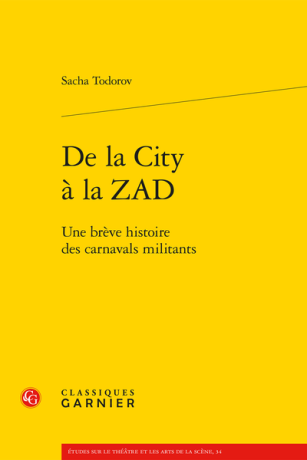
About: Sacha Todorov, De la City à la ZAD. Une brève histoire des carnavals militants, Classiques Garnier
About: Sacha Todorov, De la City à la ZAD. Une brève histoire des carnavals militants, Classiques Garnier

|
How does one tell the history of an activist strategy? Though it might seem, at first glance, to be an example of “immediate history,” Sacha Todorov’s book, which is drawn from research and creative work done for his doctorate, [1] is an original study of “activist carnivals.” [2] As one of several tools used by social movements as they underwent a complete renewal in the 1980s, the activist carnival first appeared in England, before spreading to the rest of the world, notably France in the 1990s.
Drawing on activist sources and studies of the various events and movements that it considers, the book, by considering two successive contexts, brings to light the continuities of a protest tactic and the commonalities shared by several movements (beyond their similar demands). By examining the discourses of activists about their “carnivals,” Todorov adopts an “emic” approach (p. 25), which is more concerned with the descriptions of organizers and the meaning they assign to their actions than to the actions themselves. The latter are often difficult to fully understand, at least for the reader, as they are discussed solely through participant testimonials, without any visuals.
Carnival’s subversive potential
Todorov, who on several occasions emphasizes carnival’s revolutionary potential, traces its genealogy to several sources. In particular, he connects contemporary forms to the work of the Russian literary theorist Mikhail Bakhtin, notably his Problems of Dostoevsky’s Poetics [3] and particularly Rabelais and his World. [4] In his writings, Bakhtin explores the concept of the “carnivalesque” as the locus of the conflict between mass culture and official culture. He believes that the power of mass culture enables it, through laughter and an aesthetic of the grotesque, to subvert and overthrow the social and political order. In his introduction, Todorov notes that the “rise … of carnival in activist circles owes everything to Bakhtin," as the discourse of the organizers of activist carnivals almost systematically refers to him.
The activist use of carnival does not, of course, appear to be lacking in effectiveness. This is clear from its first appearance in London in 1983 with the “Stop the City” campaign, which was directed against the growing power of economic and financial milieus. It was followed by “Reclaim the Streets”, a collective driven by the idea that public space should be shared and, in particular, resistance to cars. Founded in 1991, “Reclaim the Streets” organized demonstrations and street parties over the entire decade.
As the years went by, carnival’s protest potential appeared to have been realized, as evidenced by the fact that, by 1996, Subcommander Marcos—the instigator of the neo-Zapatist uprising in Chiapas, Mexico—had become associated with the movement. Though inauthentic, as Todorov notes (p. 69-70), a quote widely attributed to him identified the revolutionary process with carnival:
The revolution in general is no longer imagined according to the patterns of socialist realism, that is, as men and women stoically marching behind a red, waving flag towards a luminous future: rather it has become a sort of carnival. [5]
Activist carnivals also imposed themselves, more concretely and less ambiguously, through such actions as the use of masks (p. 79-80). While protecting participants from video surveillance, the masks worn by activists also functioned as a means of recognition and as an incentive for mobilization. Text printed on the inside of masks read: “Our masks are not meant to hide our identity, but to reveal it. This mask brings us together, allows us to act together … By putting on these masks, we reveal our unity.
Carnival as a safety valve?
Yet there is another, more critical interpretation, that rejects the idea of carnival as a subversive force. Todorov calls it the “safety valve controversy.” Beginning with the book’s introduction, he recalls the duality of the carnival: does the “festive” practice of revolt really call the established order into question, or is it simply an authorized outlet and thus, at the end of the day, little more than political theater, which reinforces the political and social structures against which it had allegedly revolted? This debate, which is “impossible to settle in absolute terms” (p. 25), shapes the conflict between two interpretations of the activist carnival, as a “reactionary” or “revolutionary” expression—contributing to order, in one case, and challenging order, in the other. In fact, these two coexist from the outset in carnivalesque expression, as Michel Agier makes clear when he observes that carnival “can turn, almost imperceptibly, from a cathartic into a seditious festival.” In other words, a temporary outlet can turn into a “political revolt.” [6]
Yet the fundamental ambiguity of carnival does not necessarily bother activist movements, which seem to expect this critique and rely on their own determination. Leaving the controversy aside, the carnival-form’s seemingly inoffensive nature could even be turned into an advantage, as it encourages festive mobilization while also preempting the risk of repression. That said, some carnivalesque demonstrations seem to have missed their mark when their political character was eclipsed and rendered inaudible. Some participants observe that their demonstration “veered decisively towards a party” (p. 125). In a similar vein, the Slovenian philosopher Slavoj Žižek articulated the most severe reply to the hopes elicited by the Occupy Wall Street Movement: “Carnivals come cheap. What matters is the day after, when we will have to return to normal lives. Will there be any changes then?” [7] (p. 156).
A global phenomenon
Having identified the United Kingdom as the birthplace of activist carnivals and street parties, Todorov shows the way in which these forms of protest spread in the late 1990s due to movements that were increasingly organized on a global scale around two major causes: anti-globalization and environmentalism. Thus on May 16, 1998, a full-fledged “global street party” was organized by “Reclaim the Streets,” with iterations in over thirty cities in Europe, the Americas, and Australia. Then, on June 18, 1999, “Carnival against Capital” was organized, again on several continents, to protest the G8 summit in Cologne.
In both cases, however, London remained the center and model for these initiatives. The first demonstration that clearly embraced the carnivalesque form outside the United Kingdom was organized in Seattle on November 30, 1999, on the occasion of the WTO summit. It was dubbed the “Battle of Seattle,” and has long been remembered for its violence and repression. Yet while the event is remembered as the “foundational act of the anti-globalization movement” (p. 89) and for the images of conflict associated with it, the discourse of the organizers drew undeniably on a carnivalesque inspiration. The same can be said of several other exemplary events of the alter-globalization movement at the dawn of the 2000s.
France imports activist carnivals
France, for its part, was initially a place where carnivalesque demonstrations at first occurred only infrequently, perhaps due to a preference, which Todorov notes, for forms with a more long-term focus, such as action camps and “alternative villages” (p. 126-128). It was later, in the context of a more original and autonomous wave of protests that began in 2008 in the “Zone to Defend” in Notre-Dame-des-Landes that references to carnival in France began to increase. In particular, they grew from 2013 through demonstrations held at the original site and in several cities that sought to support it (such as Nantes, Toulouse, and Rennes).
The organization of carnivals in activist settings further expanded in 2016, against the “labor law” and the state of emergency, and during the Nuit Debout movement. [8] Todorov notes the various practices used by these movements, notably the symbolic execution of effigies resembling political officials and employees representatives (who were decapitated, eaten, or burned). These theatrical gestures, which became the target of various lawsuits and criminal investigations, nonetheless clearly belong to the register of transgressions typical of carnivalesque moments (p. 148-149).
Yet though it is a source of inspiration and a cultural reference point, carnival remains, in France, subject to suspicion, notably in the case of the Yellow Vest movement that began in late 2018. Some participants feared that a festive atmosphere was inappropriate for expressing “anger” and worried that demonstrations that might be compared to a “community dance,” a “magic roundabout,” or a “street party” would make their efforts seem “tacky” (p. 157-159).
Transforming capital into carnival?
Yet once again, carnival’s distinctive ambiguity is also the reason for its effectiveness as an activist strategy. Ultimately, the inspiration behind carnival is that of an overturning, which protest movements, by appropriating it, could use against an order that increasingly imposes itself through exceptional and emergency measures. The goal is thus “to turn the pejorative dimension of carnival (its grotesque, vicious, unfair character) against capitalism” and, in this way, “to reverse the relationship between norm and exception.” Behind carnival’s success as a form of activism, another certainty is thus being proclaimed: “the existing norm is abnormal,” and, consequently, “reversing it means putting things right side up” (p. 86-87).
In an “upside down” world, to quote the Uruguayan writer Eduardo Galeano (1940-2015), a key anti-capitalist figure (quoted by Todorov), could there be a better appropriation of carnival than by activists, who remain faithful to the original Biblical inspiration for carnival and Erasmus’ In Praise of Folly? If the answer is “no, ” then only one relevant question remains, which itself is profoundly carnivalesque: “if the world at present is upside down, should it not be reversed and put back on its feet?” [9]
Sacha Todorov, De la City à la ZAD. Une brève histoire des carnavals militants From the City to the ‘Zone to Defend’: A Short History of Activist Carnivals), Paris, Classiques Garnier, 2024, 196 p., €24 (ISBN 9782406158516).
by , 24 September
Share this article
Find us here :


To quote this article :
Julien Le Mauff, « Carnivalizing Capital », Books and Ideas , 24 September 2026. ISSN : 2105-3030. URL : https://booksandideas.net/Carnivalizing-Capital
Nota Bene:
If you want to discuss this essay further, you can send a proposal to the editorial team (redaction at laviedesidees.fr). We will get back to you as soon as possible.
You might also like




Footnotes
[1] Her work was directed by the late Christian Biet and defended at the Conservatoire national d’art dramatique shortly after his accidental death in 2020: Sacha Todorov, Le Théâtre, la rue, la ZAD. Usages contemporains du carnaval: performances artistiques et militantes, doctoral thesis, Université PSL/CNSAD, 2020.
[2] Due to the original nature of the research-creative endeavor doctorate, this study, which is drawn from the thesis’ second part, is only partially reflective of the work, whose center of gravity remains the stage. It consists of three plays written between 2016 and 2018: Le Baby-Sitting (2016), Comment Frank a changé ma vie (2017), and Le Mimosa pudique (2018).
[3] Mikhail Bakhtin, Problems of Dostoevsky’s Poetics, trans. Caryl Emerson, Minneapolis, University of Minnesota Press, 1984 (1929).
[4] Bakhtin, Rabelais and His World, trans. Hélène Iswolsky, Bloomington, Indiana University Press, 2000 (1965).
[5] Catherine Héau-Lambert and Enrique Rajchenberg, “History and Symbolism in the Zapatista Movement,” in John Holloway and Eloina Peláez, eds., Zapatista!, London, Pluto Press, p. 19-38, at p. 33.
[6] Michel Agier, Anthropologie du carnaval. La ville, la fête et l’Afrique à Bahia, Marseille, Parenthèses/IRD, 2000, p. 25.
[7] Speech to protestors in Zuccotti Park, October 9, 2011, transcription at imposemagazine.com. See, too, Slavoj Zizek’s thoughts in “Occupy First. Demands Come Later,” The Guardian, October 26, 2011.
[8] Translator’s note: The “labor law” or El Khomri Law (named after the labor minister at the time) was a piece of legislation introduced in 2016 during the presidency of the socialist François Hollande that, among other measures, sought to give companies greater flexibility in laying of employees. The state of emergency refers to the security measures taken by President Hollande in the wake of the November 2015 terrorist acts. Nuit Debout (roughly, “Up all Night”) was a protest movement against the El Khomri law that began in 2016. It was notable for the nightly gatherings that occurred at the Place de la République in Paris.
[9] Eduardo Galeano, Sens dessus dessous. L’école du monde à l’envers, Paris, Homnisphères, 2004.
Our partners


Sections
Keep in touch
© laviedesidees.fr - Any replication forbidden without the explicit consent of the editors. - Mentions légales - webdesign : Abel Poucet