

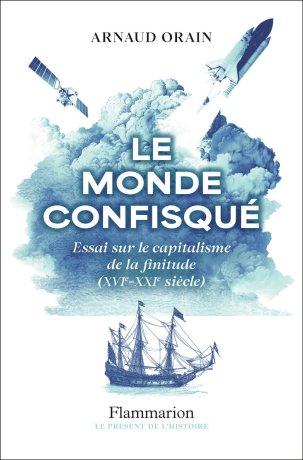
According to Arnaud Orain, capitalism, with the exception of a few historical periods when free markets prevailed, has primarily been characterized by mercantilism, or “capitalism of finitude,” which pits against one another the ambitions of nation-states that seek to escape competition by imposing their hegemony through force.
Capitalism’s stormy waters
About: Arnaud Orain, Le Monde confisqué. Essai sur le capitalisme de la finitude, Flammarion
About: Arnaud Orain, Le Monde confisqué. Essai sur le capitalisme de la finitude, Flammarion

|
The crises of the last twenty-five years have shaken our faith in progress. Of this, Arnaud Orain no longer has any doubts. In an elegant and erudite essay, he breaks with the Promethean tradition of economic history. Diverging from the triumphalist narratives celebrating humanity’s emancipation through economic development, he offers a new interpretation that emphasizes the coercive and cyclical nature of capitalism’s history.
An economist by training, Orain has established himself as one of the most original historians of eighteenth-century economic life. In The Politics of Utopia: A New History of John Law’s System, 1695-1795 (Fayard, 2018; Chicago, 2024), he proposed a novel interpretation of the vast commercial and financial monopoly established at the beginning of Louis XV’s reign. Rather than focusing on the financial modernization as conceived by Law alone, Orain describes his system as a collective and carefully considered project to create an “economic Leviathan”—a prototype of contemporary capitalism. In Les Savoirs perdus de l’économie. Contribution à l’équilibre du vivant (Economics’ lost knowledge: Contribution to the equilibrium of the living, Gallimard, 2023), he attacked the status of the Physiocrats—the first resolute defenders of private property and free trade—as the founders of contemporary political economy. According to Orain, physiocracy’s supposedly universal laws rest on a “vertical” conception of power and the rejection of more “democratic” forms of knowledge, such as genuine business knowledge, which is far more empirical, and natural science, which is concerned with ecological balances.
Drawing on this reinterpretation of the eighteenth century, seen not as the age of the Enlightenment but one in which a coercive and productivist form of capitalism was invented, his new book demonstrates the permanence of this project, across the centuries and beyond the vicissitudes of geopolitics. Orain stresses this project’s contemporary relevance: the global economic disorder that has become increasingly worse since the 2007-2008 financial crisis has less to do with liberalism’s ideological retreat or the revenge of atavistic nationalism than with a return to capitalism’s awareness of its own “finitude,” which has motivated it from its origins.
The “Orain law” of capitalism
The first merit of Orain’s new book is its chronological scope. Unlike the journalistic chatter that ritualistically invokes a return to the 1930s, Orain situates the present moment in a longer history of capitalism. He has no qualms about rejecting liberal teleology, which holds that economic development is inevitably tied to promoting the free market and which unfortunately still shapes public debate.
Orain distinguishes between two kinds of capitalism. The liberal variety, which is the best known, only really existed for five or six decades in the mid-nineteenth century and an equivalent amount of time in the mid-twentieth century. During these periods, a sense of abundance prevailed.
The other variety, which is the focus of Orain’s book, is often called “mercantilism.” It is associated with the belief that economic relationships are a zero-sum game. To avoid uses of the term that connects it to the early modern period, Orain prefers the term “capitalism of finitude.” In practice, the latter consists in a “vast naval and territorial enterprise led by nation-states and private companies seeking to monopolize assets […] to ensure rent income independently of the principle of competition” (p. 8).
To show the permanence of the capitalism of finitude, Orain identifies its three major characteristics: the privatization of the seas through naval power; a preference for monopoly over competition; and the creation of empires that ensure access to specific resources. He examines the predominance of these characteristics at each of the three eras when the capitalism of finitude flourished: from the early sixteenth century to the end of the Napoleonic Wars; the rise of European imperialism from the 1880s to the Second World War; and since the early 2010s.
Orain’s argument is particularly convincing on the topic of the privatization and militarization of the seas as a fundamental trait of the capitalism of finitude. It is customary to associate Europe’s commercial expansion in the early modern period with the rise of long-distance maritime trade. But there is a tendency to forget that the principle of the “freedom of seas” embraced by Hugo Grotius (1583-1645) referred to the freedom to use force to fight for access to the high seas, rather than free circulation. Thus the expansion of trade between 1500 and 1800 was accompanied by the militarization of maritime commerce under the authority of states and large companies that had been granted commercial monopolies and the right to carry out military operations. Overseas, the state of war was almost permanent, oscillating between open conflict and truces interrupted by acts of violence.
This age of mercantilism ended with the establishment of British hegemony over the seas at the end of the Napoleonic Wars. When British power waned after 1880 with the emergence of new naval powers, the need to ensure the security of commercial exchange returned. As evidence, Orain cites the influential thought of the American admiral Alfred Mahan (1840-1914), who saw the development of naval power and the acquisition of colonies as the inevitable consequence of the growth of industrial power. As Paul Kennedy has noted, Germany’s challenge to Great Britain’s hegemony was arguably the structural cause of the First and the Second World Wars. With Germany defeated and Great Britain exhausted, it befell the new naval hegemon, the United States, to suppress its mercantilist tendencies and impose a new era of liberal capitalism.
Apparently confirming Mahan’s intuitions, the rise in China’s industrial and naval power now challenges the United States’ hegemony. We would appear to be at the dawn of a new age of finitude, exacerbated by pressures tied to the ecological crisis. Orain is right to recall that 80% of global trade (by value) still depends on maritime trade. Recurring tensions in the Gulf of Aden and the aggressive expansion of exclusive economic zones can be seen as the symptoms of a new era of maritime insecurity, which is one of primary mechanisms of capitalism of finitude. But there are reasons to doubt the strategic relevance of this conception, which is very close to Mahan’s. The uses of submarines, naval air forces, and increasingly effective missiles and drones have gradually reduced the importance of surface navies. By making it more difficult for any country to achieve naval hegemony, these technological developments increase maritime insecurity.
Less originally, Orain sees the rejection of competition as a second fundamental trait of the capitalism of finitude. It is true that from Antoine de Montchrestien (1575-1621)—the first writer to use the term “political economy”—to Peter Thiel, the Silicon Valley magnate who says “competition is for losers,” many apologists of trade and capitalism have favored limiting competition. Long ago, Adam Smith denounced mercantile interests’ preference for monopoly. Fernand Braudel maintained that capitalism “was always monopolistic.” Late nineteenth-century social reformers and Marxist theorists saw this trend as a justification for state intervention or the advent of socialism. Only university economists and a handful of libertarian ideologues still believe in the utopia of economic freedom.
In capitalism’s long history, it is the brief pseudo-liberal moments that should surprise us. Even these episodes rest far more on political coercion than Orain suggests. Nineteenth-century free-market imperialism was often bellicose. During the 1850s, Great Britain and France attacked Russia to deny it access to the Mediterranean and thus keep for themselves the resources of the Ottoman world. They then attacked China to force it to open its market to imports, particularly opium, which was produced by a public monopoly in British India. Similarly, the emergence of American hegemony after 1945 cannot be separated from military activism at the planetary level that continued even after the Cold War ended. There is no doubt that the existence of a hegemon means greater freedom to engage in trade, but this hegemony is itself just a higher order monopoly: who cares about sectoral or regional monopolies when you have global supremacy, like Great Britain in the Victorian age and the United States in the second half of the twentieth century? In this sense, global economic liberalism may be considered a kind of “false consciousness.”
Finally, Orain is no doubt right in saying that periods of strong interstate competition are more propitious for the acquisition of colonies than periods in which a hegemonic power prefers to assert its domination informally. Furthermore, his view about the reorganization of international trade through the creation of “imperial silos”—that is, flows of goods that are directed by political considerations rather than market mechanisms—offers a better explanation of periods when free trade declines than the vague concept of “deglobalization.” But his attempts to show that colonial expansion at the end of the nineteenth century or the vague imperialistic ambitions of Trump’s America constitute a return to mercantilist practices are less convincing. Imperial silos in the eighteenth century allowed for an unprecedented expansion of foreign trade, in Britain as well as France. The silos acquired after 1880 served at most as shock absorbers when international trade collapsed between the two world wars. The post-2010 silos remain aspirational.
A paradigm’s limits
Orain’s essay is highly stimulating. I will, however, allow myself two criticisms. First, Orain pushes too far into the background the extraordinary improvement in standards of living allowed by the capitalist system, at least in dominant countries. The establishment of rents to exploit the planet’s resources is only part of the story. Can one understand the power of capitalism over the past three centuries without considering the tripling of life expectancy or the decline in infant mortality from one quarter to half a percent of births? The progress of literacy as well as secondary and higher education were both causes and consequences of capitalist enrichment. The Marxist critique of capitalism hits home precisely because it acknowledges these achievements. In the Communist Manifesto, Karl Marx and Friedrich Engels pay homage to the “most revolutionary part” played by the bourgeoisie.
Furthermore, by shifting the focus from the market to the state, Orain’s essay seems—probably inadvertently—to play into the hands of libertarians and anarcho-capitalists. Naturally, the economic Leviathan has had bellicose tendencies, particularly during periods of finitude. But it has also played an emancipatory role. The vast increase in states’ fiscal needs in the eighteenth century triggered the democratic revolutions in America in 1776 and France in 1789. Nation states from 1880 to 1945 were imperialistic, but they also introduced the welfare state. Being aware of the finitude of wealth also legitimates the politics of redistribution.
Orain’s book is, moreover, less original and convincing in what it says about the present moment than about previous ages of finitude. This has partly to do with sources. Based on his notes, his reflections on the period beginning around 2010 draw primarily on the daily and weekly Francophone and Anglophone press, primarily of a center-left orientation. I counted 21 citations from Le Monde alone. But it is also a question of method, as Orain frequently takes official discourse at face value, without comparing it to social and economic reality. Can one really place on the same level the great powers’ partitions of Africa and Asia in the late nineteenth century and Donald Trump’s annexationist fantasies? The enormous gap in power that made economic imperialism possible has been considerably reduced. Is the reindustrialization of the United States through chaotically imposed tariffs credible, when the federal government is simultaneously targeting the two most important instruments of an industrial policy: universities, which train engineers, and immigrant populations, which provide cheap labor?
Orain’s cyclical scheme is less naïve than the old promethean history of capitalism, but it strikes me as too reassuring, since it fails to entertain the possibility that we are witnessing less a resurgence of mercantilism than the exhaustion or even the decline of the western economic model. A major difference with previous ages of finitude is income stagnation, the decline in industrial production, and, over the past few years, the end of increasing life expectancy and—in France as well as the United States—higher infant mortality rates. Even if we wanted to return to a more predatory form of capitalism, do we have the means to do so? Orain vigorously condemns the political ambitions and environmental plunder of what he still calls the “Middle Kingdom” and its “great Russian vassal” but shouldn’t the rise of China—including the progress it has made in certain low carbon technologies—and the partial restoration of Russian power lead the Western world to be more rather than less humble?
Orain concludes by suggesting that a less radical version of the “war ecology” advocated by Pierre Charbonnier—in other words, decarbonization, even if it means a lower standard of living, to maintain Europe’s strategic economy—is the best “progressive” solution for avoiding a “reactionary” capitalism of finitude. He also dreams of “an economy focused on the four elements [which, according to Linneaus, are the earth, water, air, and fire] that is democratic, decentralized, and focused on degrowth,” implemented by citizens’ collectives. Yet his realistic disposition leads him to predict the advent of a European capitalism of finitude that is a little bellicose than others through the partial adoption of war ecology and institutions that, while weakened, remain democratic.
Even this chastened hope seems at best semi-realistic. First, Europe is an entity that does not have its own fiscal or military capacities—in other words, the basic tools of power, according to realist conceptions of international relations. It has long lost its strategic autonomy. In June and July 2025, it capitulated without significant resistance to the Trump administration’s budgetary and commercial demands. Promises to help Ukraine rearm and pay for war costs will not facilitate Europe’s ability to finance the ecological transition, while the European Union’s commitment to increase its imports of American energy resources (primarily hydrocarbons) to $250 billion annually contradicts its decarbonation projects.
Moreover, Orain strikes me as excessively optimistic in assuming that the European Union will remain a bastion of “progressivism”—in the sense in which he uses the term, which is almost the opposite of the old confidence in progress. He is perhaps correct in accusing far-right parties of being “incoherent,” due to the weakness of their economic analysis. But the same often-repeated accusations against Trump did not prevent him from winning several elections and to undertake a thoroughgoing rupture with liberal internationalism. The cause of progressivism would be better served by examining its own incoherence, particularly in politics. Why does its agenda, which supposedly favors the least privileged, so repel the working classes and increasingly large segments of the middle classes? Is its suspicion of the nation-state, which, even in Europe, is the only institution that can wield fiscal and military authority, still tenable, especially given that Orain rightly emphasizes the generalized return of power politics?
Le Monde confisqué is a stirring reminder that capitalism’s history cannot be separated from interstate power relationships. By the same token, it should encourage critics of capitalism to propose clear-sighted alternatives to well-intentioned but increasingly ineffective internationalist rhetoric.
Arnaud Orain, Le Monde confisqué. Essai sur le capitalisme de la finitude (The confiscated world: An essay on the capitalism of finitude), Paris, Flammarion, 2025, 368 p., €24, ISBN 9782080466570.
by , 13 October
Share this article
Find us here :


To quote this article :
David Todd, « Capitalism’s stormy waters », Books and Ideas , 13 October 2026. ISSN : 2105-3030. URL : https://booksandideas.net/Capitalism-s-stormy-waters
Nota Bene:
If you want to discuss this essay further, you can send a proposal to the editorial team (redaction at laviedesidees.fr). We will get back to you as soon as possible.
You might also like


Our partners


Sections
Keep in touch
© laviedesidees.fr - Any replication forbidden without the explicit consent of the editors. - Mentions légales - webdesign : Abel Poucet