


Is it possible to identify the origin of the shift from feudalism to capitalism? Such a transition cannot be reduced to the expansion of trade or a linear evolution. It implies a transformation of social relations, work, and production.
Capitalism: the great transition
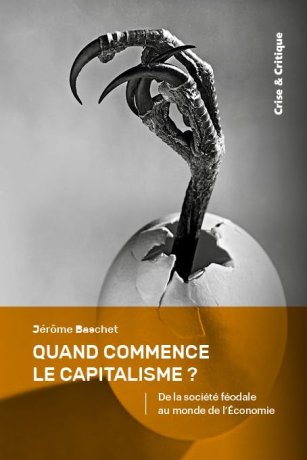
About: Jérôme Baschet, Quand commence le capitalisme ? De la société féodale au monde de l’économie, Crise et critique
About: Jérôme Baschet, Quand commence le capitalisme ? De la société féodale au monde de l’économie, Crise et critique

|
Frederic Jameson’s line is well known: “it is easier to imagine the end of the world than to imagine the end of capitalism.” [1] But what about the beginning of capitalism? Might understanding what the world was like before the advent of capitalism and how capitalism emerged provide us with valuable information about what could come after capitalism? This depends, of course, on agreement about the meaning of the terms “capitalism” and “the transition from feudalism to capitalism.” What does that phrase mean? Is it a uniquely European phenomenon whose chronological boundaries can be precisely determined? Or is it a global longue durée process? How are we to grasp this process without falling into the trap of projecting backward onto practices and modes of thought of our non-capitalist past that epitomize our present moment, which is locked into “capitalist realism” [2]? These are the questions that Jérôme Baschet tries to answer in his latest book.
In doing so, he does not hesitate to revisit existing literature and to evaluate the relevance of well-traveled arguments, whether it be when capitalism began, the factors leading to its emergence, or a conceptual delimitation of the term “capitalism” by way of distinguishing the various it refers to (as it is too often used in a fuzzy way). Following this method, Baschet arrives at several clear-cut positions.
The 1760-1830 transition
To begin with, Baschet rejects the periodization proposed by the sociologist Immanuel Wallerstein and the historian James W. Moore, for whom the beginnings of capitalism coincide with the colonization of the Americas. They contend that capitalism as a “world-economy” [3] or “world-ecology” [4] took off during the long sixteenth century (1450-1648). For these Marxists, overseas colonial expansion was the way out of the crisis of the feudal system of the fourteenth and fifteenth centuries, as it overcame the economic and ecological impasses of feudalism (declining agricultural revenue, land shortages, labor shortages, and so on). Baschet does not accept this account of capitalism’s emergence. He plays down the scale of the crisis, which was far from being feudalism’s death warrant. Indeed, feudalism reasserted itself in the fifteenth century, at the very moment when the conquest of the Americas began. Moreover, Baschet accuses this thesis of paradoxically succumbing to an “Americanocentric bias,” (p. 31), while ignoring the continuities between the periods before and after 1492, notably the power of the Christian church as the “dominant and all-encompassing institution of medieval society” (p. 93).
Nor does Baschet find favor in approaches that date the birth of capitalism earlier (in the eleventh or twelfth centuries). While Baschet recognizes that the Middle Ages can be synonymous with the development of towns, commercial exchange, and financial activity, he refuses to see these trends as the signs of emergent capitalism. Rather, he accepts the thesis of a “long Middle Ages” [5] that evolved and transformed over time, incorporating the innovations of the Renaissance and the Reformation and lasting, ultimately, to the eighteenth century. According to Baschet’s “resolutely discontinuous” (p. 81) approach, it was not until the period between 1760 and 1830 that a genuine “rupture” (p. 50) with feudalism and a “great shift” (p. 50) to capitalism occurred. It was at this moment that a major economic gulf appeared between England and China. Inspired by the work of Kenneth Pomeranz, [6] he maintains that the “great divergence” between the two countries was further accentuated by the British conquest of India, beginning in 1757. The latter precipitated the collapse of the Mughal Empire and the deindustrialization of the Asian subcontinent while ensuring Great Britain’s hegemony.
While also using to his own ends the analyses of Karl Polanyi, [7] he contends that the invention of “economic science” and the emergence of liberalism in the eighteenth and nineteenth centuries in this country contributed to the “autonomization” (p. 193) of the economic realm in relation to the social and moral codes that prevailed in the feudal-ecclesiastical system, while inaugurating a “genuine anthropological shift” (p. 57) due to the emergence of the idea of homo economicus, defined as possessive individualism.
Finally, as an additional argument supporting his chronology of capitalism’s emergence, he rehabilitates the concept of “industrial revolution,” despite the criticism often directed at this concept (that it is too simplistic, that its timeframe is too limited, and so on). Revisiting the traditional content and periodization from the standpoint of more recent scholarship (notably the work of the geographer Andreas Malm [8]), he claims that it can be used in a measured and careful way, since he sees it as indispensable for grasping “the rise of a productive sphere with unprecedented traits, due to its colossal scale … [and the fact that it was] entirely dominated by capital and essentially founded on salaried labor and tightly connected to markets based on competitive mechanisms” (p. 61).
Rejecting Eurocentrism
Without this “industrial revolution,” it is impossible to understand Europe’s decisive advantages over the rest of the world in this period, be it the unification of its markets or its maritime, military, and commercial power. Yet is it not a form of Eurocentrism to hold up Europe as an exception, a special place that was unique in achieving the conditions required for capitalism’s emergence, thanks to the slow accumulation on its soil of the necessary factors? Baschet acknowledges that his “biased approach … has as its main goal to argue for a transition that gives considerable weight to endogenous factors” (p .97) – that is, internal European factors. This argument has also been made by Marxist economists like Robert Brenner, who, to explain the transition, emphasized conflict between lords and peasants from the fourteenth to the seventeenth centuries and their consequences for the distinct character of English feudalism [9] (the common law system, a powerful monarchical state, enclosures, and so on).
Realizing that he must respond preemptively to this critique, Baschet tries to neutralize it by throwing it back at its proponents. Emphasizing that the preconditions for capitalism and globalization (that is, commercial networks and proto-industrialization) can be found in other regions and civilizations (such as the thirteenth century Mongol empire, for instance), this critique, he believes, falls into the trap of “anti-Eurocentric Eurocentrism” (p. 88-89). He claims that the attempt to “reduce the gap between Europe and other civilizations, while attributing to the latter an active role in the emergence of the modern world, makes one vulnerable to the temptation of universalizing capitalism’s formation process” (p. 190). The desire to break with the myth of a European exception paradoxically attributes European characteristics to the main non-European civilizations, trivializing and reifying capitalism, making it the necessary culmination of “any take-off in production or commerce” (p. 89).
Yet it is unclear if Baschet’s reversal of charges clears him of the crime of Eurocentrism. He proposes an analysis of the transition in which factors that are endogenous and exogenous to Europe are combined and mutually support one another rather than excluding one another. Moreover, he notes that “only a recognition of agency on the part of non-European societies allows one to fully avoid European bias” (p. 97). Yet he does not really employ this methodological principle, which he borrows from Alexander Anievas and Kerem Nişancıoğlu. What makes the latter’s thesis compelling in How the West Came to Rule is precisely that they show that “Ottoman attempts at empire building curtailed the imperial threat of the Hapsburgs, giving Northwestern European states the structural geopolitical space in which the formation of capitalism could occur.” [10]
Leaving this matter aside, one of the major contributions of Baschet’s work is its quite original reassessment of the importance of the Church as a European peculiarity that laid the long-term foundations for the transition from feudalism to capitalism. According to Baschet, this institution’s material and spiritual stature during the Middle Ages is important for two reasons. First, “Christian universalism, which became possible thanks to the ecclesiastical configuration of society” (p. 105) became the main driver of “feudal-ecclesiastical globalization” (p. 105), which originated in Europe and spread to the Iberian colonies of the American continent. Second, the Christian doctrine of the soul as transcending the body paved the way for the dissociation or “great divide” between man and nature and modern science’s shift towards naturalism, even as it affirmed the value of individualism by defining the person as a distinct, self-owning entity.
Capital’s activities vs. capitalism
The book’s other notable and meaningful contribution is the conceptual distinction between “capital’s activities” (p. 142) and capitalism. By dubbing “capital’s activities” any activity that seeks to invest some amount of money in exchange for a greater amount, Baschet protects himself from the danger of interpreting “antediluvian forms” [11] of commerce and moneylending as the clear signs of a capitalism that is either already constituted or in formation.
This is the pitfall encountered by the “commercialization model” [12] (p. 77), which derives capitalism from the continuous rise of commercial practices and exchange once obstacles to their development have been eliminated. Against this linear and teleological model, it is essential to recall how in non-capitalist societies, capital’s activities, even when they are highly developed, remain politically controlled and socially marginalized. For capitalism to impose itself as a “mode of production” (p. 145) governed by the imperative of capital accumulation, something else is required. (Industrial) capital must seize hold of most of the productive sphere and social relationships must be modeled primarily on capitalist relations of production based on salaried labor. In short, a “major reconfiguration” (p. 200) of elements present in the feudal-ecclesiastical system is needed.
As Baschet notes, it was Europe’s rival states that, during the seventeenth and eighteenth centuries, hastened its reconfiguration. Seeking to enhance their power and (monetary and fiscal) resources, they supported the development of capital’s activities, while also pursuing commercial and colonial expansion. That said, it is a shame that Baschet does not say more about the crucial role of monarchical states – which he deals with too hastily – and that he does not spend more time discussing the hypothesis that “the lack of the empire-form is a precondition for capitalism’s formation” (p. 128). Is it not possible that the capitalism’s emergence in Europe is in fact the result of a twofold transformation of Christian “imperiality” (i.e., secularization and its dissemination in the colonies), as the philosopher Mohamed Amer Meziane argues? [13]
While these claims deserve further discussion, Baschet’s book will satisfy readers who wish to learn more about the birth of capitalism. It is an excellent, concise, and pedagogical synthesis that will help readers navigate the key debates surrounding this question.
Jérôme Baschet, Quand commence le capitalisme ? De la société féodale au monde de l’économie (When did capitalism begin? From feudal society to the economic world) Albi, Crise et critique, 2024, 204 pp., €16, ISBN 9782490831371.
by , 10 March
Share this article
Find us here :


To quote this article :
Quentin Badaire, « Capitalism: the great transition », Books and Ideas , 10 March 2026. ISSN : 2105-3030. URL : https://booksandideas.net/Capitalism-the-great-transition
Nota Bene:
If you want to discuss this essay further, you can send a proposal to the editorial team (redaction at laviedesidees.fr). We will get back to you as soon as possible.
You might also like



Footnotes
[1] Fredric Jameson, “Future City,” New Left Review, vol. 21, 2003, p. 76.
[2] Mark Fisher, Capitalist Realism: Is There No Alternative?, Zero Books, 2009.
[3] See Immanuel Wallerstein, The Modern World-System I: Capitalist Agriculture and the Origins of the European World-Economy in the Sixteenth Century, Oakland, University of California Press, 2011.
[4] See Jason W. Moore, Capitalism in the Web of Life: Ecology and the Accumulation of Capital, London, Verso, 2015. With this term, Moore seeks to identify a specific historical configuration of “humanity-in-nature” (ibid., p. 31) that is distinct from capitalism. According to Moore, capitalism can be characterized as the “twofold internalization” of capitalism and nature: on the one hand, the appropriation and integration of nature in capitalism through the use of (human and fossil) energies, and on the other, the internalization of capitalism’s (atmospheric and geological) effects on nature.
[5] Jacques Le Goff, “Pour un long Moyen Âge,” in L’imaginaire médiéval, Paris, Gallimard, 1985, pp. 7-13.
[6] Kenneth Pomeranz, Une grande divergence. La Chine, l’Europe et la construction de l’économie mondiale, trans. N. Wang, Paris, Albin Michel, 2010.
[7] Karl Polanyi, La Grande Transformation. Aux origines politiques et économiques de notre temps, trans. M. Angeno, C. Malamoud, Paris, Gallimard, 1983 (1944).
[8] Andreas Malm, L’anthropocène contre l’histoire. Le réchauffement climatique à l’ère du capital, trans. E. Dobenesque, Paris, La fabrique, 2017.
[9] From this perspective (i.e., “political Marxism”), these conflicts culminate unintentionally in farmers becoming increasingly dependent on markets and subject to the imperative of competition. See François Allison and Robert Brisset, Aux origines du capitalisme. Robert Brenner et le marxisme politique, Lyon, Éditions de l’ENS, 2023.
[10] Alexander Anievas, Kerem Nişancıoğlu, How the West Came to Rule. The Geopolitical Origins of Capitalism, Londres, Pluto Press, 2015.
[11] This is Marx’s famous term. See Karl Marx, Le Capital. Livre III, trans. C. Cohen-Solal and G. Badia, Paris, PUF, p. 273.
[12] See Paul M. Sweezy, “The transition from feudalism to capitalism,” Science & Society, vol. 14, no. 2, 1950, pp. 134–167.
[13] Mohamed Amer Meziane, Des empires sous la terre. Histoire écologique et raciale de la sécularisation, Paris, La Découverte, 2021.
Our partners


Sections
Keep in touch
© laviedesidees.fr - Any replication forbidden without the explicit consent of the editors. - Mentions légales - webdesign : Abel Poucet