


The separation of church and state is a principle that is often difficult to apply. In some cases, a delicate balance must be struck between religious freedom and equality.
“Jaune-Rouge-Bleu”, Kandinsky (1925)
The Limits of Religious Freedom
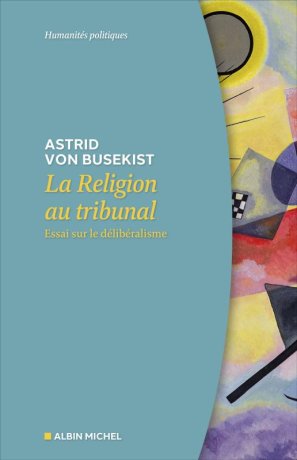
About: Astrid Von Busekist, La Religion au tribunal, Essai sur le délibéralisme, Albin Michel
About: Astrid Von Busekist, La Religion au tribunal, Essai sur le délibéralisme, Albin Michel

|
Three Court Cases
In 2006, in Germany, an evangelical Protestant family withdrew their children from school for religious reasons: The Romeike parents wanted to educate their children at home. This was illegal, however, because school attendance—and not just education—is compulsory in Germany. In 2008, having exhausted all legal remedies, the family went to the United States, where homeschooling enjoys significant support, and applied for political asylum. An immigration judge in Tennessee initially granted their request. Yet, after a lengthy legal process that took them all the way to the U.S. Supreme Court, their application for political asylum was denied. The Romeike were nevertheless granted permanent residence in the United States.
In 2010, a German doctor performed a circumcision on a four-year-old boy in his practice at the request of his Muslim parents. The intervention resulted in significant bleeding, and the boy was taken to a hospital, where he was quickly and successfully treated. The hospital, however, reported the case to the police, who then launched an investigation. In 2012, the Cologne Regional Court ruled that circumcision violated the child’s physical integrity and was therefore punishable by law. The doctor, who was deemed to have acted in good faith, was acquitted.
In 1983 and then in 1992, the State of New York enacted the Get Laws, with a number of Canadian provinces soon adopting similar legislation. In the Orthodox Jewish tradition, a get is a written document that spouses who wish to divorce must give each other in order to end the religious marriage. In practice, some husbands refuse to grant a get to their wives, who are then unable to remarry or have other children. Without the get, any new union that women legally enter into and any children born of it is considered illegitimate by religious law, which is not the case for children born of a man’s new union. Under the Get Laws, the civil court works with the rabbinical authorities to ensure that the civil divorce is not pronounced until the wife has received the get.
These are the three court cases analyzed by Astrid Von Busekist in Religion on Trial: An Essay on Deliberalism. Each in its own way, the cases question the place accorded to freedom of religion in constitutional democracies. They show that, far from being a perfectly and definitively settled matter, the relationship between the democratic state and religions is regularly questioned and periodically reinterpreted by judges, governments, and more broadly by societies themselves.
The Pluralism of Justice
Since Rawls, it has been widely recognized that liberal democracies are characterized by a plurality of conceptions of the good: Different, even divergent, metaphysical and ethical doctrines are embraced by democratic citizens.
The other form of pluralism, the pluralism of justice, has received less attention. And yet, to define what constitutes justice, liberal democracies draw on several fundamental political values, in particular the values of liberty and equality. Moreover, citizens of democracies enjoy multiple rights and freedoms: the right to physical integrity, freedom of conscience, freedom of assembly, etc. This pluralism of justice necessarily raises problems of arbitration. Since what favors individual freedom does not automatically contribute to equality, it is often necessary to choose between freedom and equality. Similarly, the different rights and freedoms do not always fit together easily: One must often decide which right or freedom should be given priority.
The book also highlights the problems posed by the existence of a plurality of rule-making groups. In liberal democracies, the state defines what is legal for everyone. Certain groups, particularly religious groups, nevertheless enjoy a degree of normative autonomy. They can decide for themselves the rules that will govern their functioning and that will bind their members. This raises the question of the degree of autonomy and normative authority that these groups should be granted by virtue of the principle of religious freedom.
The pluralism of justice inevitably confronts us with complex cases. Drawing on contemporary legal and philosophical literature, Von Busekist highlights the desirable forms of balance that can be achieved in such cases.
Issues of Balance
The three cases analyzed by Von Busekist raise issues of balance. They show how different liberal democracies arbitrate between freedom and equality and conceive of the hierarchy between multiple rights. They also illustrate how liberal democracies engage in deliberation to develop their own interpretation of what constitutes justice.
The Romeike case is analyzed in the first part of the book. Here the balance to be struck was between the parents’ religious and educational freedom and the right of the democratic state to educate citizens. On the one hand, the parents wanted to educate their children in accordance with their religious beliefs—a right recognized in several fundamental legal texts that make educational freedom an essential dimension of religious freedom. They believed that sending their children to school would expose them to “esoteric subjects,” for instance sex education and, more broadly, scientific topics. They also complained that school textbooks talked more about “witches than God.” In their eyes, all of these factors hindered their ability to pass on their religion to their children.
On the other hand, the German state asserted that one of its legitimate prerogatives is the education of citizens. Democratic states frequently take on an educational mission, whose objectives and methods they define. The transmission of liberal values and virtues and the development of citizen autonomy are common elements of this mission. In making school attendance (and not just education) compulsory, the German state offers its own interpretation of democratic citizenship. It makes clear that it will not accept “parallel societies” and declares that children must attend school to acquire the virtue of tolerance, a political virtue it views as essential in a pluralistic society.
As Von Busekist explains, in the Romeike case, the democratic state separated: It prioritized what it deemed necessary for children’s civic education over certain aspects of parents’ religious freedom.
In the Cologne case, which is discussed in the second part of the book, the balance to be struck was between the child’s right to physical integrity and religious freedom and the parents’ religious and educational freedom.
On the one hand, by criminalizing circumcision, the Cologne Regional Court established the inviolability of the child’s body as an absolute. It also considered that it had to protect the religious freedom of children—that is, their ability to freely choose their religious affiliation later in life—so as to ensure them the “open future” that an irreversible physical mark would necessarily deny them.
On the other hand, the court’s decision radically limited the religious and educational freedom of parents. Muslims and Jews, the two largest religious minorities in Germany, were prohibited from practicing a ritual that most of them consider essential and that serves to integrate boys into their community. Furthermore, it made little sense to require children to wait until adulthood to choose their religious beliefs, since it amounted to denying the reality of the socialization process through which all of us initially inherit the affiliations of our parents.
In the specific context of Germany, the ban on circumcision also had particular resonance given the country’s Nazi past. Von Busekist, for whom context plays a decisive role, notes that then-Chancellor Angela Merkel took a stand by declaring that Germany “would become a nation of comedians” if it became one of the only countries where Jews are not allowed to practice their religion. A coalition of parties quickly opposed the Cologne ruling and had circumcision decriminalized by creating a civil code article aimed at ensuring that “Jewish and Muslim religious life [continues] to be possible in Germany.”
In this case, unlike the previous one, the democratic state composed. To protect civic harmony, and to ensure that Jews and Muslims could consider themselves full members of the community of citizens, it gave priority to the religious freedom of minority groups over other rights.
The Get Laws are analyzed in the third part of the book. This case raises an issue of balance between the principle of separation of church and state, which is derived from the right to equal religious freedom, and the principle of gender equality.
Democratic states often consider that the separation of church and state is necessary to ensure the respect of the equal religious freedom of citizens. The principle of separation means that the state must not interfere in the internal affairs of religious institutions. These institutions are allowed to decide for themselves their rules of operation. For instance, they can set the rules governing religious marriage and divorce.
The Get Laws entail a novel form of cooperation between civil courts and religious authorities that de facto contravenes the principle of separation. As Von Busekist explains, however, the aim of these laws is to restore civic equality between women and men, a principle that is undermined by unequal access to the get. They are meant to ensure that the religious beliefs of women in the Orthodox Jewish community does not undermine their civic equality.
Von Busekist points out that these measures are based on a unique interpretation of religious freedom that breaks with certain aspects of the liberal tradition.
In this tradition, membership in a religious organization is considered to be voluntary, even though it is more often inherited than chosen. Membership is said to be voluntary because political and civil rights are independent of religious identity and because individuals have the right to leave the organization: They can leave the religion in which they were raised without it affecting their public identity. Correlatively, the liberal tradition generally considers that individuals should be held responsible for their ends. It is up to them, and not the community, to bear the cost of their beliefs. If this cost is too high, they can always renounce or reinterpret some of their beliefs.
Like many other authors, Von Busekist distances herself from the liberal idea of responsibility for one’s ends. She does so by arguing that for women in the Orthodox Jewish community, the right to leave is often purely formal. While Orthodox Jewish women do have the legal right to leave their community, the material and psychological cost of leaving is such that, in practice, they remain chained to an obsolete religious marriage rather than renounce their beliefs.
It is on these grounds that the State of New York and some of the Canadian provinces cooperate with religious authorities. In doing so, they effectively declare that real civic equality between women and men takes precedence over other principles, including the principle of separation of church and state.
This solution, which the author favors, is obviously open to debate. Other liberal democracies may choose to prioritize the principle of separation. They may argue that the role of the state is not to intervene in the internal affairs of religious organizations, but to ensure that women can effectively leave their communities by providing them with material support and offering them an education that enables them to learn about their rights, imagine a different life for themselves, and acquire the skills needed to achieve such a life.
Deliberalism and Contextualism
All three cases illustrate what Von Busekist refers to as “deliberalism.” The term does not have a negative connotation, but rather describes the result of the encounter between liberalism and democracy.
Liberal theories, which often give primacy to individual rights, provide a set of hierarchically ordered principles. As Von Busekist argues, however, in defending a system of well-defined principles, liberal philosophers have too often neglected the democratic dimension that necessarily shapes reflections on what constitutes justice.
Every democracy questions liberal principles as part of its normal functioning. It reflects on how to interpret the values of freedom and equality and how to rank different principles. It does so in light of what the national community considers to be its common good. It therefore also does so in light of its particular context, taking into account its political and social history and the traditions of thought that have shaped it.
Thus, far from being undermined by democratic deliberation, liberalism accomplishes itself through it. The courts, which are often complemented and sometimes contradicted by the debates within civil society and the decisions of political authorities, provide an ideal lens through which to observe this process of accomplishment.
Ultimately, far from the common, frozen image of democratic values and principles, Von Busekist gives us a glimpse into the moral dynamics at play in real democracies.
Astrid Von Busekist, La Religion au tribunal, Essai sur le délibéralisme, Paris, Albin Michel, 2023, 378 p., 22,90 €.
by , 16 October 2025
Share this article
Find us here :


To quote this article :
Ophélie Desmons, « The Limits of Religious Freedom », Books and Ideas , 16 October 2025. ISSN : 2105-3030. URL : https://booksandideas.net/The-Limits-of-Religious-Freedom
Nota Bene:
If you want to discuss this essay further, you can send a proposal to the editorial team (redaction at laviedesidees.fr). We will get back to you as soon as possible.
You might also like




Our partners


Sections
Keep in touch
© laviedesidees.fr - Any replication forbidden without the explicit consent of the editors. - Mentions légales - webdesign : Abel Poucet