


A longstanding local historiographical tradition maintains that during the French Revolution, the politics of the city of Orléans were notable for their moderation. Yet this view ignores the presence of highly politicized factions, extending well beyond the revolutionary period.
Portraits et insignes impériaux brûlés publiquement à Orléans (> 1816) Source : AD Loiret, 5 FI 335.
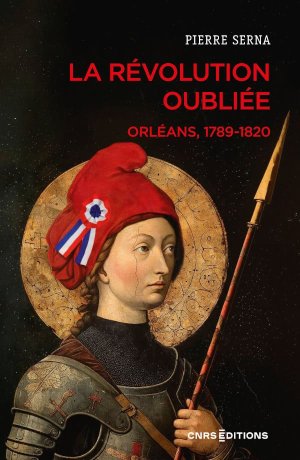
Orléans: A forgotten revolutionary history
About: Pierre Serna, La Révolution oubliée. Orléans, 1789-1820, CNRS Éditions
About: Pierre Serna, La Révolution oubliée. Orléans, 1789-1820, CNRS Éditions

|
“The Champ de Mars—this is the only monument bequeathed by the [French] Revolution … The Empire has its column, and it has also claimed most of the Arc de Triomphe for itself; the monarch has its Louvre and Invalides; the feudal Church of year 1200 still reigns over Notre-Dame; even the Romans have Caesar’s baths. And the Revolution’s monument is … a void.” [1] It is in these terms that the historian Jules Michelet, in the 1847 preface to his no less monumental Histoire de la Révolution Française (History of the French Revolution), discussed the near absence of any architectural legacy of his book’s subject in Paris’ urban landscape.
In his latest book, the historian Pierre Serna makes essentially the same observation about the town of Orléans—hence its title. He speaks of an “architectural void” (p. 7) and an “erased history” (p. 398), in relation to the revolutionary as well as the imperial period. A longstanding local historiographical tradition, extending from the nineteenth to the twentieth centuries, presented the city of Joan of Arc as a paragon of moderation that was largely spared the revolution’s excesses. The period when the National Convention held the reins of power was simply a “temporary catastrophe, a red scourge” (p. 8) that disturbed the town little, as if it were protected by its mostly moderate population.
Rejecting this vision, Serna argues, to the contrary, that the city fully engaged in a form of political jousting that was the “polar opposite of easy-going moderation” (p. 18). He emphasizes that while there did exist a party that strove for moderation, there was also “a fierce political battle between proponents of ideas that were strongly opposed to one another, from the deepest red to immaculate white” (p. 16). In this way, Serna’s study belongs to a new breed of political history that tries to account for complex realities. Moreover, it adopts a chronological perspective that is transversal, simultaneously encompassing the revolution, the empire, and the restoration, to better understand political conflict over the long term. This urban-focused monograph seeks to revitalize the genre, as it shifts subtly back-and-forth between micro and macro scales in ways that recall the microhistory inaugurated in the late 1970s by the Italian historian Carlo Ginzburg. [2] Serna sees Orléans as a “world-city” (p. 18) whose port was integrated into the slave trade, making it “key to understanding a country that was at war with all of Europe” (p. 31).
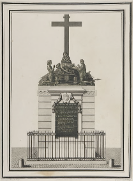
Monument honoring Joan of Arc built on the old Orléans bridge in 1771 (1817)
Source: Departmental archives of the Loiret, 4 FI 60 a.
A rich body of sources
Serna, who calls this book an “essay” (p. 34), draws, as he notes, on sources that are both rich and original. Among the plethora of archives he has consulted, he uses what historians have dubbed “ego documents,” that is, highly private writings that are essential to a kind of history that seeks to understand “lived experience at the most modest level” (p. 31). By recovering scraps of individual lives and how people viewed unusual events, these documents provide scholars with direct and first-hand testimony of a past that is rarely reflected, for example, in administrative documents. Victoire Dellezigne and Marie-Anne Charpentier, two workers who were fervently Catholic without being intolerant, left written testimony of their lives in the form of extensive journals, covering 1788 to 1797, in the former’s case, and 1789 to 1804, for the latter. Their views are basically anti-revolutionary, as “religion, politics, and the mystical force of events and religious signs are all mixed together” (p. 29). The seed merchant Silvain Rousseau also produced three notebooks between 1767 and 1803. Transcribing everything that happened in Orléans while also commenting extensively on news from Paris, he provides a wary perspective on revolutionary events. Serna draws especially on the day-to-day chronicle of the Abbey Pataud (1796-1816), a “political-scientist priest” (p. 268). This clergyman is described as a genuine moderate, accepting disagreement “as the Republic’s foundation, and not as a sign of its weakness” (p. 268).
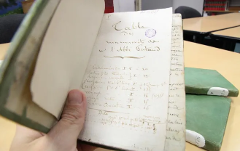
Memoirs of the Abbey Pataud (1796-1816)
Source: Departmental archives of the Loiret, P 1776
Other archives enrich Serna’s analysis, notably from the revolution’s early stages. He also consulted 19 boxes containing the deliberations of the Orléans sections from the departmental archives of the Loiret. This source is especially valuable given that such abundance is hardly the norm. In this way, he was able to show the sections’ dominant role in Orléans during year II. From this “grassroots” (p. 153) perspective on the revolutionary process, the sections were not only guardians who politicized the people towards the republican ideal, but also played a political, economic, and social role in the city, orchestrating policies for monitoring grain circulation, overseeing power production, and organizing welfare for the poor. In this way, they acted as “a parallel institution to the municipality, assuming government functions” (p. 151).
Deconstructing the myth of a moderate city
The major role played by the sections suggests that political contests in Orléans occurred between two highly politicized factions, which challenges the idea, emphasized by local historiography, that “the Orléanais’ moderation was part of its urban DNA” (p. 402). On May 30, 1793, a delegation of sans-culottes from Orléans to the National Convention described the municipal authorities as “aristocrats” who should be dispensed with. In this way, the town participated in “the first act—which historians have paid scant attention to—of the crisis of May 31-June 2” (p. 143), when the Montagnards removed their rivals, the Girondins, from power. Thanks to the représentant en mission Laplanche, the city resolutely pursued a policy of dechristianization, replacing the cathedral’s cross with a red cap, launching a (brief) cultural revolution in which many place names underwent a “republican baptism”(p. 184). Orléans was also “one of the French cities that was most radically involved in the war effort pursued by the Montagnards” (p. 196), due to the fact that it was a garrison and stage town located between domestic battlefields (it was, for instance, near the Vendée) and external battlefields (it housed, for example, foreign prisoners). On the other end of the political spectrum, by year III, under the Thermidorian Convention, young people organized punitive expeditions against the hated “jacoquin” (p. 222). One of them was even known as the “bludgeoner of year III” (p. 222), whose feats resulted in him being ennobled under the Restoration. Using a concept that was important to the historian Albert Mathiez, [3] Sterna speaks of the “white terror” (p. 376) that the town experienced between 1815 and 1817. For cathartic purposes, various symbols of the revolutionary and imperial periods, such as the tricolor flag, were thrown into the flames.
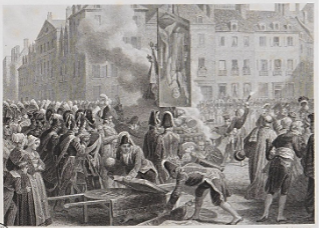
Public burning of imperial portraits and insignia in Orléans (1816)
Source: Departmental archives of the Loiret, 5 FI 335.
Even so, Serna does not deny that there existed in Orléans, throughout the period considered, a political center that frequently sought moderation but that, depending on the circumstances, could display a radical streak. He speaks of a “radical center mainly focused on protecting its interests, achievements, and wealth” (p. 403). In this way, he reuses a sociopolitical concept that he coined two decades ago: the “extreme center” (p. 305). According to this logic, a segment of the Orléans’ elites was opportunistic, aligning itself with whoever happened to be strong at a given moment. This was particularly evident in the year III, during the Thermidorian reaction: “the poison of political flip-flopping, as a rejection of republican ethics, was born at this precise moment” (p. 220). The most archetypal instance involved members of the directory of the Loiret, many of whom were former Hébertistes, that is, the most leftist faction of the Montagnards. As the winds shifted to reaction, they made a 360-degree turn, “declaring their views to be part of a new humanity’s struggle against barbarism” (p. 228). With Napoleon Bonaparte’s rise to power, their dithyrambic praise of his victories showed how eloquence had become “the manifestation of their flexibility in the quest for offices, decorations, and recognition” (p. 358). Serna sees their conduct as evidence of “general flip-flopping” (p. 362).
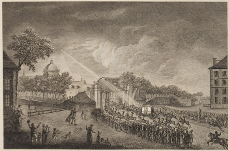
Napoleon Bonaparte’s arrival in Orléans, April 2, 1804 (1804)
Source: Departmental archives of the Loiret, 5 FI 92.
The book fully achieves its initial goal as it relates to Orléans, which Serna reiterates in his conclusion: “the period of revolutionary disremembering is over” (p. 404). By reconstructing Orléans’ political landscape in all its nuance and complexity, Serna sheds light on the Revolution’s impact on local political life over an extended period. He makes an implicit argument for the autonomy of individual actors and local authorities, which breaks with a “top-down tradition” [4] in political analysis—that is, one that is largely Paris-centric. Serna notes that the chain of influence between Orléans and the capital was reciprocal, “but never in a mechanical way” (p. 60). Serna’s lively style makes for a pleasurable reading experience, particularly since the book contains many literary references (Denis Diderot, Jacques the Fatalist, p. 34; Eugène Sue, The Mysteries of Paris, p. 378). The book is a stimulating dive into the twists and turns of a rich and tumultuous history that is a far cry from the dullness to which local historiography had relegated the town. Due to the richness of the archives examined as well as the remarkable quality of its analyses of sources (particularly Pataud’s chronicle and Brival’s speech), its interest goes well beyond its local context.
Pierre Serna, La Révolution oubliée. Orléans, 1789-1820, Paris, CNRS Éditions, 2024, 435 p., €26, ISBN 9782271152312.
by , 27 October
Share this article
Find us here :


To quote this article :
Fabien Salducci, « Orléans: A forgotten revolutionary history », Books and Ideas , 27 October 2026. ISSN : 2105-3030. URL : https://booksandideas.net/Orleans-A-forgotten-revolutionary-history
Nota Bene:
If you want to discuss this essay further, you can send a proposal to the editorial team (redaction at laviedesidees.fr). We will get back to you as soon as possible.
You might also like


Footnotes
[1] Jules Michelet, Histoire de la Révolution française, Paris, Jean de Bonnot, 1974, volume I, p. 12.
[2] Carlo Ginzburg, Signes, traces, pistes. Racines d’un paradigme de l’indice, Paris, Gallimard, 1980. The original Italian version of this book appeared the previous year.
[3] Albert Mathiez, La Réaction Thermidorienne, Paris, Armand Colin, 1929, p. 211.
[4] Laurent Brassart, Gouverner le local en Révolution. État, pouvoirs et mouvements collectifs dans l’Aisne (1790-1795), Paris, Société des études robespierristes, 2013, p. 31.
Our partners


Sections
Keep in touch
© laviedesidees.fr - Any replication forbidden without the explicit consent of the editors. - Mentions légales - webdesign : Abel Poucet