


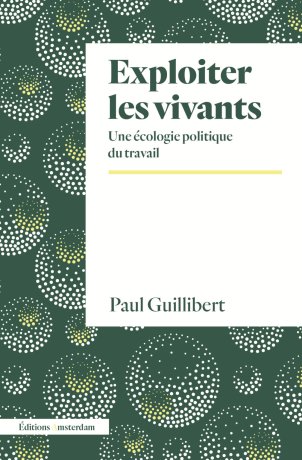
How can we reconcile the working classes with ecology? By reminding ecologists of the need to address together production and consumption. Doing so would lead to the constitution of “biocommunism,” the fundamental concepts of which are outlined by Paul Guillibert.
Ecologists, Let’s Get to Work!
About: Paul Guillibert, Exploiter les vivants. Une écologie politique du travail, Amsterdam
About: Paul Guillibert, Exploiter les vivants. Une écologie politique du travail, Amsterdam

|
Is misunderstanding inevitable between, on the one hand, workers who defend their factories and cars, and therefore their necessary access to wages, and, on the other, ecological activists who promote degrowth, non-market commons, and energy sobriety? It may in fact be fatal, especially if the former see the latter as urbanites out of touch with the reality of the working classes and, conversely, the latter view the former as “barbarians” oblivious to climate change and in urgent need of civilization. For eco-Marxist philosopher Paul Guillibert, the opposition between workers and ecologists, although sometimes very real, is neither productive nor insurmountable. It is, however, reinforced by the fact that little attention is paid to labor in contemporary ecological discourse, which tends to center on consumption rather than production.
Combining the conceptual tools of contemporary ecological Marxism with currents of critical feminist, anti-racist, and decolonial thought, Guillibert’s book, Exploiter les vivants. Une écologie politique du travail (The exploitation of life: A political ecology of work), aims to contribute to the formation of a common bloc around “biocommunism,” a form of communism that addresses all relations of domination in their irreducible diversity while also connecting them to the capitalist exploitation of labor in all its forms. As Guillibert points out, the alliance between workers, ecological activists, and citizen movements is not only possible, but has already been achieved in certain local struggles: the 2006 joint campaign to ensure social security for truck drivers and reduce pollution in the Port of Los Angeles; workers’ struggles for the ecological reconversion of the Taranto steelworks in Italy and the Grandpuits refinery in France; American forestry unions’ efforts to link labor rights and forest protection since the beginning of the twentieth century; etc. To favor such convergences, which are still few and far between, the author proposes a common conceptual and strategic framework capable of uniting the actors of struggles that are too often kept separate. [1] He also puts forward powerful slogans and broad political strategies. Thanks to his exceptional capacity for synthesis and conceptual clarification, Exploiter les vivants could well become a classic for contemporary progressive movements.
The Many Faces of Exploitation
The book consists of three chapters. The first two propose to redefine capitalism and the ecological crisis it has precipitated. The third chapter (along with the conclusion) explores the means and strategic objectives of the fight against ecocidal capitalism. Guillibert elaborates the theory and practice of a Marxist “political ecology” that is opposed both to liberal ecology’s “moralistic” injunctions (“ecology begins at home”) and to authoritarian eco-fascism (“ecology begins with the nation”).
The first two chapters characterize capitalism as “a system of devaluation of the conditions of life, human and non-human” (p. 79): Capital can only grow by devaluing what it needs to appropriate for free, be it natural resources and ecosystems, the bodies of colonized populations, or the reproductive labor generally performed by women. Guillibert cites several recent works on the history of the environment and fossil capitalism (Andreas Malm, Timothy Mitchell), feminist theory (Maria Mies and Veronika Bennholdt-Thomsen, Silvia Federici, Ariel Salleh), and the history of colonial plantations (Jean-Baptiste Fressoz and Fabien Locher, Anna Tsing, Donna Haraway). He clearly discusses their relevance and limitations, while also highlighting their contribution to classical Marxism. As these various works recall, the exploitation of wage labor to generate surplus value is only one aspect of the capitalist mode of production. Capitalism would not have been possible without the generalized putting to work of slaves and colonized populations; nor would it have survived without the reproductive labor of women which is devalued so as to be appropriated for free. The cotton that fed the English textile industry in the eighteenth century was grown by slaves, and the reproduction of the working class was guaranteed by women’s unpaid domestic work. From the outset, the racial and sexual division of labor was essential to the existence of the salaried, surplus-value producing industrial proletariat: “There is not a brick in the city of Bristol but what is cemented with the blood of a slave” (Eric Williams, Capitalism and Slavery, 1944). Guillibert’s overview of the literature is instructive and well-crafted. He does not waste time quarreling with the authors, nor does he lavish praise on them; rather, he usefully discusses their works in relation to each other.
A Generalized “Putting to Work” of Life
Guillibert goes further by linking the putting to work of humans to the generalized putting to work of life under capitalism: He advances the counterintuitive idea that the category of work, as we commonly understand it, does not adequately describe most animal activities and may not even be universal in humans given the many “laborless societies” identified by anthropologists. In line with this idea, he persuasively argues for a concept of labor that applies only to societies characterized by the division of labor—and therefore by the separation between work and free time—and only to animals engaged in human activities—through either relations of coercion (milk cows in agro-industry) or relations of cooperation (guide dogs for the blind). In his view, the notions of animal alienation and animal resistance to being put to work reveal the limitations of two conceptual frameworks: the philosophy of animal liberation and the philosophies of life. While the first sees animals merely as the suffering victims of humans, the second give “epistemological priority to life over politics” and consequently study animals without taking into account “the various social forces that determine our relationship to wild lives and the threats faced by those lives” (p. 115).
That said, the “putting to work” of humans and domestic animals does not exhaust capitalism’s relationship to living things. What of wild animals, arable land, the atmosphere? And what of the vast ecosystems which capitalism has not produced but from which it extracts more and more goods for the sake of profit? While speaking of plant labor or land labor would be stretching the concept too far, Guillibert is right to point out that for capital nature is not merely a stock of inert resources to be monopolized: It is also a set of generative processes that need to be activated through the “pathological, disruptive, and alienated intensification of its productivity in the name of profit” (p. 108).
Of course, most of our subsistence activities since Neolithic times have rested on the putting to work of land and life and on the knowledge and exploitation of the interdependencies that make it possible to cultivate, raise, and domesticate life in an ecologically sustainable manner. Yet, capitalist production is unique in that it uses all available technical means to intensify the generative processes of nature to the point of exhaustion: Far from ignoring the interdependencies in nature, which some naturalist philosophers (rightly) call on us to recognize, [2] capitalism operates an unsustainable and destructive “putting to work of interdependencies” (Léna Balaud and Antoine Chopot, Nous ne sommes pas seuls, 2021, quoted on p. 118). Guillibert offers a synthetic view of the modes of appropriation of nature that distinguishes between, on the one hand, the “appropriation of natural forces” (already existing resources) and, on the other, the “putting to work of life and ecological relations” that favors the more or less complete domination of life processes under capitalism. He also proposes to classify the degrees of this domination based on Marx’s four modes of subsumption of labor—the last mode being the “total subsumption of life,” wherein the genetic and metabolic processes of life are fully integrated, exploited, and transformed for the sake of profit (p. 127).
From Differentiated Exploitation to the Common Struggle
“Without revolutionary theory,” wrote Lenin in What Is to Be Done?, “there can be no revolutionary movement.” And yet, the revolutionary theory that will ensure that all struggles converge towards the abolition of capitalism without ignoring their specific demands is still under construction. In order to contribute to this construction, Guillibert proposes a common theoretical framework for progressive intellectual and political movements that puts the question of labor back at the heart of ecological reflection. This framework denounces the capitalist mode of production as the main cause of the ecological crisis and as the primary enemy of the ecological movement, highlighting the logic of “putting to work” and destructive alienation that structures the various relations of domination between humans and non-humans. The book logically concludes with a number of strategic considerations based on examples of real social movements that have combined the defense of workers with the protection of the environment.
The main question underpinning these considerations is the degrowth of production, a necessary yet unpopular concept that has been the target of repeated (and often exaggerated) academic and political criticism. Degrowth appeals mainly to highly educated people—their comfortable salaries and lower dependence on the market making it easier for them to change their lifestyle—rather than to precarious workers. This antagonism between social groups has been exploited by capital to “form a hegemonic cross-class coalition of workers and capitalists who oppose the degrowth movement on the grounds that it goes against their common interest: the unlimited pursuit of production” (p. 149).
These efforts to build a cross-class coalition against anti-productivist ecology must be thwarted, as must attempts to unite native white workers and capitalists against racialized and immigrant populations in a period marked by the fear of decline and scarcity. To this end, Guillibert calls for rallying around “biocommunism”—a communism that prioritizes degrowth yet builds on a “new imaginary of abundance” made up not of commodities, but of richer, more satisfying relationships among living beings. Under biocommunism, rationing measures would primarily target the wealthiest classes and the most superfluous goods, which would lead to a general increase in quality of life for all or most people. Such rationing is precisely what, since the 1970s, degrowth advocates have been calling for in their pursuit of an alternative vision of abundance summed up in the motto “fewer goods, more relationships.” Guillibert draws in particular on the latest work by Japanese eco-Marxist Kohei Saito, author of a recent defense of “degrowth communism” (Marx in the Anthropocene: Towards the Idea of Degrowth Communism, Cambridge University Press, 2023). Saito points to the convergence of basic communist demands and calls for the degrowth of production: Social production for use value as opposed to profit, the reduction of working time, the abolition of the division of labor through the rotation of arduous tasks, the eradication of market competition, and the elimination of the division between manual and intellectual labor.
Organizing the “Ecological Proletariat”
The slogan “biocommunism,” aimed at “achieving degrowth through the multiplication of the natural or social commons” (p. 173), is a plausible one. The central task, however, lies in the strategic orientation that this slogan induces: “Identifying the social forces capable of transforming the ecological balance of power” (p. 171). From this perspective, one might think that the book provides only superficial proposals and fails to escape the general tendency of eco-Marxist works to ultimately pin their hopes on the constitution of a new revolutionary class, an “ecological proletariat,” or a “biotariat” (Jason Moore) composed of workers, citizen movements, and even animals—in short, a class capable of bringing about the necessary revolution. It is hard to see how such a class could be formed given the variety of situations, relations of domination, and geographical spaces at stake (not to mention species).
Nevertheless, Guillibert does distinguish between a “class technically made up of all exploited life” and a political alliance between sections of this class that are capable of waging a real struggle. The fact that pigs belong to the working class, in the sense that their lives are exploited and put to work, does not mean that they constitute a revolutionary force... One could also argue that good Marxist practice does not consist of imposing a strategy from on high, but of proposing conceptual tools that can render more effective the real movement of self-organization of the working class, which is precisely what the book aims to achieve.
Guillibert ends by stressing the importance of maintaining the internationalist and anti-racist dimension of biocommunism against ecofascist and nationalist temptations. The fact that he addresses this question in the conclusion gives the impression that he only belatedly recognized the risks of a political ecology centered on labor and anti-capitalism, a position that is not necessarily emancipatory or progressive. While sound analyses of capitalism do highlight the racial and sexual structuring of the proletariat, this does not mean that all movements claiming to be anti-capitalist, or even communist, are anti-racist, feminist, or truly ecologist. Guillibert poses the problem in an incidental but relevant way: True commons necessarily imply forms of exclusion (of those who monopolize resources or fail to respect the rules). It is, of course, important to emphasize, as he does, the risk that the rules of exclusion will be those of an ethnic nation-state. Yet, we must also reflect on these rules,” and therefore on the delimitation of new political communities, as opposed to merely rejecting the ones that reinforce the existing order.
Conclusion: Towards an Eco-Marxist Unionism?
Guillibert does not claim to resolve all the difficulties that stand in the way of the emancipation of the masses. Rather, he provides conceptual tools inspired by Marxism and contemporary critical theories with a view to placing labor (as opposed to consumption) at the center of the ecological movement. The book offers both an overview of the subject and a series of proposals, and, in this sense, it is a success. It will be of value to readers familiar with the issues, but also to those who have only heard of the concepts of Capitalocene or Plantationocene, extractivism, or social reproduction feminism. That said, Guillibert could have productively engaged with slightly older (but still relevant) works that connect ecology, labor, communism, and degrowth—for instance, the studies of André Gorz, Murray Bookchin, and Michaël Löwy on eco-socialism, those of Ivan Illich on the convivial society, or those of Henri Lefebvre and Neil Smith on the production of space and nature under capitalism. It is also regrettable that labor is treated in the book primarily as a conceptual device for defining exploited categories. More space could have been devoted to exploring the new relationships to concrete work—including with nature and animals—that “biocommunism” might bring about. Guillibert likely neglected the issue because the concrete content of this otherwise unifying slogan is a source of disagreement and unresolved questions.
The fact remains that Guillibert’s redefinition of capitalism, which centers on the devaluation of the conditions of life and the pathological activation of natural processes, sheds useful light on the ecocidal and imperialist effects of the capitalist mode of production. More so than many contemporary ecological theories, this redefinition can inspire a concrete, collective, and combative ecological practice. While the means to constitute a unified international ecological proletariat are not yet clear (and for good reason), books such as Guilibert’s can help foster—in the name of the liberation of labor—a renewed unionism that brings together ecologists and the working classes, industrial livestock workers and the animal cause, farmers and the protection of soils, refinery workers and the planned phase-out of fossil fuels, the proletariat of the banlieues and that of the countryside, etc. Clarifying our concepts to achieve a better grasp of reality: Such is the task of the philosopher.
Paul Guillibert, Exploiter les vivants. Une écologie politique du travail, Paris, Amsterdam, 2023, 160 p., 13 €.
by , 30 September 2025
Share this article
Find us here :


Further reading
Bibliography:
– Andreas Malm, The Progress of this Storm: Nature and Society in a Warming World, London, Verso, 2018.
– André Gorz, Capitalism, Socialism, Ecology, London, Verso, 1994.
– Kohei Saito, Marx in the Anthropocene. Towards the Idea of Degrowth Communism, Cambridge University Press, 2023
Alexis Cukier, Le travail démocratique, Puf, Paris, 2018
– Léna Balaud et Antoine Chopot, Nous ne sommes pas seuls. Politique des soulèvements terrestres, Paris, Seuil, 2021
– Anna Lowenhaupt Tsing, The Mushroom at the End of the World: On the Possibility of Life in Capitalist Ruins, Princeton, Princeton University Press, 2017.
To quote this article :
Bertrand Vaillant, « Ecologists, Let’s Get to Work! », Books and Ideas , 30 September 2025. ISSN : 2105-3030. URL : https://booksandideas.net/Ecologists-Let-s-Get-to-Work
Nota Bene:
If you want to discuss this essay further, you can send a proposal to the editorial team (redaction at laviedesidees.fr). We will get back to you as soon as possible.
You might also like




Our partners


Sections
Keep in touch
© laviedesidees.fr - Any replication forbidden without the explicit consent of the editors. - Mentions légales - webdesign : Abel Poucet