


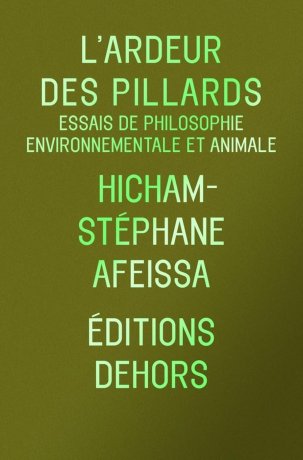
The “ardor of pillagers” refers to the momentum driving the depletion of life, which is outlined by Hicham-Stéphane Afeissa in his new book, drawing on the entire field of ecological thought.
The Depletion of Life on Earth
About: Hicham-Stéphane Afeissa, L’ardeur des pillards, Essais de philosophie environnementale et animale, Éditions Dehors
About: Hicham-Stéphane Afeissa, L’ardeur des pillards, Essais de philosophie environnementale et animale, Éditions Dehors

|
L’Ardeur des pillards, Essais de philosophie environnementale et animale (The Ardor of Pillagers, Essays on Environmental and Animal Philosophy) is a book that complements two previous works (Nouveaux fronts écologiques and Portraits de philosophes en écologistes). It thus completes, as its author acknowledges, “a trilogy that we had not conceived as such [...] and whose conclusion we could have foreseen even less” (p. 22). Hicham-Stéphane Afeissa is a key figure who has helped raise awareness of ecological discourse in France through his collections of texts on environmental ethics and aesthetics. With this new book, he appears to be ending more than a decade of study and reflection in the field of ecological thought. Under the evocative title L’Ardeur des pillards, borrowed from Rimbaud’s A Season in Hell, Afeissa brings together a selection of essays, including five previously unpublished ones, divided into four sections: animal philosophy, political ecology, environmental aesthetics, and ecosophy.
This book addresses a number of topics related to environmental philosophy, ethics, and aesthetics: the domestication of pets; the slaughtering of animals; the conditions for a policy on the living world; the contribution of an apocalyptic perspective to political ecology; the limits and value of environmental aesthetics and its moral implications; the originality of Arne Næss’s deep ecology, the ways in whichh it differed from continental ecology and environmental ethics, the debate it sparked between deep ecology and ecofeminism; and the possibility of a phenomenologically inspired urban ecosophy.
The economy of pillage
In L’Ardeur des pillards, there is no original thesis as such. Rather, it is the chosen theme that serves as the book’s core proposition and guiding thread: pillage. In using this term, the author is referring to the economy of pillage (Raubwirtschaft) as described by geographers in the late nineteenth and early twentieth centuries. This concept initially referred to a stage in the development of a human community that appropriates environmental resources, but it was later used to denounce the “destructive occupation” through which humans appropriate the earth’s resources (p. 22), an idea that can be traced back to the work of ecologist Henry Fairfield Osborn, Our Plundered Planet (1948). For Afeissa, pillage therefore refers to extractivism as a mode of capitalism defined as “a global enterprise of widespread appropriation of nature and living bodies” (p. 23). It is in light of this notion that Afeissa addresses the various themes he brings together in his book. Sometimes it is invoked explicitly, sometimes it is implicit in the chosen themes. The key point here is that Afeissa sees pillage, like Marx’s vampire capital, as a deadly enterprise, “a powerful dynamic for the depletion of life,” as he admirably puts it (p. 23-24).
In a section entitled “The dumbing down of animals,” Afeissa defends the idea that the domestication of pets strips them of all animal characteristics to make them resemble “ridiculous creatures” (pp. 25 and 29 ff.). Drawing on the work of Jocelyne Porcher, he shows that the “bilateral socialization process” of domestication has always been rooted in the social relationship of labor that benefits both partners (pp. 33-4); and it is because humans have distorted this relationship, by reducing part of the animal world to the status of pets (p. 47), that the domestication of animals contains a process of unilateral domination that denaturalizes them by stripping them of all animal characteristics (p. 51). Afeissa also identifies this lethal relationship—this depletion of life—in the hidden practices of meat production and consumption, practices which, according to the author, are part of the “decision” to have a violent relationship with animals (“The denial of animal slaughter,” pp. 63-4). Here, Afeissa is pointing to the existence of a fundamental continuity and permanence between the sacrificial structure of animals in Antiquity and their modern-day killing in the slaughterhouse. What links the two phenomena is the mechanism of denial, in the Freudian sense, of murder through ritual in sacrificial practice, and through the invisibilization of the processes of breeding, slaughtering and processing in contemporary meat diets, and thus the concealment of our violent relationship with animals (p. 63).
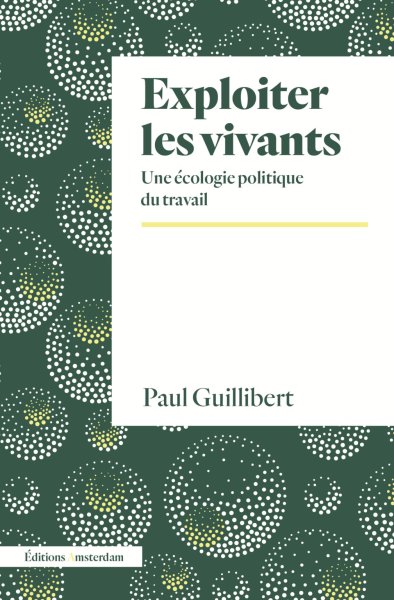
These analyses could build on the works of political ecology by philosophers such as Paul Guillibert (Exploiter les vivants. Une écologie politique du travail) and Léna Balaud and Antoine Chopot (Nous ne sommes pas seuls : politique des soulèvements terrestres) on the appropriation and exploitation of the planet’s living resources [1]. What sets Afeissa’s texts apart from this Marxist-inspired trend in political ecology is the ethical, sociological and anthropological perspective his analyses bring to the question of our relationship with domestic animals.
Vandalism
At the other extreme of ecological thinking, this same theme of pillaging, in the form of vandalism, is explored in a section combining environmental ethics and aesthetics. In “Ecological vandalism and the intrinsic value of nature,” the concept of vandalism is used to morally disqualify actions that destroy something of intrinsic value: the existence of a beautiful world (pp. 174-5). The destruction of marsh landscapes is a prime example of this violent relationship with nature. In a superb essay on applied aesthetics, entitled “The aesthetics of marshes,” which combines environmental history and aesthetics, Afeissa shows how these much maligned landscapes have come to be seen as areas worthy of protection and heritage status, as well as places offering a wealth of aesthetic experiences: visual, auditory, olfactory, tactile, and kinesthetic (p. 235). Marshlands can therefore be considered “the paradigm of aesthetic experience” (p. 236).
An ambivalent world, divided between gods and humans, between the dead and the living, combining the above and the below, earth and water—marshes blur all boundaries and aesthetic categories (p. 238).
Marsh landscapes also provide a striking example of the harmful effects of rampant pillaging. Centuries of colonization, drainage, suppression, and clearing of these areas are evidence of human ignorance, blindness, and contempt for these ecosystems, which are among the most fertile and productive on the planet and the most threatened in history (p. 229).
Voracity
Lest there be any doubt, the term “ardor of pillagers” describes the “voracious appropriation of nature” that aims to accumulate capital at the expense of nature (p. 23). The diversity of topics addressed in this collection of essays highlights this “momentum driving the depletion of life on Earth” in its various manifestations. One such form, this time in an urban setting, is the loss of an intuitive world in our relationship with the city, through the use of new modes of transportation such as electric scooters. The phenomenological implications of this type of transportation are the nullification of the body and movement (walking) along with the abolition of practical space. As Afeissa writes, “Under such conditions, there is no longer any pedestrian appropriation of the city or any relationship to space through the body […]” (p. 312); in short, there is no constitution of an inhabited space. In this case, pillage is the reduction of the world in which walking is synonymous with the constitution of the living world as a place of habitation, residence, and existence.
The collection of texts in this book effectively helps to elucidate contemporary ecological discourse by critiquing the voracious appropriation of nature in the form of the ardor of pillagers and the destruction of our intuitive relationship with the world that this entails. Indeed, this is the basis for our author’s criticism of the stance taken by certain contemporary figures in ecological thinking in France, such as Baptiste Morizot, Corine Pelluchon, and Michaël Fœssel. However, the strength of his critical intuition, which is well-founded in other respects, is liable to become controversial in certain areas. This is the case, for example, with the author’s criticism of Morizot in “From one predator to another: the wolf, humans, and capitalists.” Afeissa accuses Morizot of dissociating the issue of wildlife management (in this case, wolves) from our relationship with other animals (domestic and farm animals) (p. 72), and thus “concealing” the political and economic dimension (industrial production and meat consumption) of our relationship with domesticated animals (p.75 ff.). However, in Les Diplomates, Baptiste Morizot is seeking to establish a framework for dialogue at the interface between the human and animal worlds with a view to negotiating forms of cohabitation. The political and economic issue, while relevant in other respects, seems secondary to the initial project, which is to find ways of coexisting with wild animals.
In this regard, our author’s criticism seems overly harsh. On the other hand, a mutualist project like that of Baptiste Morizot would have much to gain from the reflections that Afeissa develops on the concept of labor (in the section entitled “The dumbing down of animals,” for example). As we have seen, Afeissa defends the idea that labor, and the social relationship it creates, is what primarily defines our relationship with domestic animals (which has been distorted, as our author rightly points out). However, by drawing on the concept of labor, it is possible to explain the socio-historical creation of the interface between human and wild worlds where mutualistic dialogue takes place. Taking inspiration this time from Hannah Arendt’s concept of labor, it is possible to shed light on this relationship between the social and the wild. Indeed, for Hannah Arendt, labor is the basis for the reproduction of the biological process, of life itself, and through this, of society. If we consider that domesticated animals are part of this process, we see the emergence of an interface between the social world (humans and domesticated animals) and the wild world, where mutualistic dialogue is of critical importance.
The controversial tone that sometimes emerges does not detract from the rigor and erudition that permeate all of these texts, and above all from the author’s powerful critique of voracious capitalist appropriation. Afeissa is right to make this the central focus of his work and the criterion by which to judge contemporary ecological discourse.
Hicham-Stéphane Afeissa, L’ardeur des pillards. Essais de philosophie environnementale et animale, Éditions Dehors, 2024, 328 p., 24 €.
by , 13 November 2025
Share this article
Find us here :


Further reading
– Afeissa, Hicham-Stéphane. Éthique de l’environnement : nature, valeur, respect. J. Vrin, 2007
– Afeissa, Hicham-Stéphane. Esthétique de l’environnement : appréciation, connaissance et savoir. J. Vrin, 2015.
– Bertrand Vaillant, « Écologistes, au travail !», La vie des idées, 2023,
– Paul Guillibert, Exploiter les vivants. Une écologie politique du travail, Amsterdam, 2023
– Léna Balaud et Antoine Chopot, Nous ne sommes pas seuls, Seuil, 2021
– David Abram, Comment la terre s’est tue. Pour une écologie des sens, La découverte, 2013
– Baptiste Morizot, Les Diplomates. Cohabiter avec les loups sur une autre carte du vivant, Wildproject, 2016
– John Bellamy Foster et Brett Clark, Le pillage de la nature, Éditions critiques, 2022
– Osborn, Fairfield, et Maurice Planiol. La planète au pillage. Payot, 1949.
To quote this article :
Esteban Arcos, « The Depletion of Life on Earth », Books and Ideas , 13 November 2025. ISSN : 2105-3030. URL : https://booksandideas.net/The-Depletion-of-Life-on-Earth
Nota Bene:
If you want to discuss this essay further, you can send a proposal to the editorial team (redaction at laviedesidees.fr). We will get back to you as soon as possible.
You might also like


Footnotes
[1] On this point, see the review (in French) by Bertrand Vaillant, « Écologistes, au travail ! », of Paul Guillibert’s book Exploiter les vivants. https://laviedesidees.fr/Paul-Guillibert-Exploiter-les-vivants
Our partners


Sections
Keep in touch
© laviedesidees.fr - Any replication forbidden without the explicit consent of the editors. - Mentions légales - webdesign : Abel Poucet