


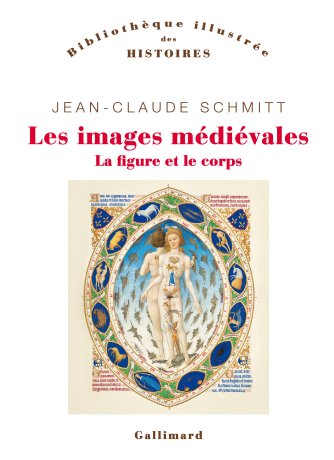
In this collection of essays, Jean-Claude Schmitt continues his examination of medieval images. Considering the topic from a semantic, historical, and artistic perspective, he explores how the medieval West thought about images and, at times, through images.
« L’homme astrologique », Très Riches Heures du duc Jean de Berry, ms 65 fol. 14v, vers 1416, tempera sur vélin, musée Condé, Chantilly
Unrepresentative images
About: Jean-Claude Schmitt, Les Images médiévales. La figure et le corps, Gallimard
About: Jean-Claude Schmitt, Les Images médiévales. La figure et le corps, Gallimard

|
Images—primarily, but not exclusively, from the Middle Ages—are a major theme of Jean-Claude Schmitt’s work. In 1996, he published a major article in Annales, entitled “La culture de l’imago” (The culture of the imago). [1] Imago “refers in fact to three sets of concepts”: first, the image of God in Jesus Christ, emphasizing the incarnation’s crucial importance for Christianity; secondly, “the entirety of human symbolic production,” notably images arising from language (such as ekphrasis and metaphors) and material images; third, mental images, including products of the imagination, dreams, and memory. Consequently, imago is something more than an image, and the medieval West was steeped in the thought and culture of the imago, which Schmitt has studied in numerous works, like Le corps des images. Essais sur la culture visuelle au Moyen Âge (The body of images: essays on the visual culture of the Middle Ages) in 2002. [2]
Images are as central to the thought of the medieval West as they are to the thought of Jean-Claude Schmitt, as the form of his books makes clear. Le corps des images (mentioned previously) and Les Images médiévales. La figure et le corps—the focus of this review—are constructed similarly, consisting of multiple essays—ranging from 2006 to 2023, in the book under consideration. While the form is somewhat surprising and can complicate reading, due to the fact that the “chapters” alternate between methodological and conceptual concerns [3] (1; 2; 4; 6) and case studies (3; 5; 7; 8; 9), it proves, through the recurrence of particular topics, the extent to which Schmitt’s focus has, over the years, remained the same. More than an essay collection, the volume is a genuinely coherent book.
Christian images
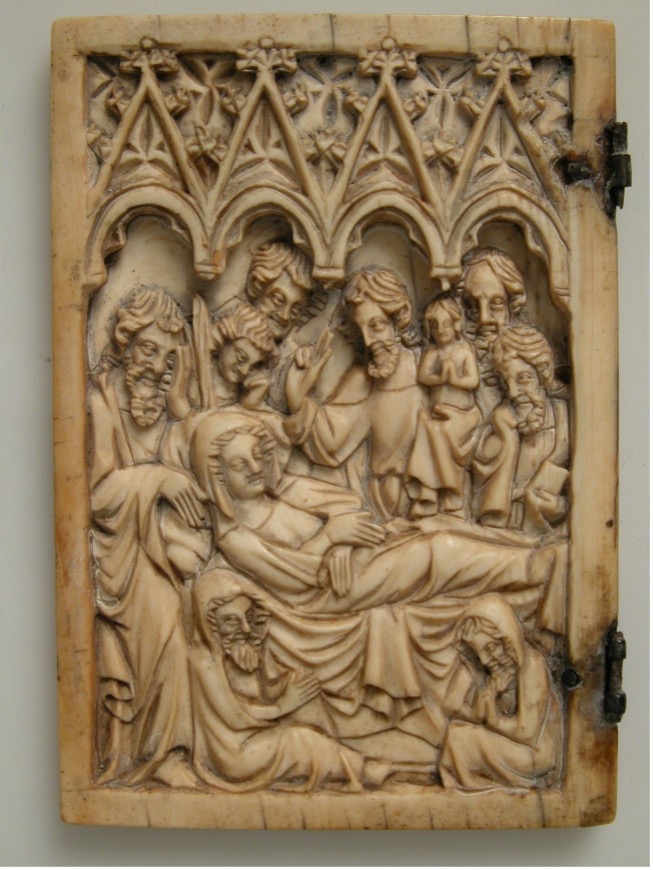
Dormition, XIVe siècle, Metropolitan Museum of Art, New York
The book’s subject is medieval images, most of which were produced in Christian contexts. Schmitt justifies this focus primarily because of the central—though, in some instances, problematic—place of images in Christianity. This centrality is explained in the first chapter, “The Paradox of an Iconophile Monotheism” (p. 25-64). Christianity differs from the two other monotheisms in that the presence of images is justified by the doctrine of the incarnation. It is due to Jesus’ twofold nature—both divine and human—that Christians feel permitted to represent him with human traits. This permission even extends to the father, in a reversal that Schmitt perceptively discerns. While the son is portrayed in the father’s image, the father is eventually portrayed in the son’s image.
While Schmitt provides a convincing rationale for focusing on images produced by the medieval Christian West, he also provides a rationale, through his highly pedagogical rationale, for the three other words—image, figure, and body—found in his book’s title.
The simple fact of describing images immediately confronts us with a terminological problem. Where do medieval words stand, and where do ours stand? (p. 159)
What do images mean for the Western Middle Ages? Schmitt’s answer is simple: “Any object seeking a visual effect” (p. 17). This definition owes much to the art historian Hans Belting and his work Likeness and Presence: A History of the Image before the Era of Art. [4] The image as imago is a more relevant concept than that of art, which generates a hierarchy.
One of Schmitt’s great merits is his constant desire to be clear and pedagogical in defining his work’s key concepts. He does so, as we have seen, for the concept of image/imago (like Schmitt, we will henceforth use the term “image”), as well as for those of “figure” and “body.” By introducing these concepts as early as his introduction, Schmitt insists that an image’s meaning, which for the medieval West is essentially religious, must be grasped and analyzed in the way that it intersects with “figure” (its signification) and “body” (its contents).
A culture of analogies
The concept of figure—figura in Latin—must be understood from the standpoint of medieval culture. According to Schmitt, who draws on the thought of Eric Auerbach, [5] medieval culture broke with the mimesis of antiquity. The former is not conceived as an imitation of reality, but as a “figurative interpretation” of it (p. 75) from within a culture of analogy. In representing a person, an object, or a place, a figure’s relationship to its referent is not direct but mediated through an index. These objects cannot be reduced to themselves, but recall an older, hidden sense that they bring to light.
Taking the doctrine of biblical typology as an example, Schmitt speaks of an “infinite network of analogies woven between past ’figures’ and ’types’ (such as Adam and Eve or David) and their corresponding figures or ’antitypes’ in the New Testament and Church history” (p. 20-21). This network of analogies can just as easily be woven outside of the Old Testament/New Testament binary: between pagan and Christian figures in moralized Bibles, between microcosm and macrocosm, between vices and virtues, as well as in the lower margins of the famous Belleville Breviary, which Schmitt analyzes in chapter four, entitled “Analogical Figures.”
In the medieval West, images do not aim to reproduce reality and even portraits do not necessarily seek a likeness with their model.
The medieval image is thus not an objective imitation. At the same time, it is also not a representation. Schmitt writes that the image
“is also and most importantly a material object: its material nature is defined by its medium, materials [used to make it], and the material or vegetable pigments or gold leaf that cover part of the painting’s or miniature’s surface” (p. 22).
From a methodological standpoint, several aspects of the book stand out. The first is the central role of materiality, which is mentioned in the title itself. Having considered figures, it next examines bodies. Christian monotheism stands out because images are embodied, through the incarnation of Jesus Christ, in objects whose presence in the world must be studied. Schmitt pursues the path opened by the “material turn” of the 1980s.
Schmitt is an historian, not an art historian. Yet this does not prevent his book from being very important for contemporary art history. Last June (2024), the Comité International d’Histoire de l’Art (International committee of art history) organized its conference on the concepts of “matter” and “materiality,” which are “inherent to the conception, production, and interpretation of the artifacts of ever culture and every period.” Schmitt considers materiality, conceived as the effects produced by matter’s properties, via the relationship between signifier and signified and devotional and liturgical practices and, more broadly, “as a central and paradoxical element of Chistian culture”“(p. 175). By virtue of their materiality, images acquire a form of materiality, images acquire a form of freedom in relation to texts and can no longer be considered solely as representations or illustrations. This insight is another nail in the coffin (if a new one was even needed) of the”Bible of the Illiterate.“From images conceived in their materiality arise an effect, a capacity for action, and a form agency in Schmitt’s very definition of the image (”Any object seeking a visual effect," p. 17). He thus again aligns himself with Auerbach, as well as with Alfred Gell, the British anthropologist and author of the seminal essay Art and Agency. [6] A work of art—particularly, according to Schmitt, a work of medieval art—is something that acts on its spectators and users.
Across history
An image is not simply the translation of a belief; it also helps to shape a belief, particularly when a belief is not fixed by doctrine, but … is in constant search for itself, even as it develops (p. 227).
This quote connects an image’s effect to its role in constructing belief over time. For herein lies the book’s final noteworthy point. Belief and images are historical objects and they change over time. And while the idea that images change as beliefs change seems self-evident, the reverse is also true, though it is less intuitive for those who are not art historians. Schmitt provides a magnificent demonstration of this claim in chapter eight, entitled “Mary’s Corporeal Exception” (p. 226-270), which is undoubtedly the book’s most impressive achievement. Adopting Pierre Francastel’s concept of “figurative thought,” [7] Schmitt analyzes over an extended period, which at times goes beyond the Middle Ages, the emergence and flourishing of the image of Mary’s corporeal assumption and the gradual abandonment of the Byzantine iconography of the Dormition, a term used to refer to the non-violent death of saints in general and the Virgin Mary in particular.
In a context in which the problematic is once again that of the body—Mary’s corporeal exception—Schmitt shows how it was images and not theologians who fashioned this belief in the elevation of the Virgin’s body and soul. Mary’s corporeal exception returns, moreover, in a final chapter that is more anthropological than historical, in which the author studies the ceremony of Círio de Nazaré in Brazil, which he witnessed in 2013.
Schmitt’s new book is a rich and profoundly complex work, though the fact that it consists of a collection of articles makes reading it occasionally difficult. While it is perfectly aligned with the research angle on medieval images, which lies on the cusp of history and art history in their current forms, the book tells us as much about its author as its subject. Its deliberately fragmented construction and the essays’ non-chronological arrangement may, at times, frustrate readers due to the abrupt transitions and occasional repetitions. Even so, it offers rare and privileged access to the underpinnings of Schmitt’s thought and to the historian’s private laboratory.
Jean-Claude Schmitt, Les Images médiévales. La figure et le corps (Medieval images. Figures and bodies), Paris, Gallimard, 2023, 368 p., 29, 50 €.
by , 3 February
Share this article
Find us here :


To quote this article :
Fabien Lacouture, « Unrepresentative images », Books and Ideas , 3 February 2026. ISSN : 2105-3030. URL : https://booksandideas.net/Unrepresentative-images
Nota Bene:
If you want to discuss this essay further, you can send a proposal to the editorial team (redaction at laviedesidees.fr). We will get back to you as soon as possible.
You might also like

Footnotes
[1] Jean-Claude Schmitt, “La culture de l’imago,” Annales. Histoire, Sciences Sociales, 1, 1996. p. 3-36.
[2] Jean-Claude Schmitt, Le corps des images. Essais sur la culture visuelle au Moyen Âge, Paris, Gallimard, Collection “Le temps des images,” 2002, 410 p. We should also mention the essay Penser par figure, in which Schmitt analyzes medieval diagrams as full-fledged images. See Jean-Claude Schmitt, Penser par figure. Du compas divin aux diagrammes magiques, Paris, Arkhê, 2019.
[3] The quotes are ours.
[4] Hans Belting, Likeness and Presence: A History of the Image before the Era of Art, Chicago, University of Chicago Press, 1994.
[5] Eric Auerbach, Mimésis: la représentation de la réalité dans la littérature occidentale, Paris, Gallimard, 1992.
[6] Alfred Gell, L’art et ses agents: une théorie anthropologique, Dijon, Les Presses du réel, 1998.
[7] Pierre Francastel, La figure et le lieu. L’ordre visuel du Quattrocento, Paris, Gallimard, 1967.
Our partners


Sections
Keep in touch
© laviedesidees.fr - Any replication forbidden without the explicit consent of the editors. - Mentions légales - webdesign : Abel Poucet