


Julia Cagé and Thomas Piketty’s economic history of political conflict in France is a defense of bipartition: The Left-Right divide, which is the foundation of our democracy, has enabled social progress. We must therefore work to restore it.
Two Centuries of Alternation, 1
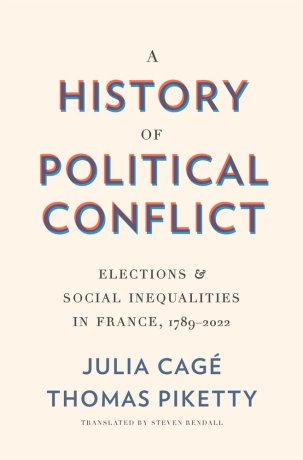
About: Julia Cagé & Thomas Piketty, A History of Political Conflict: Elections and Social Inequalities in France, 1789-2022, The Belknap Press of Harvard University Press
About: Julia Cagé & Thomas Piketty, A History of Political Conflict: Elections and Social Inequalities in France, 1789-2022, The Belknap Press of Harvard University Press

|
Below is the first part of Michel Offerlé’s review of Julia Cagé and Thomas Piketty’s book on the history of elections in France. The second part presents a critical evaluation of the selected indicators, followed by a comparison with works of electoral sociology and electoral history
A History of Political Conflict: Elections and Social Inequalities in France, 1789-2022, by economists Julia Cagé and Thomas Piketty, takes us through more than two centuries of French elections.
This very substantial book contains 848 pages, nearly two million characters, 11 reproductions of electoral records, 47 maps, 273 figures, 1 table, plus countless “supplementary materials” and references that are freely available on the site unehistoireduconflitpolitique.fr. It also builds on an unprecedented, large-scale digitization of electoral and socioeconomic data spanning more than two centuries (1793-2022). The data cover all legislative elections held in 1848-49 and in 1871-2022, all presidential elections held in 1848 and in 1965-2022, as well as the referenda of 1793 and 1795 and those of 1946, 1992, and 2005 (the imperial plebiscites and the other referenda of the Fifth Republic—1958, 1961, 1962 (2), 1969, 1972, 1988, and 2000—are left out of the analysis). It has been a long time since an effort of this magnitude has been expended on the sociology of elections in France, especially one using a spatial and long-term perspective.
As with all immediately impressive works, Cagé and Piketty’s book will be subject to a variety of readings and interpretations.
Unfortunately, the first reactions will be limited to cursory, fragmented, and perfunctory readings, or else to paratextual readings (to use Gérard Genette’s terminology) that draw on pre-digested excerpts or radio commentaries. Indeed, few will be able and willing to devote a full week to reading the text in its entirety, from p. 1—“Who votes for whom, and why? How has the social structure of the electorates of the various political tendencies in France evolved between 1789 and 2022?”—all the way to p. 802—“But it goes without saying that only a comparative perspective based on the accumulation of national monographs could go further.” These hasty reactions will likely emphasize the political thrust of the book (which is intended as a situated public intervention) and will probably try to appropriate or discredit it at little cost and with great fanfare. I will quickly summarize these reactions below.
Second, I will follow Cagé and Piketty’s epistemological line of reasoning, remaining within their universe of thought and respecting their stated orientations and modes of intervention as economists eager to use interdisciplinarity and to explore together the “exclusive preserve” of electoral sociologists and historians. Who are their interlocutors? Who are their allies? Who do they seek to distance themselves from? How does this study of French elections renew our knowledge of more than two centuries of political conflict?
Third and last, I will compare the authors’ methods and achievements with those of scholarly traditions that they barely mention or even completely ignore. In other words, I will confront their reflections and results with questions very different from the ones posed in the introduction (as outlined above): What does voting mean? And what is an electorate?
In short, three possible readings will be considered: A political reading that draws direct political consequences from the main historical conclusions; a reading grounded in economic history that takes seriously the proposed indicators and examines how they are constructed and validated; and an external, sociohistorical reading that compares the book with works produced by social and electoral historians over the last decades.
A Political Book?
First, let us see what a cursory reading would say about the book.
Such a reading would marvel at the massive amounts of data covering several centuries and would highlight the impressive reasoning apparatus supported by elegant figures and maps. It would point to this or that page to illustrate the main variables collected to support the thesis. Alternatively, it would stress the book’s general structure, which is well summarized on the back cover and in the introduction.
After noting that political conflict is always multidimensional and that the cleavages of the past continue to linger (contrary to what some would have us believe), Cagé and Piketty describe their project as follows:
There are historical periods in which one main axis may take precedence over the others. In particular, this may involve a socioeconomic conflict between the working classes and the property-owning classes as a whole, in which case, the electoral confrontation takes the form of a Left-Right bipolar conflict that may to a certain extent merge with a conflict between rich and poor. We shall see that this “classist” type of bipolarization is generally structured around inequalities of property (even more than around inequalities of income) and always leaves an autonomous role for the rural-urban conflict and the religious and educational conflicts, and obviously for the complexity of individual experiences and subjectivities. This “complexified classist” configuration has occupied an essential place in France beginning around 1990-1910 (with the rise in the power of the Socialist Party and then the Communist Party) and continuing until 1990-2000. It played a maximal role from 1958 to 1992, a period during which almost no political tendency could exist outside the Left-Right bipolarity, particularly in the emblematic elections of 1974, 1978, and 1981, when the Left-Right structure of the voting in relation to wealth was indeed very marked. If we take a long-term view, we have to admit that this bipolarization, which was especially strong between 1910 and 1992, had a deciding and largely positive impact on the country’s democratic, social, and economic development over the course of the century. It fed a prolific competition to set up multiple essential public policies while at the same time permitting more peaceful democratic transfers of power at the head of the state. One of this book’s essential goals is to better understand the socioeconomic and political-ideological contexts and the strategic choices made by actors capable of explaining why and how this type of bipolar conflict is constructed or deconstructed. (p. 6)
The main purpose of the book is to provide an “economic history” [1] of political conflict in France that maps the relationship between electoral results and social inequalities based on the idea of a bipartition or tripartition of the party system.
Although the book purports to illuminate the period 1789-2022 (as the subtitle indicates), the bi/tripartition hypothesis effectively concerns the period 1871-2022. The period 1848-1852 also displayed a tripartite structure (since it was marked by an electoral contest between the Democratic Socialists, the Moderate Republicans, and the Party of Order), but the tripartition only became dominant in 1871 (the conflict was then essentially between a Socialist/Radical/advanced Republican bloc, a Moderate Republican/Opportunistic Republican bloc, and a conservative/monarchist bloc). In the 1910s, a clear Right-Left bipartition was established along the lines of socioeconomic conflict, a configuration the authors deem desirable and effective in that it enables “social and economic and progress.” This configuration lasted until 1992, when it gave way to a new, “unstable” tripartition (between a Left-ecological bloc, a central bloc, and a Right bloc ranging from Gaullists to Frontists [2], though this classification poses a number of problems, as we shall see in the second part of this review).
It should be noted that the notion of bloc is never really defined. Is it a reference to Gramsci [3] or Poulantzas or is it an echo of recent political debates around the so-called “bourgeois bloc” (the term is used in passing on p. 27)? The authors seem to treat blocs more as active political entities than as instruments constructed by and for the analysis.
One of Cagé and Piketty’s main objectives is to identify the conditions for the emergence of a bipartition or tripartition. This, they believe, will make it possible to overcome the current tripartite system, to politically defeat the “nationalist-patriotic bloc,” and to reunite the working classes—which are now divided between the “nationalist-patriotic bloc” (in villages and towns) and the “social-ecological bloc” (in suburbs and metropoles)—around the “social-ecological bloc.”
A cursory reading would highlight the book’s “interventionist” thrust. Indeed, while A History of Political Conflict is a scholarly work built on extensive and meticulous research, it is also an appeal to the “reader-citizen” (p. 797): The argument gives rise to a set of political proposals that could serve as a platform for reflecting on the “social-ecological bloc” being called for by the authors. The first part, which points time and again to inequalities in France, displays both a solid mastery of statistics and a good, beautiful, and democratic aspiration that sets the tone for the rest of the book. The aim is not merely to produce good science, but to offer keys to intervening in the social world and to developing strategies and proposals that will encourage mobilization and facilitate the restoration of the “beneficial” Right-Left divide. Cagé and Piketty take a stance, just as they did in their earlier works.
As a cursory, political reading would point out, [4] the authors conclude from their data that the (geosocial) class conflict prevails over all other forms of conflict, and they draw political consequences from this. They thus extend their work on socioeconomic inequalities by trying to link these to historical structures of electoral behavior.
“In summary,” Cagé and Piketty write, “bipartition and classist conflict allow democracy to function and continue the march toward equality and social and economic progress” (p. 26). From a programmatic perspective, p. 703 ff. are especially eloquent, as is the long passage (pp. 787-796) on possible visions for the future of the European Union: the “social-federalist” approach, which the authors embrace, versus the “liberal-progressive” approach and the “nationalist-patriotic” or “social-nationalist” approach, which they reject.
In addition, the authors formulate a series of ad hoc proposals for institutional reform (social parity, participative primaries, democratic equality vouchers, zero-interest loans, etc.) and for relaunching the welfare state. They also propose ways of bypassing the Senate (which is hardly mentioned in the book) and “the local” (namely, municipal elections), despite the latter being a very important component of democracy over the long term.
This extremely interesting reflection can certainly contribute to democratic debate and can even provide the foundations and contours of a political program for the 2027 election. However, one cannot help but wonder how RN leaders will respond to Cagé and Piketty’s intervention. Although the RN program is picked apart in the book, the party emerges from it with a triple win: It is not stigmatized as extremist (see the second part of this review); it is described as the bedrock of the Right bloc, such that the latter appears as the heir to this “political family” in France; and it is said to represent a very large section of the working class, particularly blue-collar workers. And yet, contrary to popular belief, “the Left” has not lost the working class: The most precarious wage earners continue to vote Left, and La France Insoumise (LFI) is more popular among the poorest households (pp. 772-773).
We could certainly stop here, and no doubt many readers and radio listeners will move on to another topic. Yet if we are to fully understand and master this work, we must dig deeper into it. In other words, we must make the effort to enter its intricate web of figures, maps, and arguments.
Julia Cagé and Thomas Piketty, A History of Political Conflict: Elections and Social Inequalities in France, 1789-2022, translated by Steven Rendall, Cambridge, The Belknap Press of Harvard University Press, 2025. 848 p, 69€, ISBN 9780674248434
by , 18 December 2025
Share this article
Find us here :


To quote this article :
Michel Offerlé, « Two Centuries of Alternation, 1 », Books and Ideas , 18 December 2025. ISSN : 2105-3030. URL : https://booksandideas.net/Two-Centuries-of-Alternation-1
Nota Bene:
If you want to discuss this essay further, you can send a proposal to the editorial team (redaction at laviedesidees.fr). We will get back to you as soon as possible.
You might also like


Footnotes
[1] The French version of the book uses the term “Eco-histoire.” A reference to “socio-histoire” (socio-history), the term has recently come into use in the French academic sphere. In this regard, it should be noted that A History of Political Conflict was published in Le Seuil’s new “Éco-Histoires” Series.
[2] “Frontists” refers to the Front National (FN), now known as the Rassemblement National (RN).
[3] Antonio Gramsci, Prison Notebooks, Columbia University Press, 2001; Nikos Poulantzas, “Les classes sociales,” L’homme et la société, N°24-25, 1972; Bruno Amable et Stefano Palombarini, L’illusion du bloc bourgeois. Alliances sociales et avenir du modèle français, 2nd edition, Raisons d’agir, 2018.
[4] And indeed, the first spate of commentaries that followed the book’s publication tended to rely on this type of reading.
Our partners


Sections
Keep in touch
© laviedesidees.fr - Any replication forbidden without the explicit consent of the editors. - Mentions légales - webdesign : Abel Poucet