

School is mandatory and fully justified in being so. Educational authority in no way impairs freedom, provided it focuses on developing students’ multiple capacities.
The value of school
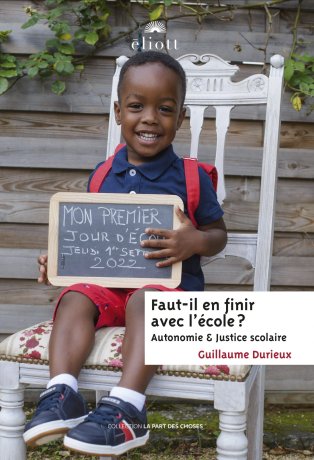
About: Guillaume Durieux, Faut-il en finir avec l’école ? Autonomie & justice scolaire, Éditions Eliott
About: Guillaume Durieux, Faut-il en finir avec l’école ? Autonomie & justice scolaire, Éditions Eliott

|
The deliberately provocative title of Guillaume Durieux’s book is sure to shock readers, since his question – “should we do away with schools?” – is intended to challenge our deepest assumptions and beliefs. In the book’s opening pages, Durieux answers his question with a resounding “no”. Yet the point of this question lies neither in its shock value or its effectiveness as a publicity stunt. Rather, it defines the theoretical framework in which Durieux will make his argument. This framework is rooted in a critical analysis of the thought of Ivan Illich (1926-2002), which Durieux examines while rejecting Illich’s goal of an “unschooled” society. Durieux’s goal, however, is less to defend schools than to make a strong case for the moral necessity of mandatory schooling.
Durieux claims to embrace a liberal conception of education. This stance leads him to reject any educational project that simply consists in training future economic actors or binding future citizens to their social conditions.
Durieux’s argument proceeds, as he clearly states, in two steps. The first, which corresponds to the first chapter, seeks to refute the position of schools’ theoretical opponents. In this context, Illich is Durieux’s key interlocutor, since Illich is “probably the most brilliant critic of schools” (p. 45). The second step, which unfolds in later chapters, consists in “a positive justification of mandatory schooling” (p. 15), while defending the claim that “a system of mandatory schooling can be considered just” (ibid.).
A critical dialogue with Ivan Illich
Focusing on Ivan Illich’s well-known book, Deschooling Society (1971), Durieux offers a critical examination of the Austrian philosopher’s radical claims. These claims amount to a rejection of the school-as-institution, on the grounds that, by privileging the best off over the worst off, it adds to injustice and inequality.
The purpose of schools is to serve the interests of all students. Yet, according to Illich, they are contradictory institutions that necessarily fail in achieving their aims. They cannot, as Durieux writes, “simultaneously produce and fight against academic failure” (p. 21), academic failure being primarily a problem that afflicts disadvantaged students.
In Illich’s work, Durieux identifies three main arguments.
The first concerns academic injustice. Insofar as they reflect society, schools, according to Illich, are destined to reproduce inequality, which weakens social cohesion. By granting degrees that help to distribute social positions, schools oppress those in danger of academic failure. For Durieux, this functionalist argument “lacks subtlety” (p. 23). It makes no distinction between different kinds of educational organizations and assigns them all a single function: dividing society into different positions. Yet it cannot be denied, Durieux contends, that a strong correlation exists between schools and social needs, “there is no reason to conclude that there exists a strict and necessary dependence” of schools on social expectations (p. 24).
Illich’s second argument is based on a critical examination of the content of the knowledge and instruction that defines education and the school system’s curricula. Illich seeks to validate forms of learning that take place outside of school. He vigorously criticizes school-based education, which prevents “motivated and efficient investment in the learning process” (p. 27). Yet, Durieux insists, “a school system is, whatever its faults, more efficient in imparting learning than Illich suggests” (p. 31).
Finally, the third argument that Durieux draws from Illich’s analysis concerns schools’ control over knowledge. Schools have a monopoly on legitimate knowledge. Moreover, degree-granting turns the school system into a “system of privilege allocation” (p. 34). Such a system transforms knowledge into a commodity to be exchanged on the labor market. Durieux challenges this critique using a contextualist argument, which holds that the destructive effects of schools have less to do with their inherent nature than with contingencies tied to the society in which Illich lived (p. 37).
Learning to be autonomous
Based on his critique of Illich, Durieux proposes “a positive justification of the school system and the principles of justice that must govern how it is organized” (p. 46).
The task of positive justification first entails an analysis of the justifications for school authority and prove that “it is legitimate for the state to impose educational goals and constraints through schools” (p. 47).
The question of school authority would appear to founder on the problem of education’s inherent purpose – that is, autonomy. How does authority align with the demand for autonomy? Durieux responds to this question with an instrumentalist conception of educational authority. The legitimacy of educational authority depends entirely on its ability to make students autonomous. This idea leads Durieux to propose a “child-dependent [conception of] agency”, which would grant them positive rights at various stages of their development. In concrete terms, “this means that they have the right to participate, consistent with their abilities, in how classes operate and that, as much as possible, they should be agents in their own education” (p. 95).
Durieux begins with the premise that autonomy must satisfy two goals. First, it must ensure the mastery of a range of cognitive competencies and dispositions that will instill the “appropriate attitudes” enabling students to engage in effective action. Second, students must be offered intellectual resources and “relevant knowledge about the world” (p. 101) that will allow them to get their bearings and orient themselves. Promoting “appropriate attitudes” means that teachers must create learning situations in what Durieux calls “controlled agency-inducing contexts”. Students must be able to develop different capacities: to evaluate information, pose and solve problems, and act.
Durieux, in this way, brings to light what he calls “the paradox of democratic schools”. This paradox consists in the fact that “schools are not strictly democratic institutions, without which democratic society would not be viable” (p. 155). But this paradox, as Durieux emphasizes, is only evident to the extent that the asymmetry that is inherent to educational relationships does not contradict each student’s need for autonomy and the rejection of all purely vertical transmission relationships.
Education in autonomy depends on the kinds of knowledge that students are taught. To determine what kinds of knowledge will be included in a school curriculum, Durieux proposes that they be submitted to “indispensability tests” (pp. 164-167) based on the principle that “the only cultural forms to be included in the curriculum are those that are foundational to developing individual autonomy” (p. 165).
Within the framework of the kind of liberal education to which Durieux subscribes, education must have as its goal and ideal a moral good. Utilitarian and professional goals are prohibited. The result is a thesis that Durieux boldly embraces: early professionalization and specialization must be rejected to the degree that they undermine autonomy. When students are prematurely directed towards professional paths, their competencies risk being limited solely to the profession they choose, with the consequence that they may “experience their lives as foreordained” (p. 176).
Durieux, in this way, borrows Michael Young’s theory of powerful knowledge in support of his theory of scholastic justice. Durieux defines powerful knowledge as whatever provides “rich and complex understanding of one’s experience” (p. 201).
When a curriculum “is neither a curriculum of erudition nor a curriculum of performance” (p. 212) but a “curriculum of autonomy”, it is no longer necessary to impose upon students, upon the completion of their secondary education, exams like the baccalaureate, which subject all students to the same test (p. 215).
A relational theory of scholastic justice
The question of autonomy in school belongs to a theory of educational justice that Durieux defines as a theory of relational equality.
This relational theory of scholastic equality stands opposed to three concurrent theories. First, it rejects the meritocratic theory of equal opportunity, which Durieux criticizes insofar as it “fails to guarantee each individual a social basis for self-respect” (p. 289). Second, it must be distinguished from equal treatment, which Durieux accuses of being “indifferent to differences” (p. 258), using a phrase from Bourdieu. Finally, it is different from the equality of outcomes, though Durieux recognizes that, of the three, this theory is “the most promising basis for a just school system” (p. 289).
What characterizes the relational theory of equality, in contrast to the three other theories, is that it “considers that scholastic inequalities are a problem as such, even beyond the sufficiency threshold” (p. 268). Consequently, a just school system excludes any mechanism that makes students compete with one another, so that different learning speeds should not “lead to options and opportunities of unequal value” (ibid.), nor should they compromise the equal status of all students.
Conclusion
Durieux concludes his book by revisiting his question: “should we do away with schools?” He recalls the thesis he has defended throughout the book, that “schools are necessary institutions for any complex society that takes autonomy seriously as a value” (p. 291). Contrary to appearances, this thesis is hardly self-evident. It is at odds with the republican tradition that has prevailed in French society where, from the Ferry law of March 28, 1882, to the ordonnance no. 49-55 of January 6, 1959, school is mandatory for children aged 3 to 16. In France, schools are free institutions made available to individuals, with each family having the choice to enroll their children or not.
Durieux, of course, does not overlook the distinction between mandatory education and mandatory schooling. But as he explains in a footnote (note 3, p. 19), he has chosen in his essay not to deal with it so as not to “unnecessarily complicate the argument” (p. 19). Yet given the book’s topic, is this distinction not crucial?
The decision to organize learning in a specific place and institutional context – namely, schools – implies distinct motives and has serious consequences for how one relates to knowledge (the cognitive factor) and others (the moral and political factor). “Home” schooling is driven by other motives and has different consequences. Analyzing them would have been useful. Considering the distinction between mandatory education and mandatory schooling would have allowed Durieux to better defend mandatory schooling. He might, for instance, have emphasized the importance of “joint attention” in the process of knowledge acquisition, the cognitive benefits resulting from group learning, or the moral advantages associated with taking young children away from familiar environments. While it is true that Durieux presents his approach as normative rather than descriptive, the consideration of real forms and practices certainly deserves a few pages. His handling of the question of parental authority is interesting but limited. It is not considered from the standpoint of mandatory schooling. Homeschooling practices cannot fulfil schooling requirements as Durieux conceives them. From a “developing autonomy” perspective – what Durieux calls the “autonomy curriculum” – is it not legitimate to think that it makes sense to take students out of their family environment? A comparative analysis of “homeschooling” (which is not a school) and the school qua institution would no doubt have shown how the experience of otherness also contributes to promoting children’s autonomy.
That said, readers will particularly appreciate the many issues raised by the educational questions examined in this book, which Durieux considers with knowledge and integrity.
Guillaume Durieux, Faut-il en finir avec l’école ? Autonomie & justice scolaire (Should we do away with schools? Autonomy and scholastic justice). Paris, Éditions Eliott, 2024, 318 pp., €28, ISBN 9782493117366.
by , 26 February
Share this article
Find us here :


To quote this article :
Nassim El Kabli, « The value of school », Books and Ideas , 26 February 2026. ISSN : 2105-3030. URL : https://booksandideas.net/The-value-of-school
Nota Bene:
If you want to discuss this essay further, you can send a proposal to the editorial team (redaction at laviedesidees.fr). We will get back to you as soon as possible.
You might also like



Our partners


Sections
Keep in touch
© laviedesidees.fr - Any replication forbidden without the explicit consent of the editors. - Mentions légales - webdesign : Abel Poucet