

Drawing on the resources of ethno-accounting, Geneviève Pruvost conducts a fascinating investigation into “alternative” lifestyles in rural areas.
Living Frugally
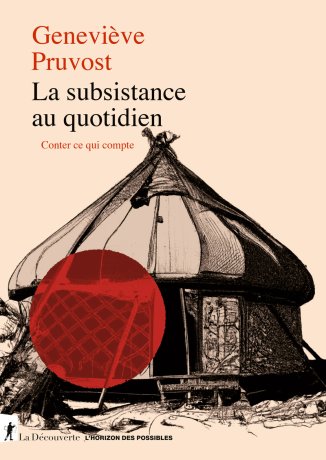
About: Geneviève Pruvost, La subsistance au quotidien, conter ce qui compte, La Découverte
About: Geneviève Pruvost, La subsistance au quotidien, conter ce qui compte, La Découverte

|
This book, written as a follow-up to an earlier work entitled Quotidien politique: Féminisme, écologie, subsistance (2021), is based on an ethnography and ethno-accounting study from 2013-2014 involving a baker-farmer couple from Valondes (Myriam and Florian [1]), their child, and the animals that share their 9.19-hectare plot of land. It also draws on a rich multisite survey of alternative farmers (living in Valondes and elsewhere in France) conducted over a ten-year period and comprising 112 interviews.
This book is a manifesto on two fronts. First and foremost, it is a battle against the stereotypes associated with what the author calls the “quiet struggles” of Valondes [2], and more broadly with “alternative” people living in rural areas and committed to environmentally friendly lifestyles. By examining the “layering [of their] ordinary gestures” (p. 17), Geneviève Pruvost sets out to dismantle preconceived ideas about these populations and nuance their sociological profile. In addition, the book defends the epistemological contribution of qualitative methods, in particular ethno-accounting [3]. The importance given to transcribing ethnography reveals the demands of this method (a relationship of trust with respondents, rigorous note-taking, commitment in the field, etc.) and the analytical precision it brings. The author asserts that ethno-accounting is “by definition an ecological method of investigation,” because “interactions are not studied in isolation, but are resituated within an entire environment.” (p 476).
A methodological innovation: ethno-accounting
These two aims are complementary. Ethno-accounting is a means of making an alternative lifestyle tangible and therefore credible. Recounting, by counting, all the exchanges of a household (a “place with inhabitants who are not necessarily related, nor exclusively human” p. 13) allows the author to show “that this way of life is within reach and accessible to those with a small budget” (p. 25).
After outlining how she constructed her research object and methodology (pp. 5-33), Geneviève Pruvost divides her analysis into three parts: ethnographic description (pp. 34-265); presentation of the ethno-accounting results (pp. 266-348); and analysis drawn from the surveys (pp. 349-470). The first part is a rather unique example of an ethnographic diary, as this type of fieldwork is rarely published. The researcher’s notebook is often considered personal, even intimate, and only selected passages are usually published. Geneviève Pruvost faithfully transcribes all the details of her investigation: the situations, discussions and key moments, as well as her feelings and questions. Geneviève Pruvost faithfully transcribes every detail of her investigation: situations, discussions, and key moments, as well as her feelings and questions. She not only allows us to make a close-up assessment of the household’s way of life, but also introduces us to qualitative and ethnographic research, its advantages and its challenges.
The second part gives a detailed account of Myriam and Florian’s exchanges in the form of tables and diagrams. It provides an inventory of all the animals, objects, tools, and working hours. All expenses are recorded in tables and compared with prices found in the “conventional” production-consumption system in order to demonstrate, in very concrete terms, the viability of an alternative lifestyle. This lifestyle requires less financial investment than buying a brick-and-mortar house and setting up a more traditional rural home, as it also relies on recycling, donations, bartering, etc. This accounting process gives a general overview of all the household’s exchanges (pp. 342-343).
Reduced consumption is not austerity!
The third part of the book presents a sociological analysis in seven chapters. Some of the findings are particularly interesting. First, the book challenges preconceived notions about the social origins of alternative lifestyles. The Valondes group (around 50 people) is relatively socially diverse: most of its members come from rural backgrounds and are often from the local area, meaning they do not have an “out-of-touch” relationship with the land, as is commonly assumed by the stereotype of eco-conscious newcomers to rural areas. The author disputes the idea that these alternative farmers are only committed because of a decline in their social status. Rather, she stresses that their commitment is not caused by an inability to climb the social ladder, but by a refusal to do so and by a “shared adherence to the world of alternatives” (p. 360). Their background and geographical origins are key to understanding their commitment: they are either “children of the land,” children of “rural handymen,” or “jack-of-all-trades” (p. 361). Their engagement is also influenced by 1) family socialization through religious education and/or community involvement; 2) the experience of a formative trip outside Europe.
An alternative lifestyle does not have to mean being isolated from the rest of the world. In fact, the daily activities of Myriam and Florian’s household are structured on three distinct levels. Every day, the household focuses on “applying the principles of justice and equality” to its human and non-human members (p. 355). At the regional and inter-municipal levels, Myriam and Florian have joined a “network of local dynamics” (p. 356), developed a network of interdependencies with other alternative producers in the region and neighboring organic farmers, and joined local professional groups. On a larger scale, they are taking part in social movements with national resonance, such as protecting the Notre Dame des Landes “zone to defend” (ZAD).
Joining these multi-scale networks has enabled the Valondes group of alternative farmers to adopt specific land strategies. Those with the opportunity and means to purchase a plot of land pursue a “rapid settlement tactic” before making these spaces available to the rest of the community, in a spirit of informal redistribution that allows them to “dissociate land status from land use” (p. 373). The allocation of land and its various uses within the group are founded on trust, informal agreements, and complementarity between nomadic individuals (with temporary settlements) and those who are permanently settled.
Geneviève Pruvost goes on to show that “voluntary frugality does not imply austerity, but in fact an abundance of objects” (p. 400). Myriam and Florian thus maintain a lifestyle that supports a wealth of objects and relationships with living things, contradicting the cliché that an ecological lifestyle inevitably leads to deprivation. This way of living and working also promotes a more gender-balanced distribution of tasks and working hours (for example, with regard to childcare, which is more evenly shared between the couple) and a more fluid organization of activities. Contrary to what might be expected, the quest for autonomy is not a quest for permanence, but rather the acceptance of the temporary. It therefore requires anticipation and organization, as well as a sense of proportionality, while offering “a change in sensory perception and worldview” (p. 399) to “reveal a chosen modernity” (p. 406).
Finally, Geneviève Pruvost shows that ecology is not divided between a depoliticized domestic ecology and a politicized ecology (i.e., one connected to social movements); on the contrary, quiet struggles have several “areas of contact” with more overt struggles.
What does the future hold for alternative lifestyles?
Given that the book aims to do justice to even the smallest gesture, this review can only scratch the surface of its rich and nuanced content. We recommend that anyone interested in the subject read the text in its entirety. This is an important work both for understanding the alternative lifestyle in a balanced way and for reflecting on qualitative methods in social sciences. As the surveys that underpin this book were conducted in 2013 and 2014 in a relatively uncharacterized area (due to anonymization), more details would be welcome on the socio-spatial context of Valondes and recent developments in the local agricultural and rural environment. Organic farming, which is part of the interdependent network linking these alternative farmers, experienced significant growth in the 2010s, albeit to varying degrees depending on the region. The sector was then weakened by the COVID-19 pandemic, due to inflation and rising food prices.
In addition, support structures for rural settlers, such as Terre de Liens, and social movements, such as Soulèvements de la terre, have emerged. It would be interesting to see how this new national context, coupled with local developments, has had an impact (positive or negative) on Myriam and Florian’s lifestyle and household. The author herself points out a number of difficulties that arose during her research: limited access to land, the precariousness of some of the farms, Myriam and Florian’s exhaustion, and a lack of time to develop the crop-livestock mixed model.
Published in laviedesidees.fr, November 29, 2024.
Geneviève Pruvost, La subsistance au quotidien, conter ce qui compte, Paris, La Découverte, collection « L’horizon des possibles », 2024, 504 p., 28 €.
by , 21 October 2025
Share this article
Find us here :


To quote this article :
Camille Robert-Boeuf, « Living Frugally », Books and Ideas , 21 October 2025. ISSN : 2105-3030. URL : https://booksandideas.net/Living-Frugally
Nota Bene:
If you want to discuss this essay further, you can send a proposal to the editorial team (redaction at laviedesidees.fr). We will get back to you as soon as possible.
You might also like

Footnotes
[1] All first names in the book have been changed by the author.
[2] A fictitious municipality anonymized to protect the interviewees, located in a “rural area of France revitalized by summer eco-tourism” (p. 369).
[3] A survey technique that consists in carefully counting all the exchanges (list of objects, materials, purchases, sales, salvages, donations, etc.) that are made within a place or household.
Our partners


Sections
Keep in touch
© laviedesidees.fr - Any replication forbidden without the explicit consent of the editors. - Mentions légales - webdesign : Abel Poucet