


According to Thomas Blom Hansen, Indian cities have become spaces of exclusion, fear, and sharpened enmity. He describes how Muslims are victims of an entanglement of communal violence, state complicity, and systemic discrimination.
Interview International Video Interviews
The Urban Condition of Muslims in India
Interview with Thomas Blom Hansen

|
This publication is part of our partnership with the Center for Advanced Study in the Behavioral Sciences. The full list of our joint publications is available here.
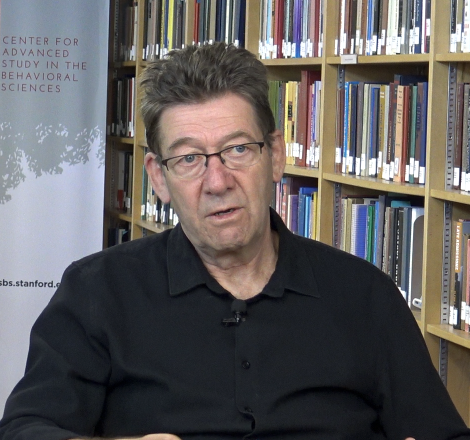
Thomas Blom Hansen is the Reliance-Dhirubhai Ambani Professor of South Asian Studies at Stanford University. Trained as a social anthropologist, he has conducted extensive fieldwork in India and South Africa, focusing on the intersections of religion, politics, and urban life in postcolonial societies. His scholarship is widely recognized for its nuanced analysis of Hindu nationalism, communal violence, and the enduring challenges of secular governance in India.
Hansen’s early works, most notably The Saffron Wave (1999) and Wages of Violence (2001), established him as a leading interpreter of the rise of Hindu nationalist movements and the reshaping of Indian democracy. His later research broadened to questions of sovereignty, inequality, and citizenship. He notably published Melancholia of Freedom (2012), a landmark study of racial and religious coexistence in South Africa. Across these projects, Hansen has combined ethnographic depth with theoretical sophistication, illuminating how ordinary lives are shaped by structures of power, exclusion, and belonging. Most recently, he authored The Law of Force: The Violent Heart of Indian Politics (Aleph Book Company, 2021) and Saffron Republic: Hindu Nationalism and State Power in India, Edited with Srirupa Roy (Cambridge University Press, 2023).
As a CASBS fellow, Thomas Hansen is currently working on a new book manuscript, tentatively titled City of Enemies, that seeks to rethink urban experience from the Global South and beyond the classical themes of urban theory. The book focuses on the city of Aurangabad in India, a rapidly growing city that like hundreds of cities across South Asia is shaped by a long history of street riots between religious communities and antagonistic caste groups. Drawing on diverse materials gathered over three decades, Hansen will describe mutually hostile social worlds marked by deep inequalities, social segregation, fear and suspicion of ‘categorical others’, where community and informal networks of trust appear as indispensable guarantees of livelihoods, dwelling and a future.
Books and ideas: Over the decades since independence, how have the forms of communal violence between Hindus and Muslims in India evolved? And how would you describe the changing role of the state in responding to or participating in these episodes?
Thomas Blom Hansen: So right after Independence, the police forces would still observe the kind of manuals and ways in which colonial policing was done, which was largely as a form of referee between warring communities. So a riot would break out, the police would try to keep peace. They would try to divide people and so on and so forth. There would be injunctions for newspapers not to report anything that could incite violence and so on and so forth.
So it was very much that kind of old colonial idea of the state being there to keep order but be neutral, essentially. Over time that changes, and it correlates also with a thinning out of the representation of Muslims in the police force and in many parts of the state and governmental apparatus throughout India. So what you see from the 1960s, 1970s and accelerating and certainly being very pronounced in the 1990s, is that the state and the police force stop intervening, actually, and in many cases, actively participate on the side of the Hindu rioters.
So the state police forces, and there are many different police forces in India, but on the whole, they are no longer seen as a kind of non-partisan force that can come in and create order. And that has, of course, sharpened divisions in the sense that many Muslims feel that they are… And even the language in which we describe the riots, it used to be like between two warring communities, now it’s much more clearly a kind of pogrom, created by the majority community, perpetrated against the minority community and Muslims mostly, but also sometimes Dalits and supported by or even orchestrated sometimes by police forces.
And this has been made possible and accelerated with the coming into power of Hindu nationalist governments in many parts of the country where it’s very blatantly clear that the police’s job is not actually to protect the minority community, but to be part of the attack on them.
I will add that in the past up to the 1960s and 70s, even into the 1980s, it was normally the case that after a major riot or incident had occurred, there would be a commission of inquiry, to determine what were the causes, what went wrong, and so on and so forth. There was a number of cases, one particularly high-profile case in the city of Bombay, where it was very clear that the police was being rightly indicted for its role in not only aiding and abetting, but also standing back and not helping in maintaining law and order. After that point, and this coincides with the last few decades where Hindu nationalists have risen to power, many of these post-riot inquiries have either been very biased or not happened at all. So that also goes to show that the role of the state as a kind of pretending at least to be a reasonably neutral kind of arbiter in conflicts between communities has ceased to be the case. And the state is widely seen now by minority communities as part of the problem, not part of the solution.
Books and Ideas: How do you account for the tension between the Indian state’s formal commitment to secularism and the ways in which Hindu majoritarian norms, often expressed through religious idioms, have become embedded in public institutions and national identity? In what ways is the normative project of secularism itself shaped by majoritarian assumptions?
Thomas Blom Hansen : The first thing to remember is, and certainly for a French audience, is that when you say secular in India, you don’t mean “laicité”, like in French, that it’s non-religious, that it is removed from religion altogether. It’s more akin to, you can say, the American or Anglo-Saxon model: the state is removed from a direct partisan role, and secularism in India has come to be seen as achieving a balance between communities.
Now, that means that the government and political parties for decades actively didn’t intervene necessarily in the inner governance of communities, although there were lots of legislations that framed how religious institutions, endowments, schools, curricula and so on were structured in those institutions for different religious communities. But it meant that the idea was that everybody had to be taken into account.
So if you made a statement about the greatness of Hinduism, then in the next breath, you would also say something nice about Islam. So it’s a form of balance between communities, which is essential to remember because what happens with the Hindu nationalists when they come up, from the 1990s growing political power, they say it’s actually pseudo secularism when the Indian state is helping the minority disproportionately in that view. So you’re not maintaining a balance between communities. That became a sort of tool to attack any form of protection of minorities as being seen as unfair, because we Hindus are already a majority. So that’s one thing.
The other thing is that if you look at the norms, how Indian nationalism in the 1950s, 60s and 70s, for decades described itself, it was shaped basically as around an idea of an Indian civilization, essentially the Hindu civilization that had been able to absorb different kinds of religious minorities and groups into itself, and had shaped this kind of what Nehru called the composite culture of India.
What that meant was that Islam was no more Islam or Christianity was no more. It was Indian Islam and Indian Christianity, and that was the important thing. But it was an inclusion that happened on majority terms or in fact, the 15, 20% of upper caste Indians that dominated Indian society historically and today. So was the inclusion on their terms, both discursively, rhetorically, but also in practice, in these institutions that administer this kind of compound, in the sense that the administration of different religious institutions were dominated by upper caste Hindu men, usually, who had a kind of bias inbuilt.
And so what we see today, the ease with which you can see the secular institutions and the secular discourse has been turned into a majoritarian discourse, is because the majoritarian assumptions were already there. They were already baked into the assumptions about Indian history, into the personnel of the state, and so on and so forth. And this idea that India was naturally a Hindu society and should be so, was already part of that compact, but with an added kind of: it would have to be balanced and sort of accept the incorporation of minorities into this compound that was essentially Hindu.
So that makes it very different from, let’s say, if you think of Turkish secularism or French secularism or other experiments, in the sense that it actively has embraced the religious component of what society is, rather than make a distance from it and say, we’re going to create a new modern republic that’s built on scientific principles and so on and so forth. That was never the case in India, although that was part of the Indian state’s attempt to plan and to create a modern society. But it wasn’t front and center of what secularism meant.
Books and Ideas: Your work often shows how macro political processes like nationalism or secularism are lived, enacted and contested in everyday spaces. What explains the persistence and systemic nature of anti-Muslim bias in India? What institutions or everyday infrastructures do you see as sustaining these prejudices, and do they interact to form a broader, coherent system of exclusion?
Thomas Blom Hansen: You can say that the systemic it a systemic that has become systemic. It was not necessarily designed to be like that. If we look at India in the 20th century, you look at the position of Muslims in the beginning of the 20th century, the elite was largely a landed elite, the small elite was landed elite, and the vast majority of Muslims were artisans, some were smallholders; many were actually, urban dwellers. And that’s an important thing that Muslims were always more urbanized than any other community in India.
So there’s a high proportion of these urban professions, but at the lower level of the labor market, as it were, it had to do with the fact that many Muslims, a majority of Muslims were converted Hindus and often from the lower rank of the caste hierarchy. People who saw it, who saw an advantage, you can say, in converting into a religion that at least had an equality principle - not always in practice. So the small elite was landed. There was not a great tradition of entrepreneurship and industry in India, whatever was there in the mid 20th century, by the time of independence, was largely controlled by small numbers of very wealthy Hindu, trading communities and commercial communities.
That remained the case throughout. Even today, there is preponderance of these communities. They own something like 80% of all assets in India today, large industries and so on and so forth. Muslims were never part of that economic development. There was one Muslim bank in India, ever in the 20th century that relocated to Pakistan. It became the first private bank in Pakistan at the time of the partition.
So that structure remained in place. So Muslims were kind of always a bit marginalized from the modern economy, as it were, the new capitalist economy and so and so forth. And they also lost a lot of land holdings. Many of the landed elite actually went to Pakistan. So that’s one thing. The other thing is that there was also a systemic discrimination against Muslims in the state, in government, all branches of government.
You can see it dwindling over the years, especially picking up in the 1970s and 80s, a dwindling number of educated Muslims who get jobs in the public sector. To this day, if you’re an educated Muslims and there are many young Muslims who are very well educated, many of them don’t even go for public sector exams, competitive exams to get jobs in the public institutions because they know they will never get selected.
Many of them have instead sought employment in the Gulf, for instance, where there’s been a preponderance of Muslim professionals, of doctors and engineers and so on who’ve been able to get jobs there. That labor market has also dried up. But the bias against Muslims has been visible in other places as well.
It’s also been visible in the labor movement, something that’s not often talked about; there’s some famous cases in the textile industry, for instance, where the textile industry began to contract, and become smaller, in the face of technological innovation in the 70s and 80s, where that had been a big source of employment for Muslim, because the weaving profession was historically dominated by Muslims.
So they had also become industrial workers. They were some of the first to be pushed out from the 60s onwards, and so on. And some of the very anti-Muslim sentiments, expressed by political organizations in the 70s and 80s, also in Bombay and in Gujarat and other places, where there was a lot of industry, were also by people who were active in the trade union movement.
So the discrimination against Muslims really happened at all levels. And then there’s another aspect of it, which is how urban life is structured and where there used to be, especially in the old centers of the older cities in North India and Western India, where there was a kind of an old core, many of these cities were founded by Muslim rulers, and Muslim communities; and it used to be a certain co-existence and mixing between Hindus and Muslims in these older urban cores that has more or less ceased to exist.
Most Hindus have moved out of these old cities into the more modern and newer parts of the cities, as they have developed. And this is where the new economy is. This is where new real estate economy is, and so on and so forth. And Muslims are left behind in the cores of these older cities that are often decried as traditional, as dirty, as undeveloped and so on and so forth.
So that’s another feature. You can see with, with the coming of new urban developments in the last 30 or 40 years, Muslims have really been left behind. They’ve also been excluded from the property market in very many systemic ways. It’s extremely difficult, even if you are young, educated, and maybe, well-earning Muslim professional to find a decent condo in an apartment complex because the local residents’ association will look at your name and say, sorry, we don’t have any availability and so on. So that kind of systemic discrimination happens now at all levels. It didn’t begin like that necessarily, but it’s become like that.
I will say one more thing. One more thing that has also been a problem for the integration and the conversation within the Muslim community about economic prosperity or about becoming part of a larger, new economy that has developed, has been hampered by the fact that many elite Muslims are unwilling to recognize that there were also caste-like structures within the Muslim community.
And that caste is practiced. There’s discrimination against people from the lower caste, from the traditional artisanal occupations and so on and so forth. Because they don’t recognize it, they have also actively discouraged Muslims from availing themselves of the potential benefits of various forms of affirmative action that have been extended to groups that would include Muslims, such as, you know, you can get stipend scholarships for education, and so on and so forth.
There’s been a resistance against this from the Muslim elite. And that’s very, very unfortunate and it’s a resistance that continues. And now that the community is under pressure, there’s less incentive to say, well, this will just divide us even further at a time where we all have to stand together against the discrimination that we face. So that’s one of the big challenges that the rest of Indian society has a very lively discussion about caste and its implications for social mobility and so on and so forth. The Muslims are not part of that conversation.
Books and Ideas: In such a climate of structural discrimination, how do Indian Muslims experience and inhabit the urban space? Would you say their relationship to the city is fundamentally different from that of Hindus or from other marginalized groups like Dalits?
Thomas Blom Hansen: Absolutely. As I’ve said early on, Muslims have always been more urbanized than any other community in India. They’ve been historically identified with urban refinement, with a certain kind of urban culture, with forms of cultural expression that are confined or expressed in the urban milieu, certain ideas of poetry, the arts, music and so on and so forth.
So there’s been a lot of pride in that. And I think the experience is predominantly one of a sense of loss. There’s a great sense of loss in that, and in my own work, I look at one city, called Aurangabad, which is in central India, which is an old Muslim city, and has been dominated by Muslims and defined by Muslims for hundreds of years. And of late, with the growth of the city and the coming into the city of large number of Hindus from the countryside, the city has completely changed its character, its demographic, its economy. And so even that history that belongs to the Muslims, this idea that this is a Muslim city and we have something to celebrate is being marginalized and made very, very difficult and even being attacked.
And that city, like many other cities in India, saw its name changed from Aurangabad to Sambhaji Nagar, after the name of a prince from the local area who supposedly died nearby and so on. The history of that is sort of contested. But be that as it may, there’s a sense of loss. There’s also a sense of defiance. It’s a sense of, you know, that these Hindus have come in yesterday. They were all farmers. Now they have the political power. They are also enjoying the benefits of the new economies of both industrial and commercial sectors. But many Muslims will also see them as, you know, people who are recent urbanites, as it were.
And so in that sense, it’s also almost like a cultural struggle between different meanings of what it is to be a city, where for many Hindus, the idea of moving to the city is a question of social mobility. You move up, you access new opportunities and so on and so forth. For the Muslims, the city has become the site of great danger and deprivation. So to give you an example, for instance, the way in which the many Muslims are concentrated in the older parts of the city I’m working on right now, Aurangabad, and some want to move out of the city, out to the outskirts, to access modern housing and so on and so forth.
All of them express that they want to be close enough to be able to get back to the old city, should a riot break out tomorrow. So the sense of physical danger is very present on everybody’s mind. It’s a very different way of inhabiting an urban space from the especially upper caste Hindus, for whom this is an experience of triumph, of a new life of modernity and so on and so forth. The Dalits, interestingly, have an experience of the city that is closer to that of the Hindus, in the sense that they have also become urbanized more, of late. And the great Dalit leader, Ambedkar, always said that you have to move away from the village because this is where the villagers are segregated.
You have no way of moving outside of your confinement. But in the city, you can become workers, you can become professionals, you can do other things. So the city there is a site of achievement, of social mobility, but also of justice and claims of justice, and less a site of violence : whereas most of the violence against the Dalits actually take place in villages where they are divided and weak and distributed, whereas in the cities they live in larger concentrations where the many Dalits feel a sense of physical security in the cities that they don’t feel in the countryside, whereas with Muslims it’s not like that.
So it’s a very different experience. And it’s hard to overestimate just how profound the sense of danger and precarity is pervading the everyday life of Muslims, almost a sense of hopelessness, especially in the last 10-15 years after Modi came to power it seems that there was no break. There was no limit on what new indignities can be imposed on the community, including, more recently, the government trying to take over and redefine the way religious property, community property within the Muslim community is owned and administered. And that has been the last blow, in the last few years.
I’ll add that one way in which we often have studied, both community violence as in India or other forms of ethnic violence in cities, in urban areas, but also more broadly, is to see them as outcomes of a competition over resources. And that’s true to some extent; it is also true, that there are long-standing forms of stereotyping, longstanding forms of memory of previous losses or grievances that are being played out again and again in some of these conflicts, for sure.
But what I’ve learned in my work both in Bombay, in Durban and in Aurangabad and in other places, is that the real effect of violence, these violent bouts that might just last a week or a month or whatever, is the long-term structural changes that they induce. So one example of this, a people have been scared. These memories last for a long time. And for both minorities and majorities, these experiences, enable new forms of behavior. They enable defensive behavior on the part of minorities. In the case of Indian Muslims, you see that each round of violence creates, decades after, forms of concentration of Muslims in certain areas. The people, instead of saying no, now we want to move in and integrate further into the majority community, we can’t. Instead, we retract even further into our own community.
You see this in terms of economic activity, where Muslims and other minority groups, increasingly, are only employed by each other. So there was a segregation also of the economy. And that’s a long term effect of violence on both sides, both as a defensive measure among Muslims, but also among Hindus saying, oh, we can’t trust these people. We have just had it confirmed that we can now feel free. We have now an experience of power, of achievement, that we have shown them their place. So of course we not going to hire them. Of course we are not going to have a contract with any Muslim firm and so on and so forth.
So I see the same and when you look across the world, you can see many effects of riots and urban sort of violent conflicts play out in for decades after. And I think we have sort of lost sight of that. I saw that in Durban also, my work there in South Africa, where a set of events that happened in 1949, a very large-scale attack on Indian neighborhoods and so on has been repeated both as a memory and renarrated in families.
But also there’s been threats from the majority community, mainly from Zulu speakers against Indians to pull back from certain sectors of economic activity or pull back from certain places to live, or else we will come for you again. And that’s embedded deeply in the psychology. But people say, no, we do not want to live in those areas. We do not want to mix too closely with these, even if it didn’t happen to you, even if it is just a story you heard from a neighbor or an older relative or whatever: these stories circulate. So I think we often look at the causes of riots, but we don’t look at the consequences of riots.
And the consequences are by far the most important. And they’re much more important than I think we have allowed ourselves to understand. That’s another part of my kind of long-term project, it is really to understand the significance of this. Because of riots, when you start killing each other in the street, it’s like a threshold has been crossed.
I’ve been in the middle of riots myself. That happened in India. And you can feel the tension. You can also see and feel. And I’ve written about this in my earlier work, the almost carnivalesque atmosphere of permission that is being released on the side of those who attack, and especially like in India today, where the Hindu majority feel that they have every right to do whatever they can do and nobody will come after them, there’s a form of permission, there’s a form of enjoyment of this form of cruelty, of this form of attack and of this form of experience of power you can have, even if you, yourself maybe a relatively powerless working class men who participate in some kind of attack. But it gives you a boost. It gives you a kick. And that lives on for a long time. That’s also a drug that’s really deep and long lasting. Just like fear is another kind of drug.
Books and ideas: You’ve studied urban religious politics beyond India as well. How did the dynamics of communalism in Indian cities compare with those in other parts of the world? Can examining how Muslims navigate urban life in India shed light on broader global patterns of exclusion or resilience?
Thomas Blom Hansen: In some ways, yes. And I’ll answer that question first, historically and then, comparatively. I worked in India, in South Africa, both major pillars of the British Empire; the way in which, the colonial state - I mentioned this because all the major cities come into being during the colonial era - the way they developed a form of management of urban space, which was a major concern for the colonial authorities, because these were new cities and they hadn’t existed before, was to create a model of what was often talked about as a form of segmented structure of urban life. It was encouraged that different communities would settle in discrete areas to minimize friction between them.
The idea that people would mix freely in urban spaces was seen, although celebrated in Europe and America, as the hallmark of civilized, modern urban life, there was an anonymity, there was a new experience of freedom in the city and all that. That was actually discouraged because it was better, the colonial authorities thought, that people settled within their own communities. And then you could, from the state’s point of view, work with natural leaders that would emerge from each of these communities. That was the management that developed in India first; it was exported when British rule, expanded across Africa and of course, first and foremost in South Africa, which became the most developed colony, that also became the norm. That Africans would be here. Indians came to South Africa to work as a coolies or as indentured laborers in plantations. They were also settled in discrete areas and so on.
So mixing between these groups was seen as a source of friction. And it was, they were also where I worked in Durban in South Africa. There was a history of violence between Zulu speakers and Indian indentured laborers. Feelings of exploitation on behalf of the Zulus who felt that the Indians were part of the colonial system that was depriving them of land and livelihood and so on and so forth.
So that’s how it began. So there’s a history of circulation, of how you manage urban space in a colonial situation. And this was copied also by the French and many other people. So this was an active circulation and conversation among people who ran empires, who ran cities, who ran labor or management programs and so on and so forth in the colonial world. After independence, these shadows lasted for a long time. And it’s very interesting to see that in South Africa, for instance, the apartheid state simply took that model and codified it, and said: it’s not only a norm now we want to make it a law, so that Africans can only live here. Indians can only live here.
We will make specific programs for each group and have them cultivate their own language and culture and all that because that will minimize friction, laws will also create a permanent hierarchy with white people on top and Africans in the bottom and Indians in the middle and other groups in the middle. Whereas in India, you can see that for a long time, social scientists talk about the language of segmentation.
This is like a natural process. Cities are segmented in different communities. So there was a almost like a naturalization of this model that of course, like in an Indian village, different caste communities would live discretely, separated from each other. That begins to change in a very interesting way. You can see in South Africa for sure, after the end of apartheid, that’s a major upheaval.
There’s a major new and many of the grudges and the grievances of apartheid was precisely this kind of tightly controlled spatial management that you couldn’t go there, you could only shop there, you couldn’t go to that beach and so on and so forth if you were people of color. Whereas in India, there was a beginning, you can see this sort of idea of segmentation being a natural thing begins to wither away or dissolve as people from the lower caste, the Dalits, but also poorer Muslims and other groups of lower caste Hindus begin to progress and begin to acquire education, ambition.
Then you see a new caste politics that arises from the 1980s onwards, and that’s where the language of segmentation becomes the language of segregation, because now it’s felt that the system we have is segregation. And segregation, as we know, is a language that comes from the US. It’s a policy from the Jim Crow era where you forcefully and by law and statute, you separate people. And this is also what happened in South Africa.
So the languages we use, whether we call something segmented or which is a kind of natural form of segregation, which is an imposed form, matters a great deal. It’s very interesting to see how the language of segregation now is something that universally adopted across the social sciences, but also by many activists on the ground.
Whereas you go back to 1960s in India, there would be very few people who would campaign against or raise grievances on the basis of residential segregation. They would campaign for asserting their rights to get education or have jobs or disability or a political voice. But now it’s different, because you have a growing elite or middle class in these groupings, and they want full access.
They experience the city as a machine of discrimination where they feel their barriers to their advancement, their barriers to their enjoyment of what urban space can be, for instance. It’s not a new ideal. It’s actually the classical modern ideal of what the city should be: a space of equality, a space of opportunity and so on and so forth.
That has now really, as urban spaces develop across the postcolonial world, that ideal is also played out in very many ways. And that ideal is especially held dear by people from historically oppressed communities, whereas the elites would like to segregate, they like to move into gated communities. They like to move into places where they can control who gets access and so on and so forth.
So the segregation is taking place in slightly different ways. It’s often now an attempt by elite groups to exit, as it were, from the city. You exit from a city you can no longer naturally control, where there’s no natural order, your dominance is no longer secured. It’s full of people who are demanding all kinds of things, to exit into your enclaves.
So this is the model that we’ve seen in Brazil and other places. So I see cities in Africa, cities in South Asia moving towards that model where it’s an experience of segregation. It’s an experience of the separation being a problem and an imposition, a border that I have to, in a sense, confront and contest. And that’s why I think we are just seeing the beginning of a whole bunch of conflicts that play themselves out around these forms of access to resources, access to dignity, access to visibility of various kinds. So that’s the big drama, as far as I can see, that the separation of communities is no longer taken for granted. It’s no longer a naturalized segmentation. This is just how it is. It’s experienced as an imposition.
by , 12 September 2025
Share this article
Find us here :


To quote this article :
Jules Naudet, « The Urban Condition of Muslims in India. Interview with Thomas Blom Hansen », Books and Ideas , 12 September 2025. ISSN : 2105-3030. URL : https://booksandideas.net/The-Urban-Condition-of-Muslims-in-India
Nota Bene:
If you want to discuss this essay further, you can send a proposal to the editorial team (redaction at laviedesidees.fr). We will get back to you as soon as possible.
You might also like


Our partners


Sections
Keep in touch
© laviedesidees.fr - Any replication forbidden without the explicit consent of the editors. - Mentions légales - webdesign : Abel Poucet