


Céline Marty offers an in-depth interpretation and contextualization of André Gorz’s philosophical oeuvre. Through a careful examination of his vision of a society of subjects that are truly autonomous—in work as in life—she sheds light on the coherence and radicalness of this highly original form of ecosocialism.
Self-management, everywhere, all the time
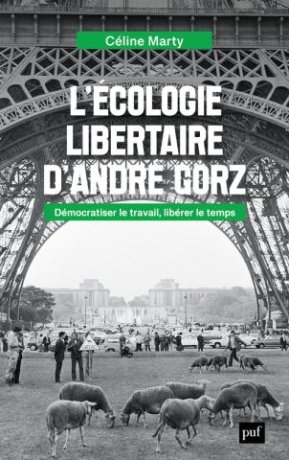
About: Céline Marty, L’écologie libertaire d’André Gorz. Démocratiser le travail, libérer le temps, Presses universitaires de France
About: Céline Marty, L’écologie libertaire d’André Gorz. Démocratiser le travail, libérer le temps, Presses universitaires de France

|
André Gorz (1923-2007), whose real name was Gérard Horst, is the author of an original body of work combining existentialism and anti-productivist Marxism, making him a pioneer of what is now called ecosocialism. Often described as “visionary,” he is included in every anthology of founders of political ecology, but his thought is often reduced to a few key ideas: a society based on free time and a life income, the self-limitation of needs, the promotion of non-alienating technologies, and ecological planning. While these ideas belong fully to the present moment, their intricacy, sources, and evolution in his life and oeuvre are rarely considered.
Gorz was also the target of recurrent criticism, which could be cutting and unfair. Criticism from the right, of course, was aimed at his degrowth anti-capitalism and his efforts to liberate life from work. But criticism also came from the left. As the author of Farewell to the Working Class, he was accused of having betrayed his commitment to class-based and revolutionary struggles associated with his early positions, succumbing to lukewarm reformism around the same time as the CFDT trade union, which was formerly deeply invested in self-management and of which Gorz had been an organic intellectual. An admirer of electronics, Gorz has been seen as succumbing to technophilia in a way that was ill-suited to his critique of technology. As an ecological theorist who was shamelessly anthropocentric and lived too soon to wrestle with climate change, he is sometimes seen as having been left behind by contemporary ecological concerns.
These criticisms, while legitimate in themselves, are too often based on caricatures. It is thus a welcome development that several books have, in recent years, sought to restore the richness and coherence of an oeuvre consisting of many books and articles, written under several different names, by an author who wore many hats: journalist for Temps modernes and Nouvel Observateur, activist, and—as he put it—a philosopher “shipwrecked” on the coasts of economics and ecology. Among these works, Céline Marty’s book, which is based on her dissertation, occupies an important place. In L’écologie libertaire d’André Gorz. Démocratiser le travail, libérer le temps (The libertarian ecology of André Gorz: democratizing work, liberating time), she offers an in-depth interpretation of his thought that is attentive to the intellectual and political context in which it was formed and its evolution (though Gorz never renounced it) over the course of the 1950s to the 2000s. Marty’s tome comes in the wake of several recent books, including Willy Gianinazzi’s wonderful biography, André Gorz, une vie (André Gorz, a life, 2016), which, while carefully retracing the development of his oeuvre, focuses more on the man, and Robert Chenavier’s André Gorz : fonder l’écologie politique (André Gorz: Creating political ecology), which presents Gorz’s philosophy in a short and clear book intended as an introduction.
Marty has in fact made two contributions, since she has simultaneously published a very useful short book called Découvrir Gorz (Discovering Gorz), consisting of excerpts with commentaries, and Écologie libertaire (Anarchist ecology), a dense and erudite book that not only draws on the previously mentioned works (as well as many others) but also on a meticulous exegesis of Gorz’s published writings and unpublished archives. She makes a case for the coherence and radicalness of Gorz’s oeuvre and its relevance to our time.
The adventures of self-management
The book’s outline provides a good overview of its argument. Marty begins by showing how Gorz deals with the problem of alienation from the two perspectives that shape his thought: existential phenomenology, as theorized by Sartre, and Marxism. Gorz attempts to connect the former to the latter by exploring some of Sartre’s concepts (the fused group, the practico-inert). The guiding thread of Gorz’s response to alienation, understood as the effect of social structures and as experienced by the subject, is a watchword: self-management (autogestion). Gorz developed the theme of self-management over time, as he encountered new problems and historical situations. Self-management is, in the first place, “productive self-management” at the workplace (chapter 2). But it gradually became “political-ecological self-management,” conceived as a social project in which needs are defined collectively for the purpose of arriving at a form of ecologically sustainable self-limitation (chapter 3). Finally, it can mean the “self-management of time,” which goes beyond the sphere of work to encompass experienced time as a whole, especially leisure: it refers to the time associated with activities whose ends and means are completely freely chosen (chapter 4). Gorz’s entire oeuvre is thus guided by an ideal of reappropriating one’s self, work, time, desires, and capacities for cooperation and creation—in short, a life in which human subjects recognize themselves fully in their activities.
The trajectory that Marty presents is thus both chronological and thematic. It closely follows the order in which Gorz’s main works were published, situating each of them in their intellectual and political context and connecting them to his professional and political engagements, which brought him into contact and dialogue with many elements of the international capitalist left. He appears as a man concerned with synthesis and debate, who willingly incorporated many disciplines into his overall philosophy, making him the antithesis of an isolated visionary. The book is particularly rich for those interested in the sources and the gradual construction of Gorz’s social theory. Marty traces its development so carefully that at times one can feel a bit lost, in part because the task requires some repetition. But one can only admire how she well she has carried out the important task of contextualization: she regularly takes the time to provide clear and precise explanations of important sources (Sartre’s conception of alienation, Panzieri’s operaismo, Illich’s critique of technology) or to situate a theoretical point in its historical and political setting (the capitalist transformation of relationships to time, the growth in ecological demands).
This review is not the place to provide a detailed summary of Marty’s in-depth analyses. Instead, we shall consider two aspects of Gorz’s œuvre that Marty is intent on explaining to challenge the criticism directed against them: first, the radical and revolutionary dimension of his thought, and second, its relevance as a form of political ecology.
Gorz the Red
Even as it was transformed through different historical experiences, Gorz’s self-management project, Marty demonstrates, lost nothing of its radicalness and maintained its revolutionary and utopian character. As we have seen, the foundations of Gorz’s thought lie in the connection between Sartrian existentialism and Marxism—a connection that Sartre himself had attempted. Given this starting point, Gorz was particularly attentive to the tendencies of human groups and action to become rigidified, ossified, and consolidated in counter-productive ways in institutions that produced the form of stasis that Sartre called the “practico-inert.” This concern resulted in Gorz’s rapprochement with self-management tendencies in the socialist movement, even as he was constantly engaged in theorizing relevant and democratic forms of workers’ organization, from grassroots self-organization to the necessary role of labor unions and political parties.
Marty devotes important pages to Gorz’s influence on Italian operaismo, a self-management tendency born in the 1960s that was opposed to the productivism of the Italian communist party and which developed a radical critique of the capitalist organization of work and technology. This tendency shaped his conviction that the current organization of productive forces, along with their technological apparatus, were created by and for capitalism’s repression of workers’ demands. Consequently, they cannot be reappropriated through self-management in their current state. This strand of his thought also includes a critique of productivism, even under workers’ control, as well as a critique of traditional unions and parties that encourage productivism to achieve better salaries. Finally, Gorz proposed a critique, which became central to his thought, of the division of labor, particularly that between manual and intellectual labor. As Marty shows, his later encounters, notably with Herbert Marcuse and Ivan Illich, were less decisive influences than occasions to enrich ideas he had already developed.
Moreover, it is also in order to critique their limits and to incorporate them into his own anticapitalist perspective that Gorz reads these authors, notably Illich’s critique of technology, which informed his analysis of alienation extended to other aspects of life (schools, transportation, medicine).
This critique of the division of labor and of a labor aristocracy that has been integrated into capitalism led Gorz to look for signs of the emergence of a new subject of self-management that went well beyond the (partially mythologized) industrial proletariat. The author of Farewell to the Working Class never broke with a revolutionary outlook. To the contrary, he understood (along with other contemporaries, such as Murray Bookchin) that the new subject of self-management would be constructed through the unification of the most radical workers’ struggles with the struggles of ecological farmers as well as student, feminist, and antiracist movements, and, later, with the unemployed and contingent labor, all of which are engaged in the fight to take back control of living conditions. They all aspire to lay the foundations of a life free of alienation, in which human beings will acquire free rein to their creative faculties without undermining their living conditions.
Of course, Marty explains, the liberation from alienation will not be total liberation from heteronomy: globalization and the complexity of production cannot simply be canceled, and maximum autonomy must be pursued by limiting economic labor, which exists just to satisfy needs imposed by necessity, in ways that would expand the domain of liberty, consisting of activities whose ends and means are completely freely chosen. Even so, though “Gorz wants to show the limits of the overly demanding self-management ideal that aspires to a complete adequation of the subject with their action and social production” (p. 256), he does not renounce the goal of making self-management socialism’s “utopian horizon.” Finally, though he became a champion of “revolutionary reforms,” it was not to support gradualist reformism, but, on the contrary, to emphasize the extent to which winning elections is insufficient and inadequate reforms end up being easily absorbed by capitalism.
Gorz the green
Though ecology is mentioned in the book’s title, it is in fact just a moment, albeit an essential one, to Gorz’s thought. Even so, Marty devoted an important chapter to ecology, which shows how Gorz’s existentialist Marxism allowed him to incorporate growing ecological concerns, particularly beginning in the 1970s. It was this anti-productivist framework, the associated critique of industrial production and the alienation of needs in consumer society, and the critique of massive technological systems as tools for centralizing (political and economic power) that allowed him to modernize Marxism through ecology. “For Gorz, Marx theorized the internal limits of capitalist development, but not the external limits that result from the economy’s hold on the ecosystem” (p. 171).
But though it offers a powerful critique of capitalism’s inherently ecocidal character, can Gorz’s ecology still provide guidance in the “age of warming,” particularly given that he theorized it before climate change was even known and, even more importantly, before it was recognized as the primary danger? Was Gorz with his critiques of advertising and “false needs,” right in believing that freedom from capitalism would naturally lead autonomous subjects to engage in self-limitation in a way that was compatible with the ecosystem’s limits, ensuring that the satisfaction of the needs of all could be guaranteed unconditionally? Finally, does Gorz’s self-described “methodological anthropocentrism” (p. 165), however useful it may be for politicizing ecology, make enough room for nature and the living beings that populate it? Marty’s book does not answer these questions, but it provides a solid basis for evaluating Gorz’s thought without caricaturing it. Marty shows, for example, in response to Aurélien Berlan’s criticism (in a fascinating book) that Gorz neglected material autonomy, how he conceived of subsistence and the desire to make oneself, connecting this desire to the production of necessary goods at the collective level, which implies an irreducible degree of heteronomy and division of labor.
Reading the book, it becomes clear that the force of Gorz’s thought lies perhaps in its nuance—not in the sense of facile moderation, but, to the contrary, that of a desire to hold together constraints of all kinds: autonomy and collective organization, the analysis of structures and the rejection of fatalism, strategic realism and a utopian outlook, and emancipation and degrowth. The force of Gorz’s thought lies in this refusal of simplistic radicalism in favor of the serious work of connecting concrete projects of reform and a comprehensive utopian vision. It deserves to be rediscovered, if only to criticize its shortcomings. While self-management is no longer a fashionable watchword, the blame should not be placed on Gorz’s irrelevance but on neoliberal repression of struggles and ways of thinking that must be urgently reactivated in every sphere of life.
Céline Marty, L’écologie libertaire d’André Gorz. Démocratiser le travail, libérer le temps (The libertarian ecology of André Gorz: democratizing work, liberating time), Presses universitaires de France, 2025, 383 p., €23, ISBN 9782130872016
by , 1 October
Share this article
Find us here :


Further reading
Bibliography:
– André Gorz, Penser l’avenir. Entretien avec François Noudelmann, La Découverte, 2019
– André Gorz, Leur écologie et la nôtre, texts edited and presented by Françoise Gollain and Willy Gianinazzi, Seuil (Anthropocène), 2020
– Céline Marty, Découvrir Gorz, 14 excerpts with commentary, Éditions sociales, 2025
– Robert Chenavier, André Gorz: fonder l’écologie politique, Michalon, 2020
– Willy Gianinazzi, André Gorz, une vie, La Découverte, 2016.
To quote this article :
Bertrand Vaillant, « Self-management, everywhere, all the time », Books and Ideas , 1 October 2026. ISSN : 2105-3030. URL : https://booksandideas.net/Self-management-everywhere-all-the-time
Nota Bene:
If you want to discuss this essay further, you can send a proposal to the editorial team (redaction at laviedesidees.fr). We will get back to you as soon as possible.
You might also like

Our partners


Sections
Keep in touch
© laviedesidees.fr - Any replication forbidden without the explicit consent of the editors. - Mentions légales - webdesign : Abel Poucet