


Black women—whether from the Caribbean, Africa, or of African descent—have conceptualized and embodied French citizenship. Their often hidden trajectories and struggles illustrate an alternative history of the nation, shaped by colonialism, when seen through the lenses of race, class, and gender.
Gerty Archimède
One is not born, but becomes Black
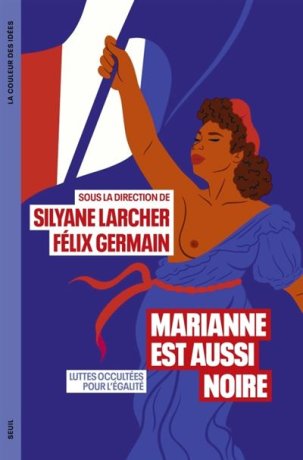
About: Silyane Larcher et Félix Germain (dir.), Marianne est aussi noire. Luttes occultées pour l’égalité, Seuil
About: Silyane Larcher et Félix Germain (dir.), Marianne est aussi noire. Luttes occultées pour l’égalité, Seuil

|
“Marianne is also Black”: with this striking title, borrowed from the introduction of the book’s American version, published in 2018, Silyane Larcher and Félix Germain situate the volume they have coedited in modern French political history. This resolutely imperial and postcolonial history unsettles “standard conceptions of national borders” (p. 20) and rejects the “restrictive umbrella of the nation-state” (p. 151). It is a history that places Black women at the center of the historical narrative and uses intersectional approaches to explain the implications of race, class, and gender for citizenship.
A new scholarly and publishing landscape
In the first place, the book makes apparent the extensive growth in social science and humanities research on women who are “racialized as Blacks” (p. 12) who must be reinscribed into the “great sisterly narrative of the emancipation of women in France and throughout the world” (p. 151). This research has been underway for years in the United States and the Anglophone world, as well as the Caribbean and, more recently, France. The political scientist Silyane Larcher and historian Félix Germain both teach in the United States but embrace their “situated position as Caribbean French women” (p. 14). In their introduction, they discuss the powerful tendency in the social societies to relegate to the sidelines the “unique experiences of Black women in French society” (p. 19). They connect this situation to the tendency to think of “all women in French women as metropolitan and white” (p. 16). They add that while this trend persists, it has somewhat abated since the book first appeared in English in 2018. Evidence of the dynamism surrounding this topic include a conference on “Black Feminisms in (Post) Imperial French Contexts,” held in Paris in 2020 and co-organized by Larcher and some of the book’s contributors, [1] several editorial decisions to reedit or translate books, [2] documentaries, [3] and masters’ theses. In terms of African studies, women’s mobilization in sub-Saharan Africa has been studied for some time, but only recently have they been connected to the history of the metropole. [4] Finally, Larcher and Germain add that the history of mainstream feminism has become more open to the imperial dimension of French history, in addition to addressing resistance (p. 19-20). [5] These different fields of scholarly production can all be found in this wide-ranging, “plural, polyphonic, and multiply-situated” book (p. 20), embracing a degree of eclecticism that makes it possible to resituate American Black feminism [6] chronologically and geographically within the “expansive space of the women’s movement” [7] in all its various dimensions.
Multiple and heterogeneous experiences
From Sarah (Saartjie) Baartman—a Black South African woman exhibited first in England, then in France in the early nineteenth century—to present-day Afrofeminists, and from Senegalese citizens hailing from the cities of Saint-Louis, Dakar, Rufisque and Gorée to Salie, the immigrant to France who is the narrator of Fatou Diome’s novel Le Ventre de l’Atlantique (The belly of the Atlantic), the volume covers a vast domain in its effort to it resist the “erasure of past emancipatory struggles” and the “silencing of contemporary antiracist movements” (p. 12). In a sense, Marianne est aussi noire brings an historical perspective to Amandine Gay’s documentary, which gave voice to Black women who were part of Europe’s colonial history. The title of the book’s original English version—Black French Women and the Struggle for Equality, 1848-2016—prioritized the protagonists. Despite their skin color, these women differ considerably from one another, hailing from places as diverse as the Caribbean, Réunion, Mayotte, Cameroun, and Senegal, and the American South. Some are African, while some descended from Africans. Some are from French overseas territories, some from Africa, other from the metropole; at times, they circulate across different spaces. They include women who, from the nineteenth century to the present, were political actors through their writing, individual and collective acts of resistance, and commitments. The book shows how they not only occupied public space, but also theorized resistance in the domestic realm, contested various forms of oppression, and questioned their membership in the French nation.
The volume, which consists of 19 essays, [8] blends life trajectories and moments of mobilization, analyses of literary texts and collectives, reflections on Frenchness, colonization, and immigration. It describes collective struggles by the Réunion Women’s Union (Myriam Paris); citizens of Senegal’s Four Communes (Hilary Jones and Jennifer Boittin); Cameroonian activists against colonial discrimination in the 1950s (Rose Ndengue); Caribbean members of the Feminine Rally and the Union of Martiniquais Women after Martinique became a department (Félix Germain); women from Mayotte known as the “Ticklers” (Chatouilleuses) in the 1970s; activists of the Black Women’s Coordinating Committee, created in Paris in 1976 (Pamela Ohene-Nyako); and Afrofeminist movements in France at the beginning of the twenty-first century (Syliane Larcher). Several contributions focus on more personal struggles: the Martiniquais Émilie Aliker, the wife and collaborator of André Aliker, who was assassinated in 1934 (Monique Milia-Marie-Luce); the Guadeloupian lawyer Gerty Archimède (Annette K. Joseph-Gabriel); [9] the former justice minister, Christiane Taubira (Stéphanie Guyon); the Black Panthers activist Jean McNair (Tyler Stovall). Finally, the book addresses literary works and plays as well as their authors, most notably the Nardal sisters, whose foundational role is frequently emphasized. [10] This kaleidoscope of topics confirms the diversity of experiences and varieties of feminism, in addition to make it possible to consider the gendered character of citizenship and of Black internationalism.
Rethinking citizenship
Women’s history and gender studies have long explained that citizenship is not limited to exercising political rights and that French women in the metropole, who were citizens without citizenship (since they lacked the right to vote and be elected to office) from the French Revolution until 1944, were nonetheless political actors. Furthermore, the history of colonial and imperial societies has, over the past two decades, emphasized the disconnect between nationality and citizenship in the French colonial empire. [11] Yet studies of the gendered dimension of citizenship in French colonial and postcolonial contexts remain rare. [12] Several contributions take the issue head-on by addressing, first, how the women studied understood their participation in public affairs and, second, the complexity of their relationship to the nation.
The Senegalese women of the Four Communes in 1945 and the Réunion Women’s Union from the 1950s to the 1970s were indeed involved in struggles for suffrage—in addition, in the latter case, to fighting electoral fraud (Myriam Paris). In Cameroon in the 1950s, activists in women’s organizations were also demanding equal political, social, and economic rights. Rose Ndengue shows that Cameroon’s first teachers and midwives demanded the right to education, safe infrastructure, sanitary housing, as well as the right to vote—bringing, in this way, their capacity to act into the political space.
Most of the contributions also address expressions of national belonging. Robin Mitchell examines the articulation of race, sexuality, and nation through a French early nineteenth-century writer’s appropriation of the life and voice of Sarah Baartman. The latter was “silenced” by Charles-Joseph Colnet, a journalist, poet, and satirical writer who, in the Journal de Paris in 1814, published two fake letters supposedly written by her. For Mitchell, assuming the role of a Black woman made it possible to criticize Napoleon while reinscribing Frenchness in a form of white and virile masculinity that had been threatened by the independence of Saint-Domingue (which would become Haiti). While the argument is a bit hasty at times, it asks us to consider the gender of citizenship.
Racial imperialism and Black internationalism
Several contributions also emphasize the ambivalence and complexity of the positions they consider, such as the Black Francophone authors studied by Tina Harpin, Jacqueline Couti, and Claire Oberon Garcia. These scholars show the importance of writing in constructing insights into the conditions of Black women (if not Black feminism) through a consideration of the key figure that is Paulette Nardal as well as the writings of Maryse Condé, Gisèle Pineau and others, by way of Suzanne Césaire, Suzanne Lacascade, and Roberte Horn. These authors, often privileged from a class standpoint, challenged imperialism, racism, and the patriarchy and reflected on intersectionality before it had been theorized, yet without necessarily advocating a break with the metropole.
Moreover, these intellectuals participated, beginning in the interwar years, in the emergence of Black internationalism. In the case of Nardal and her sisters, the transnational character of these struggles is now well known. It is also central to Tyler Stovall’s sensitive portrait of Jean McNair—“Black Panther, revolutionary, air pirate, refugee, teacher, wife, mother, [and] poet” (p. 200)—who became an American exile in Algeria and then France in the early 1970s. Another example of activism that transcends national borders can be found in Gerty Archimède, a lawyer and Guadeloupean member of the National Assembly, who defended activists of the African Democratic Rally in Côte d’Ivoire in 1950 as well as Angela Davis in 1969. Pamela Ohene-Nyako emphasizes the pan-African character of the struggles of the Black Women’s Coordinating Committee, which, between 1976 and 1982, fought colonialism, the French government’s migratory policies, and the “ethnologization” of African girls and women from an anti-assimilationist perspective that differed considerably from that of the Nardal sisters and Suzanne Césaire.
Race and universalism
Gender, class, and race thus lie at the heart of this polyphonic work. Yet some of this story’s protagonists refuse to allow their Black identity to be the basis of their activism. This is true in the case of Christiane Taubira who, while declaring that her “color impacts how people look at her,” embraces “universal values” (p. 98). Her position recalls that of the Senegalese sociologist Fatou Sow, who was invited to give the keynote lecture at the 2020 conference on “Black Feminisms in (Post) Imperial French Contexts.” She announced that she refused to be confined to a racialized identity, while describing herself as a feminist “with no if, ands, or buts” and embracing the principles of the charter adopted by the African Feminist Forum in 2006. In March 2025, during the international symposium organized in her honor in Dakar by the Foundation for Innovation in Democracy, she reaffirmed her commitment to the idea that race must be constantly questioned if one is to engage in collective struggles against all forms of oppression. Her position is not necessarily shared. The volume’s richness consists precisely in embracing this very plurality.
Silyane Larcher et Félix Germain (dir.), Marianne est aussi noire. Luttes occultées pour l’égalité (Marianne is also Black: Hidden struggles for equality), Paris, Seuil, 2024, 416 p., €26,50, ISBN 9782021500660
by , 8 September
Share this article
Find us here :


To quote this article :
Pascale Barthélémy, « One is not born, but becomes Black », Books and Ideas , 8 September 2026. ISSN : 2105-3030. URL : https://booksandideas.net/One-is-not-born-but-becomes-Black
Nota Bene:
If you want to discuss this essay further, you can send a proposal to the editorial team (redaction at laviedesidees.fr). We will get back to you as soon as possible.
You might also like



Footnotes
[1] Some of the papers were published in 2023 in a special issue edited by Jennifer Boittin and Jacqueline Couti: “Debout & Déter / Standing Up & Determined: Black Women on the Move, Black Feminisms in French (Post)Imperial Contexts,” Journal of Women’s History, vol. 35, fall 2023.
[2] See Paulette Nardal in La Vie des Idées and Divergences’ reedition of La Parole aux négresses by the Senegalese feminist sociologist Awa Thiam, with a preface by Mame Fatou Niang replacing Benoîte Groult’s.
[3] Amandine Gay, Ouvrir la voix, Bras de fer production, 2017; Marie-Christine Gambart, Les Sœurs Nardal, les oubliées de la négritude, Morgane Production/Une prod à soi/France Télévision, “La case du siècle,” 2023.
[4] Emmanuelle Bouilly and Ophélie Rillon, “Relire les décolonisations d’Afrique francophone au prisme du genre,” Le Mouvement social, 255, 2016, p. 3-16; Pascale Barthélémy, Sororité et colonialisme. Françaises et Africaines au temps de la guerre froide (1944-1962), Paris, Publications de la Sorbonne, 2022.
[5] Silyane Larcher and Félix Germain welcome the way that Bibia Pavard, Florence Rochefort, and Michelle Zancarini-Fournel have integrated colonial history into their history of feminism.
[6] Elsa Dorlin, ed., Black Feminism, anthologie du féminisme africain-américain, 1975-2000, Paris, L’Harmattan, 2008.
[7] Laure Bereni, “Penser la transversalité des mobilisations féministes: l’espace de la cause des femmes,” in Christine Bard, ed., Les féministes de la 2ème vague, Presses universitaires de Rennes, 2012, p. 27-41.
[8] The book, which was reorganized and brought up to date-includes new contributions not found in the American version by Myriam Paris, Jennifer Boittin, Pamela Ohene-Nyako, Mamaye Idriss, Tina Harpin, Johanna Montlouis-Gabriel.
[9] This portrait supplements Annette Joseph-Gabriel’s study a of Suzanne Césaire, Paulette Nardal, Andrée Blouin, Aoua Keita, Eugénie Eboué-Tell, Jane Vialle, and Eslanda Robeson om Annette Joseph-Gabriel, Imaginer la libération. Des femmes noires face à l’Empire, Éditions Rot-Bo-Krik, Sète, 2022 (originally published in English in 2020).
[10] Paulette Nardal (La Vie des Idées)
[11] Emmanuelle Saada, “Nationalité et citoyenneté en situation coloniale et postcoloniale,” Pouvoirs, 160, no. 1, 2017, p. 113-124.
[12] Pascale Barthélémy and Violaine Sebillotte Cuchet, “Sous la citoyenneté, le genre,” Clio. Femmes, Genre, Histoire, no. 43, 2016, p. 7-22.
Our partners


Sections
Keep in touch
© laviedesidees.fr - Any replication forbidden without the explicit consent of the editors. - Mentions légales - webdesign : Abel Poucet