


How does art acquire commercial value? In this book, two historians concentrate on the “first market” for art, which exists prior to the resale market and speculative strategies. It examines the decisive moment when an artwork leaves the studio, the artist sets their price, and the artwork reaches the public.
Art for money’s sake
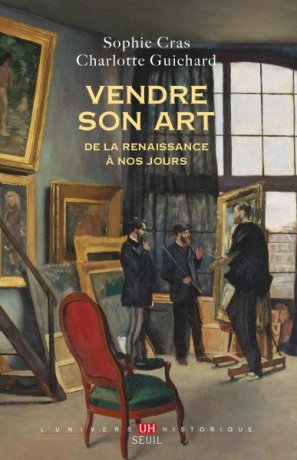
About: Sophie Cras et Charlotte Guichard, Vendre son art. De la renaissance à nos jours, Seuil
About: Sophie Cras et Charlotte Guichard, Vendre son art. De la renaissance à nos jours, Seuil

|
First market, first contact
The question of the art market or markets is often reserved for economists and sociologists, as if it were a matter of secondary concern to art history and unrelated to the essence of artistic production. Given their approach to data collection and the frameworks they use, social science researchers are typically interested in commercial transactions on the secondary market, on which works are resold by the initial purchaser, and related speculative strategies. The main issue, from this perspective, is how the value of an artist varies over time. The method used by such social scientists consists of observing auction salesrooms and studying statistical series that provide insight into artwork’s fluctuating value. Only rarely do scholars consider the initial relationship that turns a symbolic product into a commercial good: yet this is the decisive moment, when the artist’s capacity for action is greatest. In their book, Sophie Cras and Charlotte Guichard seek to grasp this process by examining archives that, in some instances, have already been examined, but with no real consideration of their implications for an artistic object’s (drawings, paintings, sculptures, or any other form) emergence as a good endowed with a value that can change over time. It is well known that this change in status does not affect all artwork equally: some works are destined to remain in the artist’s studio, while others will be given or exchanged among artists—which does not prevent them from subsequently entering the commercial cycle.
The book opens with an anecdote that has been previously analyzed. The book’s interpretive framework allows one to better understand the meaning of the inaugural transaction it describes. Manet wrote a reply to a request from Charles Ephrussi, an art collector and critic, for a painting representing a bundle of asparagus, the price of which had been set at 800 francs. After the buyer paid him a thousand francs, the painter sent him a painting of one asparagus, adding: “One was missing from your bundle.” The authors shrewdly compare this gesture to that of a greengrocer who gives a good client a few extra vegetables for free. The remainder of the book is based on one idea: an important task of art history is to grasp the chains of action that constitute what they call genuine “art making.” They adopt a process-based and interactionist approach that seeks to capture, at their source, the conditions of exchange and the often tacit knowledge practices on which exchange depends.
This recentering implies that focus on the initial market, when the artwork leaves its original biotope-that is, the studio. Every artist, even those who shy away from a purely commercial conception of art, wants to be recognized: to this end, the only possible mediation is to sell it. Drawing on anthropology and sociology, Cras and Guichard reconfigure the usual way art history sources are used and expand the scope of what they call “artistic acting” by including a range of social competencies—“commercial and plastic bricolages that appear at the time when the artwork is produced” (p. 13). They praise the pioneering work of the sociologist Raymonde Moulin, who, as early as 1967, in her monumental Le marché de la peinture en France (The painting market in France), blended an economic approach with an ethnographic examination of the art world. Their work covers a long timespan, from the Renaissance to the present, which might seem ambitious for a relatively short book. The book’s structure is not strictly chronological, as its main concern is shedding light on networks of interaction by carefully analyzing their successive forms rather than offering a history of changing market structures. In The Great Transformation (1944), Polanyi showed that village markets by no means prefigured national or international markets and that, between the former and the latter, there existed a qualitative gap. The authors prefer to speak of “commercial arrangements” (agencements marchands), a term proposed by Michel Callon. Using an approach that is close to actor-network theory (Callon, Latour, and Law), they call attention to connections and attachments and distribute agency more generously than traditional action models.
Questioning periodization
This analytical position allows one to consider, in turn, interactions occurring in very different historical circumstances, not because they are constructed in the same way, but because one can, in the immediacy of concrete relationships, many of which are person-to-person, analyze the diverse strategies and competencies that emerge through a logic of permanent negotiation. There is, according to Cras and Guichard, a “continuity of problems” that makes it impossible for their method to focus on periodization. Consequently, they reject serial approaches as well as the allure of exhaustivity. This is the price of their analysis’ richness: one must suspend art history’s general framework and its tendency to divide history into separable and relatively homogenous moments if a method based on arrangements and attachments is to bear fruit. Readers may find this choice frustrating, but these concerns are quickly dispelled by the fact that specific historic configurations reappear in the examination of particular cases. Throughout history, artists encounter recurring problems, which can be summarized as follows: how does one access points of sale and the recognition they provide? But the answers they attribute to artists differ, depending on the structural frameworks within which exchanges are configured, even if these structures are not so determinative as to result in repetitive or stereotyped structures. The book is divided into seven chapters that each test the initial claim. The book constantly focuses on the material aspects of the production and acquisition of artwork. Materials, labor, price formation mechanisms, and production cost assessments are central to the study. It offers an important lesson for sociologists, who are often the prisoners of categories that deny them access to the material lives of their object and limit themselves to examining stylistic features and using vague concepts like “symbolic revolution.” Cras and Guichard distance themselves from Bourdieu’s canonical model, which posits two types of relations to art. “Many sociologists, and most prominently Pierre Bourdieu,” they write, “have made the distinction between the ’commercial’ and the ’non-commercial’ the structuring contrast in the economy of symbolic goods. Whereas the former is characterized by the quest for ’immediate and temporary success’ through a logic of diffusion and adjustment to a preexisting demand, the latter prioritizes ’deferred and lasting success’ through production that ’ignores or defies the expectations of a constituted public.’ In practice, however, one would be hard pressed to clearly distinguish them, given the thousands of ways that artists throughout history have married their sensibilities to commercial opportunities and creative stances” (p. 156). Despite the purported modesty of the argument, which is confined to the space of “practice,” it in fact invalidates the dominant approach to the sociology of culture in France, which places interactions in a structural iron cage, ensuring that they can never be grasped in their purity. In this respect, chapter six, which is devoted to “reaching out to the public,” clearly shows that even the most radical of artists are motivated by the search for an audience.
Drawing on an analysis of the emergence of exhibitions charging entry fees in England in the eighteenth century, it presents the diversity of strategies to reach audiences that institutions keep captive. In 1855, Gustave Courbet displayed his most significant paintings, including A Burial at Ornans, in a pavilion built for the occasion in Paris in order to create, with intentions that were overtly revolutionary, a new public. The book’s analysis of the orchestration of the international career of Rosa Bonheur, whose work toured England and the United States and who received Buffalo Bill in her village of Thomery is highly instructive. Cras and Guichard observe that “she understood perfectly the importance of expanding one’s audience to less wealthy purchasers” (p. 252). For instance, she personally autographed the prints of her work that were published by businessmen. This chapter sheds light in various ways on the individual and collection action of artists dealing with the uncertainty of the market who wanted to be dependent neither on the state nor businessmen. Their capacity for self-organization can be seen in their creation of cooperative companies, alternative galleries, and feminist communities.
Setting art’s price
The book offers an original analysis of the key question in art’s price formation, which is examined through the analytical framework of arrangements and attachments. Several very different examples (Frida Kahlo, Albrecht Dürer, and Artemisia Gentileschi) address the eloquent way in which artists make their demands: correspondence between artists and patrons is a fruitful source that reveals the ability of the former to influence the price of their artwork through intense exchanges. It is important to emphasize the temporal character of these modalities, which depend on broader frameworks. In the late Middle Ages, art did not yet have a price, unlike the artist’s labor, most often in the form of a contract. For several centuries, the market for artwork and the market for artists remained interwoven. The number of days worked and the number of figures in a painting coexisted in the determination of prices. The development of the art market in its modern sense began in the middle of the eighteenth century, in Europe as well as China. Prices “were displayed more transparently and independently of buyers” (p. 52) and a normalized system of price-setting was established based on two variables: the rate (i.e., the value) and points, the number of which corresponds to a standard surface. One would like to ask Cras and Guichard if the standardization process they present does not represent a greater temporal break with older forms, since this new process no longer required the resources of premodern negotiations. This concern can be addressed by noting that production costs, both in terms of material and manpower, were crucial in medieval contracts and tended to disappear as a relevant factor in the following period. Beginning with the Renaissance, a long-term trend begins: the emergence of the idea of the artist, in contrast to that of the artisan, makes their work increasingly difficult to measure, despite the standardization of price-setting. Only in the twentieth century did artists gain control of the reproduction of their work and acquire guarantees they could earn income from it. In previous centuries, the situation was very fluid, often to the disadvantage of creators.
Attachments and affects
The art market is not like other markets. On this topic, Cras and Guichard clearly show their hand: linear representations of art history—whether they emphasize the artist’s emergence as absolute creator, the artist’s increasing autonomy, or the transition from court society to a society domination by commercial relations—are abandoned in favor of a constant: “the persistence of a grammar of attachment” throughout history. What does this mean? Renaissance patronage as well as the importance of the exclusive relationship between gallery owners and their artists were motivated by an intensity that could be characterized as friendship or, at minimum, affective, however asymmetrical the relationship between both parties. The final chapter, which is curiously titled “Speculative Imaginaries,” deals with what is usually called art’s financialization. Consistent with the overall method, the analysis focuses on artists, not markets: the imaginaries ultimately belong to the artists, even if historians draw on a precise analysis of the emergence and development of socialized investment funds in the domain of art since the 1960s. On this point, the practice of looking backwards, which has brought excellent results throughout the book, is more debatable. It is difficult to grasp what is gained from the analysis of Rococo, which follows a presentation of the recent transformations of the market, and which relates to the conversion of financial profits into valuable art. The issue, in this instance, is the imaginary of the wealthy, not of artists.
It is difficult to do justice to this book’s richness. It is easy to read, while its conceptualization is both complex and fully mastered. The book is well illustrated, with many full-page reproductions. It attaches particular importance to women artists (Frida Kahlo, Artemisia Gentileschi, Berthe Morisot, Diane Arbus, Adèle d’Affry, Angelica Kaufmann, Cecilia Beaux, Rosa Bonheur, Margaret Harrison). The book can be used in two ways. First, thanks to its theoretical and methodological positions, it is a model for disciplines that deal with symbolic forms in that it always begins with artists’ experiences and capacity for action, and it offers a process-based approach to understanding the emergence and stabilization of artwork. It exemplifies an approach emphasizing continuity, emancipating itself from chronological linearity. It challenges routine methods and the facility of epistemologies that prioritize discontinuity that are often based on arbitrary criteria. In this way, the book will be enjoyable for scholars because it will rouse them from their analytical routines, though without undue provocation. Furthermore, the quality of the writing and attractiveness of the format will also appeal to the public at large. The book is a genuine success.
Sophie Cras et Charlotte Guichard, Vendre son art. De la Renaissance à nos jours (Selling one’s art: From the Renaissance to the present), Paris, Seuil, 2025, 348 p., €29,90, ISBN 9782021472110.
by , 29 September
Share this article
Find us here :


To quote this article :
Jean-Louis Fabiani, « Art for money’s sake », Books and Ideas , 29 September 2026. ISSN : 2105-3030. URL : https://booksandideas.net/Art-for-money-s-sake
Nota Bene:
If you want to discuss this essay further, you can send a proposal to the editorial team (redaction at laviedesidees.fr). We will get back to you as soon as possible.
You might also like




Our partners


Sections
Keep in touch
© laviedesidees.fr - Any replication forbidden without the explicit consent of the editors. - Mentions légales - webdesign : Abel Poucet