

Why do we believe that our societies are freer, more prosperous or more democratic thanks to the institution of private property rather than in spite of it?
A critique of the ideology of property
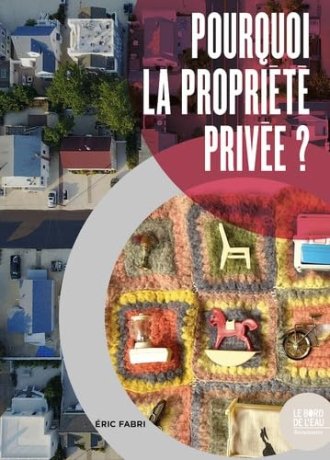
About: Eric Fabri, Pourquoi la propriété privée (The Whys and Wherefores of Private Property), Le Bord de l’Eau
About: Eric Fabri, Pourquoi la propriété privée (The Whys and Wherefores of Private Property), Le Bord de l’Eau

|
Private property is often understood as an absolute individual right, meaning that any owner of a property is entitled to use and abuse it as they please, excluding the claims of all others. However, such a conception is not self-evident. It is generally contradicted by the many legal limits that owners encounter in the enjoyment of their property. Much criticism has already been levelled at the absolutist conception of private property. [1] Éric Fabri’s book offers an original, clear and systematic summary of the arguments in favour of this conception and their refutations. Why do we believe that our societies are freer, more prosperous or more democratic thanks to the institution of private property rather than in spite of it? What justifies “this inordinate power which authorises [an owner] to put their interest above any consideration of general interest when it comes to deciding how to use their property” (p. 10)?
This work’s main focus is not private property as an institution enshrined in the right of property, but rather “the ideology of property” (p. 11), i.e. the conception of property as “an individual’s absolute control over a thing” (p. 30). This ideology appears in various ways under certain political and legal principles, in libertarian authors and in a section of public opinion. According to the author, it is based on three main arguments. Firstly, private property is a natural right, by extension of each person’s right over their own body and work. Respect for the person therefore implies respect for their property. Secondly, private property is a guarantee of economic efficiency, in that only a market economy based on property rights allows for optimal allocation of resources and produced goods. Thirdly, private property promotes and protects individual freedom from other individuals and from the State. To what extent are these three arguments valid, both in terms of internal logic and political significance?
Éric Fabri offers a reconstruction of these arguments based on the authors who have more or less explicitly defended them before subjecting them to a critical evaluation. This dual approach leads to two theories. Firstly, none of the aforementioned arguments is able to justify an absolute right of property, meaning that the ideology of property is ultimately unjustifiable. Secondly, among the justifications for a right to property that is not absolute, the most convincing is based on individual freedom. But then, it is the freedom of all individuals that is to be considered, not that of owners alone. This implies a radical reform of the existing property regime, with a view to a better distribution of property or more egalitarian access to resources. A consistent justification of the right to property paradoxically calls for its boundaries to be redefined and its power of exclusion to be limited.
Is private property a natural right?
A significant part of the book is devoted to the argument that private property derives from a natural right to the fruits of one’s labour, and to the tireless promoters of this argument: the (right-wing) libertarian authors. The libertarian position is based on an interpretation of Chapter V of the Second Treatise on Government by John Locke (1632-1704), which can be summed up as follows: each person, by nature, owns their own body and their own labour. They are, therefore, also the rightful owner of the result of their labour. This right over the fruit of one’s own labour precedes any political agreement; it is natural and absolute, albeit with a few limiting clauses, the number and scope of which are debated.
The recognition of this right has important political consequences. If my salary is a result of my work, no one can use it without my explicit consent. But that is precisely what happens when the State takes part of it, even for supposedly noble objectives, such as helping the most disadvantaged or funding hospitals. Taxation, in any form, is immediately considered a form of spoliation or institutional racket. In short, the ideology of property renders any redistributive justice illegitimate and any State intervention suspect.
According to Éric Fabri, such an interpretation, apart from the fact that it distorts Locke’s intention, [2] is fundamentally flawed. It is too quick to assume a ‘natural’ link between labour and appropriation. In a context marked by resource scarcity and competing claims to these resources, this link implies the use of political conventions to determine what is ownable, what is transferable, under what conditions, etc. The libertarian position does not withstand the ‘conventionalist challenge’ (p. 43): it is contradictory to declare ‘natural’ a right that can only exist through contingent and historically situated political conventions. [3] It is therefore wrong to assert that there is a natural, let alone absolute, right to property. Now that the libertarian argument has been invalidated, we still need to determine whether it is possible to base private property on the benefits that each individual derives from it: can the right of property be justified by the beneficial consequences that it implies for society as a whole?
Is private property necessary for a prosperous and free society?
The classic arguments in favour of the right to property stress two beneficial consequences of this institution, namely the gain in economic efficiency and the gain in freedom.
The first point leads Éric Fabri to ask this: does ownership meet the need for security felt by all economic agents? Does it encourage people to work and create wealth? Does the market guarantee an optimal allocation of resources and goods? To answer these questions, one needs to show that a system based on private property is more efficient than the alternatives. The author therefore offers a technical and detailed analysis of the concept of efficiency based on its formulations in economics. [4] Economic modelling succeeds in linking property, security and prosperity, but at the cost of significantly distorting reality, hence, for example, the dubious hypothesis of “perfect markets” (p. 197) or the “ideal-type of the rational individual” (p. 199). Above all, the efficiency argument ignores extra-economic requirements that are nonetheless legitimate, in particular political and moral requirements. Basically, the efficiency argument is not in itself enough to establish the legitimacy of property, since it leaves unresolved “the fundamental question of the purpose of efficiency” (p. 211).
Could private property be the best way to achieve freedom? First, one needs to understand what is meant by ‘freedom’. Fabri draws on three conceptions of freedom, from which three distinct but not strictly heterogeneous ‘models of property’ emerge (p. 262). ‘Negative freedom’, i.e. the absence of obstacles to the will of individuals, is realised in the model of property-owning democracy: individuals own a domain, wherein their will takes precedence. ‘Positive freedom’, if it means equal participation by individuals in making the laws to which they are subject, refers to the cooperative model, where workers help to determine their own working conditions. ‘Freedom as non-domination’, i.e. the refusal to submit to the arbitrary will of others, refers to the universal income model. whereby each person enjoys sufficient basic resources to escape domination. The author endeavours to capture the various conceptions of freedom without setting them in opposition to one another. His point lies elsewhere, namely in demonstrating that whichever concept of freedom one subscribes to, the corresponding model of property implies abandoning the ideology of property. Attention to freedom implies adhering to a ‘universalist clause’ (p. 263):
“If individuals are born and remain equal before the law, and if private property is the condition of freedom, then this can only mean one thing: that every individual has a right to private property.”
The right of private property is different from the right to private property. In the first case, the law guarantees owners the exclusive power to exclude others from access to what they own. In the second case, the law guarantees all members of society access to property. It is uncertain whether that private property is the only way, or indeed the best way, to achieve freedom, but this system involves at least guaranteeing property for all. One can debate the forms this guarantee can take—minimum capital, shareholding, a universal income, etc.—but the debate implies abandoning the idea that private property is an absolute right that can be opposed to other political demands. One can envisage different terms governing the ”individualised relationship of property to things’ (p. 266), according to requirements of freedom and even efficiency, but freed from the grip of a monolithic and absolutist concept of private property.
Ownership, efficiency and domination
Éric Fabri has chosen to devote particular attention to the Lockean argument and its libertarian interpretation, the underpinning of the ideology of property. This treatment contrasts with the relative brevity of the analysis of arguments based on efficiency or freedom. His philosophical approach to economic efficiency has the advantage of highlighting the importance of the question of ends: what is the purpose of promoting economic performance? But linking economic models and political requirements is a perilous exercise that runs the risk of judging the former against fundamentally alien criteria. Under what conditions is it relevant, for example, to criticise a model for deviating from reality, as is the case with the hypothesis of ‘perfect markets’ (p. 201)? A model never perfectly matches the reality it claims to describe. This discrepancy is not a sufficient reason to reject it. To do this, we need to show, using empirical data, that the model does not increase our knowledge of economic reality or improve our expectations. An exhaustive treatment of the efficiency argument would therefore require extensions to the epistemology of economics.
One can also regret that the various links between property and freedom are not developed in more detail, particularly in the more or less radical variants of the idea of non-domination. The proposal of a universal allowance as a “means of resisting long-term domination” (p. 256) in a market economy is convincing, but it does not solve a series of other problems mentioned by the author, including the question of whether such a configuration is the best possible way to protect against domination. Broadening the concept of domination to include, for example, structural injustices may raise the question of whether the institution of private property, at least in the field of economic relations, does not inevitably imply effects of subjugation. We might consider, for example, that the labour market produces effects of domination that are not the consequence of personal actions or intentions, but rather of a structural asymmetry between the owners of the means of production and everyone else. [5] If this were the case, a universal basic income could only imperfectly compensate for these effects, without succeeding in warding them off.
How to bury an ideology
Two contributions in particular deserve to be highlighted. Firstly, in view of the diversity of registers used by the defence of private property—natural law, efficiency, freedom—the author manages to articulate effectively different methods of analysis, including the interpretation of a classic work in the history of philosophy, the critical analysis of economic models, and recent debates in political philosophy around the notion of freedom.
Secondly, the author sets out with rigour and clarity the theoretical dead-ends of the most intuitive defences of an absolute right of property over things. He is certainly not the first to undertake this refutation, but we are delighted that it is carried out with a charitable interpretation and argumentation that does justice to the intellectual appeal and surprising popularity of libertarian positions. But is the faithful reproduction of positions enough to curb this popularity?
Fabri makes the observation, tragic in many ways, of a striking dissociation between the restrictions on private property generally accepted in law and philosophy, and the actual attachment “in the field of representations” to the ideology of property (p. 36). Indifferent or even opposed to the positions of jurists and philosophers, a large part of public opinion remains attached to the absolute right to enjoy and dispose of one’s own property. But if the aim is to “forget once and for all the chapter of the ideology of property” (p. 11), the question of the appropriate means of putting it to death remains open. Is an intellectual approach to private property capable of turning things around, or is it doomed to deepen the rift between philosophy and common sense?
Fabri, E., Pourquoi la propriété privée (The Whys and Wherefores of Private Property), Lormont, Le Bord de l’Eau, 2023, 277 pages, €22, ISBN 9782356879837
by , 4 December 2025
Share this article
Find us here :


To quote this article :
Yann Robert, « A critique of the ideology of property », Books and Ideas , 4 December 2025. ISSN : 2105-3030. URL : https://booksandideas.net/A-critique-of-the-ideology-of-property
Nota Bene:
If you want to discuss this essay further, you can send a proposal to the editorial team (redaction at laviedesidees.fr). We will get back to you as soon as possible.
You might also like


Footnotes
[1] Recent publications in the French language include La propriété de soi by Jean-Fabien Spitz. Essai sur le sens de la liberté individuelle, Paris, Vrin, 2018; by Pierre Crétois, La part commune. En finir avec la propriété privée, Paris, Éditions Amsterdam, 2020; by Catherine Colliot-Thélène, Le commun de la liberté. Du droit de propriété au devoir d’hospitalité, Paris, Puf, 2022.
[2] Éric Fabri distinguishes between a theory of appropriation, which justifies the use of natural resources in a pre-political context, and a theory of property, which justifies the existing distribution of property in politically constituted societies. Drawing on the context in which the Two Treatises was written, Fabri considers that Locke advocates a theory of the first type. One would be wrong to attribute to him a theory of the second type.
[3] See Bryan, B., The Conventionalist Challenge to Natural Rights, Social Theory and Practice, vol. 43, 2017, pp. 569-587.
[4] In particular, there are competing interpretations of the so-called ‘Pareto optimum’, named after the economist and sociologist Vilfredo Pareto (1848 - 1923).
[5] This is the position of Alex Gourevitch, in From Slavery to the Cooperative Commonwealth: Labor and Republican Liberty in the Nineteenth Century, Cambridge University Press, 2015; it is discussed in a recent article by Jean-Fabien Spitz, entitled Domination ‘structurelle’?” Le républicanisme aux prises avec les inégalités socio-économiques (Mots. Les langages du politique, 2023, pp. 23-38).
Our partners


Sections
Keep in touch
© laviedesidees.fr - Any replication forbidden without the explicit consent of the editors. - Mentions légales - webdesign : Abel Poucet