

Alongside its Paris branch, the French terrorist group Action Directe also operated a Lyon branch, responsible for dozens of attacks and robberies, and marked by a crude ideology and domestic abuse within the group. We look back at far-left violence in the post-1968 era.
Terrorists Under the Radar
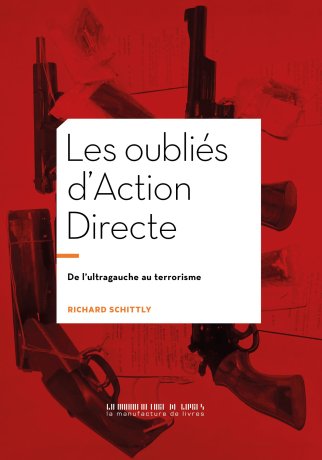
About: Richard Schittly, Les Oubliés d’Action directe. De l’ultra-gauche au terrorisme, La Manufacture des livres
About: Richard Schittly, Les Oubliés d’Action directe. De l’ultra-gauche au terrorisme, La Manufacture des livres

|
On May 1, 1979, a commando unit opened fire on the facade of the National Confederation of French Employers (CNPF), the main employers’ organization. An unknown underground group, Action Directe, later claimed responsibility for the attack. Among its four members, Jean-Marc Rouillan and André Olivier had met in 1977 at La Santé prison, where they were serving sentences for terrorist-related activities—Rouillan for his alleged involvement in violent acts, and Olivier for asking one of his former students for the plans of military installations.
After being identified by French intelligence services, Rouillan and his partner Nathalie Ménigon were arrested in September 1980 but granted amnesty a few months later. They soon resumed their activities, which included robberies and attacks, as well as murders (in 1983) and cold-blooded assassinations, including those of Inspector General René Audran (1985) and Georges Besse, the CEO of Régie Renault (1986). Their run ended with an intervention by the RAID elite tactical unit in February 1987 at a farm in the Loiret, where the four main members of Action Directe had taken refuge.
The two Action Directe groups
The powerful personality of André Olivier, a native of Lyon, and the clash between two inflated egos contributed to the breakup of Action Directe as early as May 1980—sooner than is generally believed. Rouillan accused Olivier of “authoritarianism toward the members of his group.” Both factions continued using the same name, a fact that police and prosecutors would take some time to grasp.
The first, which was linked to other European groups and described itself as anti-imperialist, was referred to as “international” or “internationalist.” Although it was made up of many activists from Southwest France (Toulouse, Perpignan, Bayonne), it could be described as “Parisian” given its base of operations. Olivier’s group, known as the “national branch,” was sometimes referred to as the “Lyon branch” due to the origin of its members and many of its operations (despite often carrying out attacks in Paris, which helped throw the police off the trail). It is worth noting the existence of a sub-group, L’Affiche Rouge, which was often confused with the Lyon group. This sub-group was composed of militants from overseas territories who, in 1982, carried out two bombings, two robberies, two aborted attacks, and a break-in at an employment agency.
Another difference lay in the more or less fantasized origins of the two groups. While the Paris branch claimed to be the continuation of groups opposed to Francoism, the Lyon branch was presented as having emerged from the Gauche Prolétarienne (GP) party; indeed, most of its members identified with it. However, with the exception of one member, none of them had actually been active in the party.
The GP was dismantled by the government in the summer of 1970, before disbanding on its own three years later. André Olivier did not become involved with the movement until 1972, causing concern among many activists who were worried that he lacked commitment. Rather than seeking instructions (and funding) from the Chinese embassy, the GP activists—distinguished by their ability to grasp social issues—embodied a unique syncretism characteristic of the post-1968 era. Historian Philippe Buton coined the term “anarcho-Maoists” for them: in his view, “the leftist leaders led their activists across the Rubicon only to take up line fishing” [1].
In fact, early in 1981, before François Mitterrand’s victory, the GP’s best-known leader, Alain Geismar, published L’Engrenage terroriste. In the book, he denounced “the macabre procession into which terrorism drags people, [which] is likely to render them deaf and blind, incapable of seizing, should the opportunity arise, a genuine chance to move forward” (p. 130).
The recruiting ground
Born in 1943, André Olivier was hired as a literature teacher at the technical school on Boulevard des Tchécoslovaques in Lyon, at the start of the 1971 school year. He quickly became known for his unconventional teaching methods, such as a study of comic books in which he argued that the popular comic-strip character of Gaston Lagaffe “undermines […] the working class” (p. 53), and for provocative behavior that led to his dismissal from the French Ministry of Education. It was around him that the Lyon branch of Action Directe was formed. He recruited his partner, Joëlle Crépet, other activists, and former students, including Max Frérot.
While some were not particularly thrilled when they understood what the group was involved in, recruitment relied on making these petit-bourgeois feel guilty and on increasing the number of services required of them: storing books, hiding a bag of supplies, then a bag of weapons, driving a car during a robbery, then keeping watch outside, and finally participating in the heist with a gun in hand. Coercion was then used to prevent followers from leaving the group, involving physical abuse—such as punches and blows with a belt—confinement, threats of mutilation and death, and starvation, culminating in unimaginable scenes: “He handcuffed me and another woman to a small table” (p. 397).
One activist later described herself as “bewitched by his words”; indeed, it is possible to describe Olivier as a guru—a fact clearly revealed in Max Frérot’s diary and personal reflections, which were discovered by police in a hideout in Saint-Étienne and published as a ten-page insert in Libération newspaper on October 24, 1986: “I, Max Frérot, terrorist and ‘coward’.” Other members of the group distanced themselves from him with clear-headedness: “André Olivier wasn’t an anarchist; he was a fanatical communist. He finally wielded power; he was the leader,” one of them wrote in a letter to his parents (p. 357). “Since I was a nurse, [Olivier] said I was a whore in the service of capital,” explains Joëlle Crépet (p. 396).
It is striking—though not surprising—to note the high number of nurses in the group and on its periphery (which was not the case in the Paris branch): the dramatic increase in hospital staff since the beginning of the Fifth Republic and the rise in the number of women with high school diplomas explain their strong presence in the generation that entered the workforce during those years. Also noteworthy is the involvement of a sociologist, who served as an assistant professor at the University of Lyon II for ten years before returning to a position as a high school philosophy teacher. He invited members of the group to his seminars, and some of his college students, and later high school students, were recruited into the group—and paid for it with lengthy prison sentences.
The use of violence
From March 1980 onward, the Lyon cell’s record was grim: 34 robberies, 32 attacks (2 in Lyon, 30 in Paris), including one that left a passerby blind. On 18 occasions, they resorted to violence. Unlike the Paris branch and other European terrorists, murder was not a conscious choice for the Lyon group. Their first homicide was a cash-in-transit security guard in October 1980, during a bank robbery in the suburbs of Lyon. Then, between 1981 and 1986, they unintentionally killed three people.
After Olivier and most of the other members were arrested in March 1986, Frérot continued alone, planting a bomb at the Brigade de Répression du Banditisme (anti-gang unit) in Paris, killing a police officer before being arrested almost by chance. Very quickly, they came to see violence not as a necessity, but rather as a source of pleasure; one of the book’s chapters is even titled “Adrenaline.” When it came to bank employees, one of their recommendations was that “makeup is important if you have to take out an employee” (p. 316). Violence within the group overlapped with domestic abuse: “He beat me with an electric cord while I was shirtless; it was horrible” (p. 397), Joëlle Crépet testified at her trial, and a medical report indicated cigarette burn marks “near the pubic area” (p. 238).
This penchant for brutality was accompanied by an unsophisticated ideology and a lack of critical thinking. Psychiatrist Michel Dubec, who was appointed to evaluate Jean-Marc Rouillan, confided: “At first, I couldn’t understand how he could actually believe the empty phrases he was uttering. I told myself it was a defense mechanism.” [2] This ideological confusion was evident in Olivier’s remarks, particularly when, during his trial—while being defended by Jacques Vergès, the lawyer who had represented Klaus Barbie in the same courtroom a few years earlier—he lambasted “bourgeois justice, which is under the thumb of the Jewish lobby” (p. 385). Beyond this anti-Semitism, which was condemned by most of the activists, it would be contrived to try to find ideological differences between the two branches.
The question of sources
Richard Schittly was a reporter for the crime and justice section of the Lyon daily Le Progrès, before becoming the Lyon correspondent for Le Monde, just as Jean-Marc Théolleyre—one of the leading figures in French legal journalism—had been in his day. This rigorous work benefits from a detailed knowledge of the metropolitan area. The book, which begins with Olivier’s arrest, reads like a (crime) novel.
The question of his sources naturally arises, especially since the numerous citations are not referenced. The acknowledgments list the names of certain witnesses who “granted their trust and their time” to the author. The book also mentions the archives of the Judicial Police. A few references to reports from the French Intelligence services would suggest that partial copies were provided to the judge or the Judicial Police, since no key details appear in them. Perhaps this explains why Olivier’s involvement in the Secours rouge and the GIP (prison information group), and then the CAP (prisoners’ action committee), is discussed only very briefly in the book.
This is especially regrettable given that his association with criminals—with whom André Olivier had some run-ins—may have contributed to his turn to armed robberies. Likewise, it appears that the Lyon leaders of the GP were not interviewed. Although one of them—a leading figure in sociology who introduced the Chicago School to France—has been dead for two decades, a close associate of Benny Lévy, the organization’s true leader, might have had a lot to say, Indeed, while writing a book about the postal unionist Georges Valero, who was part of that movement, historian Denise Zederman and philosopher Jeannette Colombel documented the charges that were brought against Olivier at the time.
The Lyon branch has received less media attention; there were no arrests with accompanying photographs or television reports, and (with the exception of Frérot, once his accomplices were behind bars) no ”Wanted” posters. As a result, the group is less well known and often portrayed in a superficial or misleading manner. Since all the key figures in the book—activists, journalists, police officers, and judges—are either dead or retired, the book will help ensure that the “forgotten members of Action Directe” are a little less forgotten. Above all, by delving into this period and sketching a portrait of the main figures and their movements, he shows that the late 1960s also produced some rather pitiful monsters, with negligible political consequences—a far cry from the tragic events that occurred in Germany and Italy.
Richard Schittly, Les Oubliés d’Action directe. De l’ultra-gauche au terrorisme, Paris, La Manufacture des livres, 2025, 439 p., €22,90, ISBN 9782385531539.
by , 7 May
Share this article
Find us here :


To quote this article :
Christian Chevandier, « Terrorists Under the Radar », Books and Ideas , 7 May 2026. ISSN : 2105-3030. URL : https://booksandideas.net/Terrorists-Under-the-Radar
Nota Bene:
If you want to discuss this essay further, you can send a proposal to the editorial team (redaction at laviedesidees.fr). We will get back to you as soon as possible.
You might also like


Our partners


Sections
Keep in touch
© laviedesidees.fr - Any replication forbidden without the explicit consent of the editors. - Mentions légales - webdesign : Abel Poucet