


During the Middle Ages, women didn’t just listen to music. They sang, composed, copied, and transmitted it. Behind the silence of the sources, there exits, from cloisters to courts, a form of musical life that remains largely unknown. A new book brings to life these flourishing musical practices.
The many roles of women in medieval music
About: Anne Ibos-Augé, Les femmes et la musique au Moyen Âge, éditions du Cerf
About: Anne Ibos-Augé, Les femmes et la musique au Moyen Âge, éditions du Cerf

|
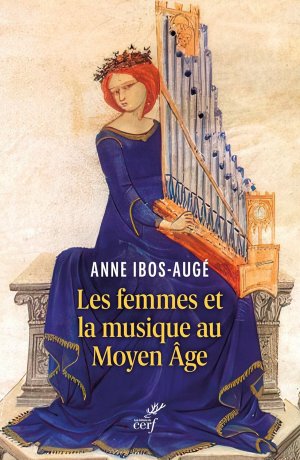
The female organ player on this book’s cover comes from an allegorical representation of Music that includes David and various other male and female musicians organized around her. The image, which was composed in the fourteenth century for the introduction of an ancient treatise, accurately captures the dual role of women in the music of the medieval West: the female musician rules harmoniously, yet she is also humble, nestled in the shadows of her male counterparts and veiled to the point of anonymity. The wager of Anne Ibos-Augé, a musicologist and an authority on medieval repertories and their sources, is to shed light on women as composers, singers, jugglers, or melomaniacs both in social reality and artistic representations in an historical study of unprecedented scope.
This book takes its place in the abundant Francophone literature devoted to the presence of women (composers, musicians, and musicologists) in music history, from feminist critiques of musicology inspired by gender studies [1] to popular books that seek to recover female musicians from neglect. [2] In this vast field of study and among this flourishing research, the medieval period was underrepresented. The reasons are no doubt many, but the most obvious has to do with sources: women rarely appear in medieval documents, which mirror society at large. The writing and production of musical books and, more generally, the formation of medieval knowledge are either heavily characterized by masculine patronyms or have remained anonymous. So should one give up on writing the history of women in a seemingly masculine musical world? Obviously not. It is well known that the place of women in medieval society is central to the anthropological method adopted by the new historiography that seeks to examine the invisible and voiceless to bring to light mentalities and deep social structures in all their complexity, in ways that complement biographical studies of prominent women.
A varied sociology
The Middle Ages, as everyone knows, is a long and multifaceted period in which circumstances frequently vary by social category. To guide the reader through this complexity, Ibos-Augé organizes the first two sections of her book according to the classic form of a portrait gallery: first religious figures, including nuns, beguines, mystics, and copyists; then profane figures, such as trobairitz and trouveresses (i.e., female trouvères), minstrels, and patrons. Rather than essentializing these types, each section focuses on an “exemplary” biography, which personalizes and personifies the argument. Ibos-Augé then fleshes out the context, while also reviewing a wide array of sources and testimonials in which, however fleetingly, traces of female activity can be seen. While this abundance of characters can be disorienting for the reader due to their rapid succession and temporal leaps with which they are presented, it proves an effective way to convey the wealth of the sources the author has consulted and synthesized, many of which are poorly known, even to specialists.
The study tries, as much as possible, to explain medieval society at every level. It is not, of course, surprising to find the number of sources increase as one examines women of higher birth. The trobairitz whose vidas have come down to us belonged to the nobility but represent only a tiny fraction of women involved in musical life. Female jugglers and minstrels of more modest backgrounds were a significant component of guild membership. The minstrels are known to us at best by their name or first name, or sometimes simply by an attribute of their role or instrument: one Parisa, who worked with her husband for the court of Savoy; Elena Pilke in fourteenth-century England; or Marion the “harpist” in the household of Valentine Visconti. Many others appear in the Statues of the Paris Minstrels’ Guild.
Moreover, if the figures referred to seem to cover unequally the various cultural centers of the medieval West (the German, Flemish, and British lands in particular, as well as the courts of Burgundy and Savoy in the late Middle Ages, which are better documented), this has to do with the availability of sources and existing research. As Ibos-Augé notes at the end of her book, there is still much research to be done by scouring archives, account books, registers, and cartularies. It is, in any case, clear that wherever one seeks their trace, women are to be found.
A stereotyped imaginary that plays its own codes
In addition to presenting a social history of women in medieval musical life, the book rounds out its approach by considering the cultural dimension of the question, as it examines, in part three, the fictions and representations that associate music with femininity. At the height of the Middle Ages, in the twelfth and thirteenth centuries, two models of femininity prevailed: on the one hand, the courtly lady, the heiress of the values of chivalry and, on the other, that of the Virgin Mary. While they belonged to seemingly different literary spheres, the male imaginaries that produced them nonetheless shared many commonalities and collusion zones. At play in the representation of these female ideals is a mystique of the feeling of love which has a profane form—fin amor—and a spiritual and devotional for—the Marian cult. This convergence is particularly evident in northern musical production, when the lyricism of the langue d’oïl meets Latin and liturgical culture in polytextual motets.
Among the superimposed voices, one voice might emphasize devotion to the Virgin while others suggest profane and more or less carnal love, even though its foundations are a melodic fragment drawn from the liturgic repertory (this voice is known as the teneur or tenor). This polyphonic architecture that is both learned and playful is powerful testimony to the capacities of poetic and musical invention of those (which may include women, though there are no traces of them) who practiced them and of their fascination with female subjects. Yet these stereotypical figures have their counterparts and contraries: for instance, the stock character of Marion is often found in pastoral poems. This shepherdess who challenges courtly ethics and the cult of our lady represents confident and simple femininity, which mocks knights by refusing their advances, mischievously undermining aristocratic values.
The history of music from a feminine perspective
Because her book is aimed at non-specialists, Ibos-Augé could not leave out an overview of medieval music history (and thus its male elements). Readers will appreciate the fact that she has enriched the book with a glossary, chronologies, liturgical tables, lists, and an index, which are very useful.
The history of music presented in her book is not a succession of female composers’ biographies. Such an approach would have considerably narrowed the book’s scope, given the small number of appropriate female figures: a few major female names (Hildegard von Binger, obviously), a few trobairitz or trouveresses (it is worth noting how rare the latter term is in the secondary literature, unlike its Occitan equivalent), and that is all. This is not just a gender problem, as the number of male composers is hardly greater. Indeed, the concept of the composer (whether male or female) as musical creator corresponds so little to the reality of medieval musical practice prior to the fourteenth century (at minimum) that writing this kind of history of music must be condemned to failure.
The strength of the book lies in the way it resituates activities pertaining to music in an array of related cultural practices: music is invented, undergoes transformation, adopts texts, and is copied, illustrated, and collected. Musical books are ordered, bought, and preserved in convent libraries or in the intimacy of seigneurial residences. The same is true of performance, for the aspirations of cantrices are great, and the social realities that lurk behind the name of and references to minstrels are varied. Thus female presence appears at multiple moments of the artistic and economic cycle that makes up musical life, pushing back against the idea of an entirely masculine history of music, at the same time that it considerably finetunes, beyond the issue of gender, our perception of musical reality, which proves fragmented and multifaceted, a far cry from modern representations.
Can music have feminine traits?
A recurring question in scholarship on women and music concerns the specificity of female repertories. Did women develop an identifiable style? Can one detect in music by women and for women the circumstances in which this music was created and used? To these questions, Ibos-Augé offers only clues and hypotheses. This prudence is perfectly understandable, given how sparse and parsimonious this music was. In the profane realm, the voices of trobairitz and trouveresses are rare, and the few texts that can be included in this corpus provides no more than weak insight into an authentically female perspective. At best one can see the emergence of a perspective that might be described as feminist avant la lettre (see p. 106 on the unique canso of Azalaïs de Porcairagues, the first trobairitz in history and a student of Raimbaut d’Orange).

Azalaïs
For nuns, the vast majority of liturgical rules applying to convents differed little or not at all from those applying to monks, whose repertory they shared. Examples of repertories that are unique to a community of women are rare (on this topic, it is surprising that more is not said of the role of Héloïse, Abélard’s famous partner and the abbess of the Abbey of the Paraclete). The divergences mentioned by the book concern minor adaptations made in some circumstances or pertain to proportions unique to certain places (for instance, the Cistercian monastery at Las Huelgas in Burgos, for example). Most additions to repertories in manuscripts intended for women are, moreover, anonymous.
Beyond what one might call the ordinary liturgy, some nuns engage in devotional exercises resulting in ecstatic visions—raptus animae and the encounter with the divine. Whether it be beguines living at the heart of the worldly city or nuns cloistered away from the world, these women, who were often literate (in Latin or vernacular languages) underwent intense spiritual experiences, which ecclesiastical authority viewed with suspicion. The music perceived or received during these ecstatic moments partook in an auditory apprehension of the divine, which visionaries attempted to describe and inscribe in the language of poetry, as with Hadewijch d’Anvers (who may have been a beguine), or music, in the case of Hildegard von Bingen. Though men could also have these mystical experiences, it seems that women were particularly distinguished in such pursuits, producing extraordinary works that no other social condition could have made acceptable.
This luxurious panorama thus offers an initial assessment of the place of women in the history of medieval music while opening new horizons. It recalls several essential and already well-known figures, such as Herrad of Landsberg and Hildegard Von Bingen for composition, as well as Eleanor of Aquitaine of Marie de Champagne for patronage. Alongside these jewels we find many nuggets—women who have hitherto been rarely mentioned in general books and rarely associated with music history. These include the copyist Elisabeth de Lünen from the Paradies bei Soest convent in Westphalia, to whom we owe two quite personal graduals. The book’s great erudition will find an audience among readers who are passionate about social history, as well as those drawn to literature (the number of novels dealing with music that are mentioned is impressive), and musicians who have much to learn from the context of the repertories and from new sources to explore or reinvent.
Anne Ibos-Augé, Les femmes et la musique au Moyen Âge (Women and music in the Middle Ages), éditions du Cerf, Paris, 2025, 285 p., 22€.
by , 8 October
Share this article
Find us here :


To quote this article :
Anne-Zoé Rillon-Marne, « The many roles of women in medieval music », Books and Ideas , 8 October 2026. ISSN : 2105-3030. URL : https://booksandideas.net/The-many-roles-of-women-in-medieval-music
Nota Bene:
If you want to discuss this essay further, you can send a proposal to the editorial team (redaction at laviedesidees.fr). We will get back to you as soon as possible.
You might also like


Footnotes
[1] Deutsch Catherine and Ragnard Isabelle, eds., Femmes en musicologies francophones de Michel Brenet, Lyon, Symétrie, 2024; Giron-Panel Caroline and Deutsch Catherine, eds., Pratiques musicales féminines : discours, normes, représentations, Lyon, Symétrie, 2016; Launay Florence, Les compositrices en France au XIX° siècle, Paris, Fayard, 2006; Traversier Mélanie and Ramaut Alban, eds., La musique a-t-elle un genre?, Paris, Éditions de la Sorbonne, 2019; Ravet Hyacinthe, Musiciennes: Enquête sur les femmes et la musique, Paris, Autrement, 2011.
[2] Kosmicki Guillaume, Compositrices: L’histoire oubliée de la musique, Marseille, Le mot et le reste, 2023; Laleu Aliette de, Mozart était une femme: Histoire de la musique classique au féminin, Paris, Stock, 2022, 288p.
Our partners


Sections
Keep in touch
© laviedesidees.fr - Any replication forbidden without the explicit consent of the editors. - Mentions légales - webdesign : Abel Poucet