


By shedding light on alternative ways of life that have hitherto been kept in the shadows, Constance Rimlinger shows that ecofeminist utopias are a reality that seeks emancipation from capitalism and patriarchy.
Millet, Glaneuses
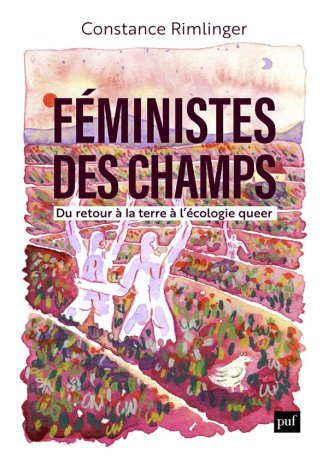
The ecofeminism of ordinary people
About: Constance Rimlinger, Féministes des champs. Du retour à la terre à l’écologie queer, Presses universitaires de France
About: Constance Rimlinger, Féministes des champs. Du retour à la terre à l’écologie queer, Presses universitaires de France

|
“What does feminism have to do with rurality or rurality with feminism?” (p. 26). In the bubbling context of a revival of feminist and ecologist issues, notably in the form of a revival of ecofeminism in France and a renewed interest in associated spiritualities [1], Constance Rimlinger conducts a survey with particularly valuable results for anyone interested in the ways in which ecofeminist convictions can be anchored in reality. Between 2015 and 2021, the sociologist conducted original research based on a comparison of practical experiments involving a return to the land by women and non-heterosexual people in New Zealand, the United States and France. Bringing to light ‘different ways of articulating an emancipatory feminist project and a project of reconnection with nature and subsistence activities’ (p. 12), Constance Rimlinger’s book allows us to appreciate the richness and diversity of the ‘neo-rural ecofeminist nebula’ (p. 22) without obscuring the difficulties involved in such an ambition.
Making margins visible
The freshness of Constance Rimlinger’s book stems first and foremost from the author’s desire to “think society from the margins” (p. 16). By choosing to focus on the experiences of non-heterosexual women and feminists to study the phenomenon of returning to the land, the sociologist is clearing up an initial blind spot in the research on the subject. She also offers her own definition of the return to the land, which, in her view, refers to “any project that is part of an individual or collective desire to reclaim the countryside in order to enhance a living environment and (re)connect with the land, both sensitively and/or spiritually and materially, in a quest for sustenance, particularly in terms of food” (p. 14). Rather than limiting herself to analysing the socio-economic conditions of ‘neo-ruralites’ prior to their rural exodus and the success or failure of these trajectories, Constance Rimlinger focuses on issues of gender identity and sexual orientation.
Her work reveals the practical experiences of a “minority within the minority” (p. 257) in that it focuses not on heterosexual women but on those whose return to the land is concomitant with a questioning of gender and sexuality norms.
In the context of a campaign taking the form of ‘polymorphous spaces’ (p. 13), her aim is to analyse different political projects and the variations in their conceptions of gender, sexuality, chosen non-mixity, nature, society and work (p. 16). Through this localised and comparative approach, Constance Rimlinger sheds light on a variety of alternatives to patriarchal capitalism, [2] the vitality of which is not limited to the 1970s or even to the Anglo-Saxon world.
Undeclared ecofeminism
Another thing that makes the author’s work original is her attempt to (re)define ecofeminism. Constance Rimlinger chose to describe the return-to-the-land initiatives she investigates as ecofeminist, even when the individuals and communities concerned do not expressly use this label.
Since ecofeminism was understated in France until 2015, and proves sometimes difficult to identify, the sociologist highlights the need to go beyond the question of the self-definition of individuals and groups. Inspired by Geneviève Pruvost’s ‘vernacular ecofeminism’ and Joan Martínez Alier’s ‘ecologism of the poor’, she justifies this decision by a desire to bring out of the shadows “a whole range of past and present experiences” by analysing the “complex space of intersections between ecology and feminism by grouping its various players under a common term” (p. 21). In this respect, Constance Rimlinger’s book highlights a ‘popular ecofeminism’ (p. 34) driven by ‘ordinary’ people (p. 20), in particular rural women and women farmers. [3]
To take an interest in these initiatives, which combine feminism and ecology, and to include them in the ecofeminist nebula is to challenge a number of preconceptions that populate the common imagination, according to which ecofeminism has not taken hold in France and a post-capitalist future would be impossible. The sociologist’s investigation shows that by taking a step to the side, by detaching ourselves from the analysis of ecofeminism as a social movement, “we can paint a more nuanced picture of its initial reception” (p. 47).
Proposing a typology of contemporary ecofeminism
Based on the data gathered over the course of her work in seven main research fields, a detailed presentation of which is given in the appendix to her book, the author identifies three ideal types on the rural ecofeminist continuum: the ‘separatist differentialist’ ecofeminist configuration, the ‘intersectional queer’ ecofeminist configuration and the ‘integrationist holistic’ ecofeminist configuration. While it is not our intention here to detail each of these configurations, which are the subject of exhaustive chapters in Féministes des champs (Feminists of the fields), it is important to return briefly to this typology, which is undoubtedly the main contribution of Constance Rimlinger’s research.
It is now widely accepted that there is not just one ecofeminism, but many. However, in French research literature, it is still difficult to find in-depth analyses of the tensions within this nebula. The sociologist devotes part of her work to the thorny and often overlooked issues of the Whiteness of ecofeminist utopias and the exclusion of transgender and non-binary people. As ecofeminist communities are not exempt from reproducing discrimination and domination patterns specific to a patriarchal and colonial capitalist society, the issues of racism and transphobia, among others, arise within them. Constance Rimlinger also notes divergences on the subject of the animal cause (should veganism be promoted, or even imposed?) and the relationship with spirituality (is the latter necessarily essentialist and guilty of cultural appropriation?), which testify to an ecofeminist continuum that bears internal tensions.
Lifestyles and spirituality as political praxis
In the (eco)feminist tradition of challenging the public-private dichotomy and encouraging political novices to gain the confidence and legitimacy they need to take action, Féministes des champs is an exciting example of redefining politics. The book confirms that “the private is political” and that theoretical and militant training is not essential for taking action. The author therefore stresses the need to look beyond traditional means of political action. To understand ecofeminism, which is attached to its anarchist roots, we cannot simply study the classic commitment of activists, but must also examine their everyday actions (p. 45). Constance Rimlinger highlights the plurality and diversity of political action. The ecofeminist, non-heterosexual return to the land – which is not always queer in that it also involves radical lesbian feminists opposed to the concept – thus reflects a quest for meaning on the fringes of patriarchal capitalism. For Constance Rimlinger’s interviewees, this quest means building an alternative, radical daily life that calls into question their relationship to work, food, housing and family. For some, it means learning about permaculture; for others, adopting a vegetarian diet or practising rituals inspired by various feminist spiritualities. The sociologist’s book provides a number of clarifications on this last point, and the comparative perspective is all the more interesting as it reveals the differences between the American Goddess movement and the French sacred feminine. Following on from Geneviève Pruvost’s work [4], Constance Rimlinger’s survey reaffirms the extent to which everyday life is political, and that the countryside is the scene of many practical and topical experiments. [5] Contrary to popular belief, rurality is not inherently hostile to feminist and LGBT+ populations, but becomes “a new space from which to think and experience emancipation” (p. 46).
While Féministes des champs primarily offers a counter-discourse to the idea that France is hermetically sealed off from ecofeminist cultures, the book also allows us to think about the future of ecofeminism. The book is brimming with ideas and one feels almost frustrated not to be able to further the discussion with the author. What about the compatibility of ecofeminism with the concept of intersectionality, which, according to the survey results, is not always a given? Constance Rimlinger looks at the evolution of a “less White” ecofeminism (p. 40) and an “explicitly (eco)queer” return to the land (p. 263).
It is perhaps regrettable that her view on the logic of exclusion reproduced by certain women authors and communities is not more clear-cut, although we understand the sociologist’s empathy for her interviewees and the tone chosen for this book. The adoption or rejection of an intersectional approach, involving the recognition of specific types of oppression and of a queer perspective, considering the fluidity of identities, calls into question the very definition of ecofeminism. This definition fluctuates if we consider that the political subject of the movement is only cisgender women – as is the case for some of the interviewees – or that transgender and non-binary people are also concerned. Féministes des champs has already established itself as a reference, particularly for young researchers [6] looking for an internal critique of the subject [7], and its accessible writing will appeal just as much to the general public.
Constance Rimlinger, Féministes des champs. Du retour à la terre à l’écologie queer (Feminists in the Fields. From the Return to the Land to Queer Ecology), Paris, Puf, 2024, 240 pages, €23, ISBN 9782130854258
by , 2 December 2025
Share this article
Find us here :


To quote this article :
Maureen Bal, « The ecofeminism of ordinary people », Books and Ideas , 2 December 2025. ISSN : 2105-3030. URL : https://booksandideas.net/The-ecofeminism-of-ordinary-people
Nota Bene:
If you want to discuss this essay further, you can send a proposal to the editorial team (redaction at laviedesidees.fr). We will get back to you as soon as possible.
You might also like


Footnotes
[1] A case in point is the forthcoming publication of the book Spiritualités radicales. Rites et traditions pour réparer le monde by Yuna Visentin, published by Divergences in August 2024.
[2] The expression ‘patriarchal capitalism’ is generally associated with the work of Silvia Federici, but it is common to (eco)feminisms, which consider the association of capitalism and patriarchy as the matrix of the domination of women and the exploitation of nature.
[3] In 2024, David Happe’s book Gardiennes de la nature (ed. Le Pommier) was published on this subject, featuring portraits of seven women who worked the land, including foresters, farmers and market gardeners.
[4] See the review of her book Quotidien politique. Féminisme, écologie, subsistance, published in 2021 by La Découverte.
[5] On this point, see Geneviève Pruvost’s interview on her latest book, La Subsistance au quotidien. Conter ce qui compte, published in 2024 by La Découverte for Médiapart.
[6] I am thinking in particular of Cassandre Di Lauro’s current dissertations Transmettre une terre lesbienne: création et préservation d’une communauté lesbienne dans l’Oregon du Sud au XXIe siècle, Angèle Ducatillion’s L’écologie au prisme des minorités sexuelles et de genre, entre ville et campagne française and Bénédicte Gattère’s Défaire le genre pour refaire nature: alliances queer et écoféministes des années 1980 à nos jours.
[7] To learn more about this topic, I would refer you to the book Des paillettes sur le compost. Écoféminismes au quotidien by Myriam Bahaffou, published in 2022 by Le Passager Clandestin.
Our partners


Sections
Keep in touch
© laviedesidees.fr - Any replication forbidden without the explicit consent of the editors. - Mentions légales - webdesign : Abel Poucet