


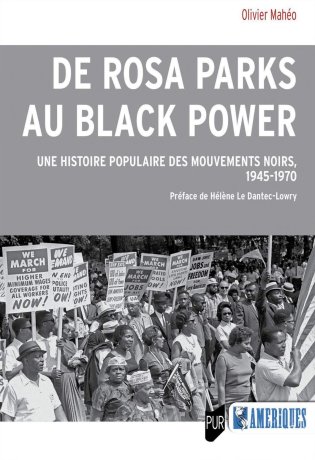
The American civil rights movement was more complex than is generally realized. Olivier Mahéo reconstructs its story by considering the marginalized voices and internal conflicts that are often overlooked.
The Many Voices of Civil Rights
Olivier Mahéo, De Rosa Parks au Black Power : Une histoire Populaire des mouvements noirs, 1945-1970, Presses Universitaires de Rennes
Olivier Mahéo, De Rosa Parks au Black Power : Une histoire Populaire des mouvements noirs, 1945-1970, Presses Universitaires de Rennes

|
In a 2005 article that has since become a classic, the historian Jacquelyn Dowd Hall wrote that “the dominant narrative of the civil rights movement—distilled from history and memory, twisted by ideology and political contestation, and embedded in heritage tours, museums, public rituals, textbooks, and various artifacts of mass culture—distorts and suppresses as much as it reveals.” [1] In this vein, Olivier Mahéo, the author of De Rosa Parks au Black Power : Une histoire populaire des mouvements noirs, 1945-1970 considers “Black movements” in their totality rather than focusing on the “civil rights movement,” which, in the United States, is generally confined to the period between 1954 and 1965. He presents this movement as being more complex and as taking place over a longer time period (to the extent that it ever ended, as he implies in his conclusion) than is generally realized. With this book based on his dissertation, Mahéo has written a history “from below” that is “popular” in that it seeks to “study defeated or marginalized narratives [and] disruptive voices that, through the focus on ’heroes,’ were either erased from or deformed by the dominant narrative” (p. 24).
A selective historiography
As Mahéo’s introduction demonstrates, the historiography of the civil rights movement tends to concentrate on a few famous (male) figures based in the South, over a period extending from the 1954 Brown v. Board of Education decision to the adoption of the 1965 Voting Rights Act. The Brown decision, which declared school segregation unconstitutional, was, however, the result of a long struggle led by the NAACP (National Association for the Advancement of Colored People). Similarly, the Montgomery bus boycott that took place in Alabama the following year was not the first action of its kind in a southern city. Mahéo also warns against presenting 1965 (which ended legal discrimination) as the moment when racial equality was achieved. These traditional markers oversimplify a struggle that was not confined to racial demands. For instance, Martin Luther King Jr.’s opposition to the Vietnam War and the economic focus of his Poor People’s Campaign in 1968 have long been forgotten. Furthermore, the transformation of the movement after 1965, in conjunction with the rise of Black Power ideology, is often construed as the nefarious alter ego of the civil rights movement—a claim premised on a binary and sterile opposition between non-violent integrationists (such as Martin Luther King) and separatist nationalists advocating self-defense (as the Black Panthers, among others, have been portrayed).
The standard historiography has excluded from the traditional narrative Black feminists and activists whose economic demands placed them on the movement’s left. In the name of the “respectability politics” [2] that sought to make the movement more acceptable to contemporary American society, these actors were rendered invisible within the civil rights movement. Modern-day historians now consider women’s rights advocates (such as Fannie Lou Hamer or Ella Baker) and the union left to be part of the movement. They also look at the northern states, where the movement’s goals and challenges were different because segregation, while very real, was no longer written into law. [3] The idea of a “long civil rights movement” (a term coined by Jacquelyn Dowd Hall) is now widely accepted.
The book makes several contributions to historical research. First, consistent with recent historiographical trends, it helps reestablish the role of women and socialist and communist activists in African American movements by bringing these perspectives together in a single book. This allows Mahéo to analyze the tensions and divisions relating to class, gender, and geography in the movement over the long term. To do so, he studies photographs, autobiographies, and biographies of activists that are rarely used, giving voice to actors whom the standard historiography, in promoting hagiographic narratives that are now well-known, has overlooked.
The Marxist roots of the struggle for racial equality
The book begins in the 1930s (chapter 1) and ends in the second half of the 1960s (chapter 8). In this way, it situates the civil rights movement in a continuum, allowing Mahéo to recall the role of Black leftists in the struggle. He considers the socialist and communist currents that defined the Black Left prior to the Second World War, as well as the student organizations inspired by the New Left and Black Power ideology in the 1960s. The book’s first part is devoted to the impact of the American Communist Party (CPUSA) on the Black community from the 1930s to the beginning of the Cold War, when Communists gradually acquired a significant influence in this milieu.
This part of the book retraces the trajectory of communist activists such as Hosea Hudon, whose narrative provides important evidence about the functioning of the Communist Party in Alabama, which was “majority Black and working-class” (p. 60). The interest of Hudson’s biography, which he co-wrote with the historian Nell Irvin Painter, lies in what it tells us about the disagreements among contemporary Black communist activists. Hudson, who remained faithful to the party his entire life, broke with Harry Haywood, whose autobiography is examined in the same chapter. Haywood was excluded from the party due to his criticism of its inability to solve the “Black question” (p. 74).
A deeper examination of the Black left shows that Martin Luther King’s actions were directly inspired by workers’ struggles in earlier decades. For instance, before the famous 1963 March on Washington, where King made his famous “I Have a Dream” speech, A. Phillip Randolph, the Black leader of the Brotherhood of Sleeping Car Porters (BSCP) union, had already planned a march in 1941 demanding the desegregation of the war effort, while calling specifically for “non-violent civil disobedience” (p. 57). This “civil rights unionism” (p. 61) is considered a precursor to the fight for equality in the 1950s and 60s. Instances of direct action from the first half of the twentieth century also inspired the sit-ins, boycotts, and demonstrations of the 1960s. [4] Mahéo also reminds us that theories of self-defense and separatism did not appear for the first time in Malcolm X’s speeches from the early 1960s. Many African Americans from the early twentieth century recognized the need to be armed, and the Communist project for creating a Black republic in the American south (the “Black Belt”) dates from the 1930s.
The missing female activists
The book’s second part is devoted to women’s participation in Black movements. Women were forced to accept male and often sexist leadership and a gendered hierarchy in various activist organizations (notably the Southern Christian Leadership Conference and the NAACP). Role model expectations also required them to adhere to the traditional patriarchal model in their private lives: “Respect for the norms of the patriarchal family, based on a strong head of family and religious devotion, was seen as a protection against discrimination” (p. 103).
The historical literature has long kept these women invisible, due to a lack of official sources demonstrating their role and a longstanding practice among historians of undervaluing sources produced by women, such as oral histories and autobiographies. Autobiographical writing, which scholars have long considered unreliable due to its proximity to fiction, is now widely used in studies of the civil rights movement. Such autobiographies constitute a “counter-narrative” situated “along the margins of the dominant narrative” (p. 225). Photographs, however, do not make it possible to account for women’s work, as Mahéo makes clear: often missing from pictures, women frequently had lower profile roles, such as community liaisons, secretaries, hostesses, and shadow organizers, in contrast to more prominent roles, like orator, organization head, and demonstration leader.
In-depth studies of the autobiographies of women like Anne Moody, an activist in Mississippi in the 1960s, fill this gap. Though rarely mentioned by scholars, her autobiography is nevertheless a valuable source on the activities of SNCC (the Student Nonviolent Coordinating Committee) from a young activist’s perspective. It illustrates the tensions between the national leadership and local activists and between generations (she is critical of Martin Luther King for being too moderate), as well as the geographic divisions, evident in her opposition to northern activists who traveled to her home state. As for Rosa Parks, while she remains one of the civil rights movement’s best-known figures, her civil disobedience action in 1955, when she refused to give her seat to a white passenger on a segregated bus, has often been presented as “accidental” activism. Parks was, however, a long-time activist, who by 1955 had been a member of the NAACP for several years. After the boycott that her action triggered, Parks met Malcolm X several times during the 1960s (p. 124)—a far cry from the tired old woman presented in textbooks.
Women have always denounced the movement’s sexism, as evidenced by the writings of activists like Ella Baker and Septima Clark or the trajectories of women who belonged to SNCC, some of whom prefigured the rise of Black feminism in the 1970s (p. 136). Well before intersectionality was theorized in the late 1980s, Black feminists associated with the CPUSA and female and feminist organizations like Sojourners for Truth and Justice (created in 1951) recognized the connection between racism and male domination and the intersection between class, racial, and gendered oppression.
Internal tensions
Finally, the book shows how the struggle for civil rights downplayed the class, race, gender, geographic (North vs. South), generational divisions that existed between 1945 and 1970. These disagreements were covered up both by the movement’s actors, in the name of unity in the face of political opponents, and by representations of Black movements, which conveyed a united movement led by middle-class educated men. The civil rights movement prioritized race-related demands, downplaying class and gender divisions in the name of cohesiveness. The book explores these tensions, notably between SNCC and other organizations, like the SCLC, during the March on Washington in 1963, as well as generational conflicts within these organizations, like the disagreements in SNCC concerning violence and the use of arms.
Finally, the book has the merit of recalling photography’s central role in the representation and reappropriation of the history of the Black movement. As a visual medium, it made possible the construction of strong identities, notably in the case of the Black Panthers and SNCC, who used it to produce positive images of African Americans. To conclude, Mahéo’s analysis enriches our understanding of the struggle for racial justice by emphasizing the continuities and internal tensions that marked African Americans’ quest for equality in the United States, while bringing together in a single French book the latest insights of historians of the Black freedom struggle.
Olivier Mahéo, De Rosa Parks au Black Power: Une histoire Populaire des mouvements noirs, 1945-1970 (From Rosa Parks to Black Power: A people’s history of Black movements, 1945-1970), Rennes, Presses Universitaires de Rennes, 2024, 286 p., 24 €, ISBN 9782753597624
by , 20 January
Share this article
Find us here :


To quote this article :
Ana Artiaga, « The Many Voices of Civil Rights », Books and Ideas , 20 January 2026. ISSN : 2105-3030. URL : https://booksandideas.net/The-Many-Voices-of-Civil-Rights
Nota Bene:
If you want to discuss this essay further, you can send a proposal to the editorial team (redaction at laviedesidees.fr). We will get back to you as soon as possible.
You might also like


Footnotes
[1] Jacquelyn Dowd Hall, “The Long Civil Rights Movement and the Political Uses of the Past,” The Journal of American History 91, no. 4 (2005): 1233–63, p.1233.
[2] This term was coined by Evelyn Brooks Higginbotham in Righteous Discontent: The Women’s Movement in the Black Baptist Church, 1880–1920 (Harvard University Press, 1993).
[3] See, for example, Dayo F. Gore, Jeanne Theoaris, and Komozi Woodward, eds., Want to Start a Revolution? Radical Women in the Black Freedom Struggle (New York: NYU Press, 2009); Thomas J. Sugrue, Sweet Land of Liberty: The Forgotten Struggle for Civil Rights in the North (New York: Random House, 2009).
[4] On “civil rights unionism,” see Robert Korstad, Civil Rights Unionism: Tobacco Workers and the Struggle for Democracy in the Mid-Twentieth-Century South (University of North Carolina Press, 2003).
Our partners


Sections
Keep in touch
© laviedesidees.fr - Any replication forbidden without the explicit consent of the editors. - Mentions légales - webdesign : Abel Poucet