

How is sociology produced today? Drawing on their intersecting career paths, three sociologists reflect on their working conditions and how these affect their scientific output.
The Making of a Sociologist
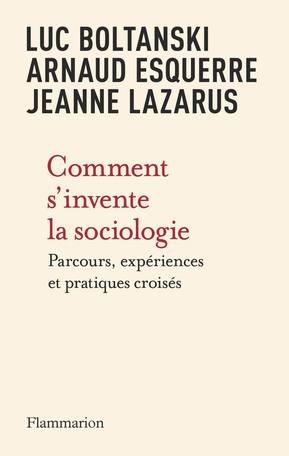
About: Luc Boltanski, Arnaud Esquerre et Jeanne Lazarus, Comment s’invente la sociologie. Parcours, expériences et pratiques croisées, Flammarion
About: Luc Boltanski, Arnaud Esquerre et Jeanne Lazarus, Comment s’invente la sociologie. Parcours, expériences et pratiques croisées, Flammarion

|
“How is sociology invented?” In their latest book, the authors present a 442-page guide to French sociology, comparing the practices and experiences of three sociologists from different generations. This book is not a dictionary of concepts or even a description of how to do pragmatic sociology [1], although the authors do lay claim to this approach. Rather, it is a review of experiences that draws on their individual career paths and the institutional contexts in which social science research is produced.
In three sections (“the sociologists’ workshop,” “the sociological apparatus,” and “sociology in society”), the book explores what constitutes sociological work. It describes the authors’ careers, their relationship to writing and journals, and the political implications of their work.
A tale of generations
This dialogue is of particular interest in the way it brings together the practices and experiences of a researcher trained in the “old school” style of the 1960s with those of more recent generations (Arnaud Esquerre defended his PhD thesis in 2008 and Jeanne Lazarus in 2009). In a path littered with obstacles, these younger sociologists’ legitimate concern is securing a permanent position and gaining acceptance within the sociological community, particularly from those who may suspect them of being hostile to the work of Pierre Bourdieu. In Luc Boltanski’s day, “it wasn’t too hard to find a job in one of the organizations that were being set up at the time” (p. 19). Today, as Jeanne Lazarus explains, it is essential to be perceived as a specialist in one’s field: laboratories, which are vast structures, are geared to meet the expectations of their supervisory bodies with regard to the industrialization of research (bibliometrics, acquiring funding from the European Research Council (ERC), internationalization, etc.). The book is thus a testament not only to the transformation of the profession in academia, but also to the institutions that embody it and, to quote pragmatist sociologists, to the changes in the conditions required to be recognized as a serious sociologist. The chapter on survey design opens the black box of sociology. It shows—beyond the usual dualism between qualitative and quantitative methods—the wide variety of creative approaches used by researchers to answer a given sociological question.
Luc Boltanski, Arnaud Esquerre, and Jeanne Lazarus are no strangers to each other: the latter two wrote their doctoral theses under Boltanski’s supervision, and Esquerre also co-authored Boltanski’s last two books [2]. Although the preface emphasizes that this is not a memoir in which young researchers seek to record the words of their mentor, there is nonetheless a marked asymmetry between the three accounts. Luc Boltanski’s narrative is interesting because it documents the emergence of new sociologies in the 1980s from the perspective of a researcher who was involved in the process [3].
Breaking free from the master
Luc Boltanski began his career in the 1960s, working alongside Raymond Aron and, above all, Pierre Bourdieu to establish the Centre for European Sociology (CSE). The most exciting moment of this period was the creation and coordination of Actes de la recherche en sciences sociales, an atypical sociology journal that combines a specific theoretical approach with rigorous research, using graphic arts to convey its message. Luc Boltanski played an active role in this venture until 1976, in a laboratory he describes as a “master/disciple” model, before being gradually sidelined and breaking with Pierre Bourdieu. He found himself constrained by Bourdieu’s paradigm, which he sought to distort by working on “troubled” situations. Luc Boltanski then had “the intention of establishing the case form as a social form and, more generally, of implementing a sociology that focused closely on the disputes in which people were actively engaged, rather than a sociology that was primarily concerned with revealing the determinisms that actors would passively undergo” (p. 88). The first part of this story has already been documented. [4]
The second part of the story, however, which led to the creation of the Groupe de Sociologie Politique et Morale (GSPM) with Michael Pollak and Laurent Thévenot, remains largely unknown. One of the book’s strengths is that it traces the origins of what was, in France, a hotbed of creativity and conceptual innovation in the 1980s and 1990s. This story is one of both personal and collective endeavors by researchers from different institutions. His exchanges with Laurent Thévenot were crucial, as it was with him that Boltanski developed the model of Economies of Worth [5], which would become the GSPM’s frame of reference for a decade. A first version of the book was published in 1987 and attracted attention far beyond the circle of sociologists, as it was discussed among groups of heterodox economists at the Université Paris 1 Panthéon-Sorbonne and the Université Paris Nanterre. Studies carried out in related institutions, notably at the Centre d’Études de l’Emploi (CEE), consolidated the theoretical model through empirical research [6].
The life and death of a research institution
At that time, the GSPM was a place of experimentation where everyone’s ideas enriched the common framework that Luc Boltanski referred to as the yeshiva [7]. The group had few resources of its own. At the end of the 1990s, it consisted of three small offices at the end of a corridor at 105 Boulevard Raspail in Paris. It had a few collective projects funded on a contract basis (for example, on risk or business with young researchers who are sometimes still working on their theses, such as Cyril Lemieux, Didier Torny, and Francis Chateauraynaud), but this was not the main focus. Whatever formal institutions they belonged to, those who chose to join the GSPM did so above all to be part of a leading intellectual adventure: they were at the forefront of reinventing sociology, just as others were at the Centre de Sociologie de l’Innovation (CSI) at the École des Mines de Paris [8]. As Arnaud Esquerre explains, Bourdieu’s laboratory and the GSPM “existed in relation to theoretical adversaries, as well as allies, with the GSPM being allied, at the time, with the CSI” (p. 131). Luc Boltanski even notes that they were “almost twinned” (p. 36).
Luc Boltanski provides little explanation for the group’s disintegration in 2012, referring to internal disagreements that began to emerge after his own research program was reconfigured, notably with the publication of The New Spirit of Capitalism and, above all, his book On Critique. As he writes: “the lab collapsed by itself in 2011, following internal conflicts” (p.128).
To understand why, it is important to remember that, according to Luc Boltanski, intellectual life in a yeshiva laboratory is carried out through hermeneutic discussions in joint seminars. In such a model, “entropy can manifest itself through chaotic agitation that prevents accumulation” (pp. 125-126). In the history of the GSPM, the seminar had ceased to be a space where “the common goal was to achieve the highest levels of interpretive creativity” (p. 123). In the history of the GSPM, seminars had ceased to be a space where “the common goal was to achieve the highest levels of interpretive creativity” (p. 123). In fact, since the 1990s, most of the creative work had been taking place in the seminars of the directors of studies; according to Luc Boltanski, these constituted the real laboratory (pp. 126 and 160) and replicated, in some ways and on a smaller scale, the “master/disciple” model he had known under Pierre Bourdieu.
This joint effort produced the framework for Economies of Worth and was followed by two competing academic trajectories. To anyone observing the laboratory from the outside, this would appear to be a division of labor: Luc Boltanski was in charge of studying the transformation of global entities, such as capitalism, by analyzing large bodies of text, while Laurent Thévenot focused on describing regimes of proximity using phenomenological approaches. The ‘joint’ seminars then became the scene of clashes between two now competing programs, where doctoral students and young researchers sometimes played the role of mavericks. Few doctoral students such as Jeanne Lazarus would allow themselves to frequent both worlds.
Alongside the yeshiva laboratory and the “master/disciple” laboratory, Luc Boltanski points to a third laboratory model: the “corporate laboratory.” This is a bureaucratic-type organization that is primarily financed on a contract basis. “As in a company, it must be possible to say who is a member, who is not a member, who does what, etc.” (p. 124). In a corporate laboratory, there is no longer a common theoretical approach; what matters is professionalization. The Centre de Sociologie des Organisations (CSO), which Jeanne Lazarus joined after being recruited by the CNRS, fits this model.
By the end of this period, the GSPM was still a prestigious label for its members, but its original quality was increasingly questionable. Luc Boltanski’s latest work was perceived by other members as “a step backwards that threatened the efforts they had devoted to building a pragmatic sociology” (p. 106). Young researchers working with Cyril Lemieux and Bruno Karsenti then created the research group Laboratoire Interdisciplinaire d’Études sur les Réflexivités (LIER), inspired by the desire to develop their own yeshiva. Looking back on their journey, it could be said that they have remained faithful to the spirit of Luc Boltanski and his colleagues when they founded the GSPM.
The careers of Jeanne Lazarus and Arnaud Esquerre illustrate the obstacles young researchers face in entering an academic world where the social sciences are undervalued. After completing her PhD thesis and seeking funding, Jeanne Lazarus applied for a position at Orange Labs (part of the French telecoms group). Her friends at the École Normale Supérieure could not understand her decision: she recounts how, upon hearing her news, they looked at her as if she had “voted for the far Right” (p. 48). The following year, at the age of 30, she was recruited by the CNRS. Arnaud Esquerre, meanwhile, after completing the second year of his PhD thesis, accepted a position as chargé de mission (a special assistant) for the CEO of France Télévisions. He then joined the CNRS in 2012, first at the Laboratoire d’Ethnologie et de Sociologie Comparative (LESC) and then at the Institut de Recherche Interdisciplinaire sur les Enjeux Sociaux (IRIS), where he was reunited with Luc Boltanski. He became director of IRIS in 2018. Both are now research directors at the CNRS.
What lies ahead for sociology?
Sociology does not come about in isolation. It evolves through interactions with others, principally its sponsors. These sponsors have changed significantly over the past 30 years. Those known to Luc Boltanski were closely linked to government ministries and generally shared the same progressive ideals as researchers. They used to act as intermediaries between the social sciences and politics, but have since been replaced by impersonal agencies such as France’s National Research Agency (ANR), whose main concern, explains Arnaud Esquerre, is to ensure that budgets are properly managed. Sociologists are also expected to focus on solving social problems. However, they must be able to distance themselves from this in order to avoid acting as experts and to advance sociological issues. Finally, although it may share common ground with politics, sociology must differentiate itself from it in order to maintain its credibility as a science. Based on these three observations, the authors conclude their book on an optimistic note. Without providing many examples, they write, “Outside the discipline, perspectives more or less inspired by sociology have spread, particularly through the media and secondary and higher education.” (p. 426).
Does this mean that sociology is doing well? Although sociology is everywhere, it is economists, whose behavioral approaches are increasingly encroaching on the domain of sociologists, who are being asked to make normative recommendations. They propose “mathematical models that claim to be predictive” (p. 325). There has never been so much talk about sociology, yet this discourse has had little impact on its subject matter, whether we call it “the social” or “society.” Is this really a sign of good health for a social science discipline?
Luc Boltanski, Arnaud Esquerre et Jeanne Lazarus, Comment s’invente la sociologie. Parcours, expériences et pratiques croisées, Paris, Flammarion, 2024, 442 p., 24€.
by , 28 October 2025
Share this article
Find us here :


To quote this article :
Emmanuel Kessous, « The Making of a Sociologist », Books and Ideas , 28 October 2025. ISSN : 2105-3030. URL : https://booksandideas.net/The-Making-of-a-Sociologist
Nota Bene:
If you want to discuss this essay further, you can send a proposal to the editorial team (redaction at laviedesidees.fr). We will get back to you as soon as possible.
You might also like


Footnotes
[1] Cf. Y. Barthes et al. Sociologie pragmatique : mode d’emploi, Politix vol 3-103, pp. 175-204.
[2] L. Boltanski, A. Esquerre, Enrichissement. Une critique de la marchandise, Paris, Gallimard, nrf, 2017. Qu’est-ce que l’actualité politique ? Événements et opinions au XXIᵉ siècle, Paris, Gallimard, nrf, 2022.
[3] Cf P. Corcuff, Les nouvelles sociologies, Paris, Armand-Colin, coll 128, 2004.
[4] L. Boltanki Rendre la réalité inacceptable : À propos de “La production de l’idéologie dominante”, Paris, Démopolis, 2008.
[5] L. Boltanski and L. Thévenot, On Justification. Economies of Worth, Princeton and Oxford, nrf, Princeton University Press, 2006.
[6] Cf in particular L. Boltanski and L. Thévenot (ed.), Justesse et justice dans le travail, Paris, PUF, cahier du CEE, 33, 1989. The investigations focus in particular on mutual banks (André Wissler), Camembert production (Pierre Boisard and Marie-Thérèse Letablier), a municipality (Claudette Lafaye), and workplace conflicts. (Francis Chateauraynaud and Nicolas Dodier).
[7] In reference to centers of study in the Jewish tradition. The term is borrowed from Marc-Alain Ouaknin, Invitation au Talmud, Paris, Flammarion, champs, essais 2018.
[8] Bruno Latour’s new sociology of science played an important role in Luc Boltanski’s departure from Bourdieu’s framework. The two schools of thought, which were then undergoing rapid development, shared the same pragmatic concerns but maintained a critical view of the overall architecture of their respective models. Cf B. Latour «Dialogue entre deux systèmes de sociologie », in M. Breviglieri, C. Lafaye, D. Trom (ed.), Compétences critiques et sens de la justice : Colloque de Cerisy, Paris, Economica, 2009, pp. 359-390.
Our partners


Sections
Keep in touch
© laviedesidees.fr - Any replication forbidden without the explicit consent of the editors. - Mentions légales - webdesign : Abel Poucet