


Since the two World Wars, the victim has been raised to the status of a sacred and predominant figure in historical memory. The victim has become the new figure of the hero, thus setting a new and controversial example.
The Era of Victims
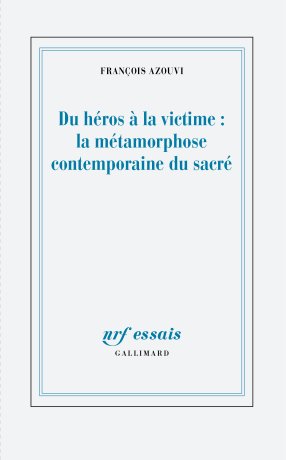
About: François Azouvi, Du héros à la victime : la métamorphose contemporaine du sacré, Gallimard
About: François Azouvi, Du héros à la victime : la métamorphose contemporaine du sacré, Gallimard

|
The predominance of the victim in our understanding of the past and the present is now a subject of controversy. In 1995, in La Tentation de l’innocence, essayist Pascal Bruckner lamented the use of victimisation for narcissistic purposes. [1] In 1997, in La Concurrence des victimes, sociologist Jean-Michel Chaumont described the creation of the ‘unique nature’ of the Holocaust in the 1960s and how it had become a political issue for communities other than Jews. [2] In 2012, in Le mythe du grand silence, philosopher and historian François Azouvi challenged the preconception that the Holocaust was obscured in the aftermath of World War II, demonstrating that, in reality, reflection on the tragedy had developed very early on. In 2024, with this new opus on the figure of the victim, the author expands his reflection on the memory of the Holocaust and its anthropological consequences.
He defends the thesis of the omnipotence of the victim in contemporary historical memory, an omnipotence that reveals a new way of understanding the sacred in a secularised world. Competition among victims has become a media phenomenon and a socio-political tool. According to François Azouvi, the cause of this competition lies in the sacralisation of the victim. Paradoxically, this reveals a shift away from the transcendence embodied in the old heroic model in favour of a new exemplarism that is ‘narrowed down’ to the defence of individual rights.
From hero to martyr
In Héroïsme et victimisation, published in 2003, Jean-Marie Apostolidès, a specialist in classical literature, suggested examining the evolution of mindsets in Western civilization based on two registers: the heroic culture, forged in Greco-Roman mythology, and the victim culture, carried by the Judeo-Christian tradition. The hero, as celebrated in the age of absolutism of the Grand Siècle, faded into the background following the traumas of World War II. The post-1968 ‘fraternal society’ then focused on remembering the victims and turned away from the cult of heroes in a rejection of the patriarchal authority it conveyed. [3]
François Azouvi adopts the same key to understanding between a heroic pole and a victim pole in order to grasp contemporary mindsets. He makes the first pole more complex by turning the hero into a martyr. The two World Wars brought about a transformation of heroism that became secularised martyrdom but still conveys a transcendent dimension, as in the image of ‘dying for one’s country’. This Christian view leads to a retrospective misinterpretation regarding the victims of the Holocaust in the 1950s. Indeed, resistance fighters are hailed as heroes vs. martyrs, while the pure victims, those massacred for what they are and not for deliberate acts against the oppressor, are lumped together in generalised compassion.
The distinction between martyr and victim, while new in the twentieth century, is not new to Western Christianity. In the 16th century, Protestant Jean Crespin’s Histoire des Martyrs distinguished between ‘heroes of the faith’ and the mere ‘persecuted faithful’. The former —and most prestigious— were Protestants who proclaimed their faith before a court, even at the risk of capital punishment, while the latter were those who lost their lives in the massacres of the civil wars of religion. [4]
Until the 1960s, victims continued to be viewed in a negative light. Victimology, which emerged in the 1950s, questions the victims’ responsibility in triggering criminal predation. This pejorative vision converges with the passivity attributed to the Jews during their extermination. Psychoanalyst and former deportee Bruno Bettelheim theorised this submissive attitude with regard to the Franck family. In his view, the universal resonance of this family tragedy revealed, in truth, the denial of the extermination insofar as these victims did not correspond to the traditional heroic profile.
The sacralisation of the victims of the Holocaust: a « negative theology »
In Je souffre donc je suis, Pascal Bruckner stresses the weight of Christian martyrology in victim sensitivity. [5] For François Azouvi, on the contrary, the victim as it emerges in the wake of the memory of the Holocaust breaks with monotheistic transcendence and the secularised transcendence of patriotic sacrifice.
From the 1960s onwards, the figure of the victim gradually overshadowed that of the martyr. In 1961, the Eichmann trial marked a turning point in the perception of the victim. Shocked by Israel’s Attorney General Guideon Hausner’s questioning of witnesses regarding their alleged ‘passivity’, future Nobel Peace Prize winner Elie Wiesel denounced what he saw as the obscene attempt to explain the behaviour of the victims of the Holocaust. The Jews, he believes, died for nothing, “neither for God nor for freedom” (p. 100). This absurdity of history is what constitutes the unique nature of Holocaust victims. It is based on a kind of negative theology insofar as the link between Auschwitz and God is unthinkable. This ‘mystery’ is a matter of sacredness, but without synagogue or church.
In 1966, the reception of Jean-François Steiner’s Treblinka refined the singularity of the victimology of the Holocaust. Part novel, part documentary, this work recounts the revolt of the prisoners at the killing centre in 1943. Some critics praised him for breaking the prejudice regarding the alleged gregariousness of the deportees. For other commentators such as historian Pierre Vidal-Naquet, on the contrary, the text shows the reality of what most victims endured, namely daily survival in the face of an inexorable machine of annihilation.
Following Jean-Michel Chaumont, François Azouvi highlights the importance of a symposium organised by the American magazine Judaism, which was held in New York on 26 March 1967. This conference brought together American Jewish intellectuals to discuss post-Holocaust religious values. The philosopher Emil Fackenheim proposed adding a 614th commandment to the 613 of the Torah, saying: “The authentic Jew of today is forbidden to hand Hitler yet another, posthumous victory.” This commandment was to be understood as a call to reject any theological interpretation of the Holocaust. François Azouvi interprets this commandment as ‘non-theological theology’, since it is not found in the Bible (p. 128), thus establishing a new way of remembering the Holocaust. It sacralises the victim as much as the hero vs the martyr without being religious.
Readers may be surprised by the concept of sacredness without religion. François Azouvi understands sacredness as the concept of the ‘numinous’ created by Rudolph Otto in 1917, in other words a radical otherness that evokes a sense of mystery and awe in everyone. The victim, sacralised in this way, would be able to take the place of religion and, in a manner of speaking, would take the place of transcendence: “It is because the victims have become sacred that they have shown themselves capable of erasing transcendence, and it is because they have erased transcendence that they have become sacred” (p. 223).
From analogy to competition between victims
The ‘unique nature’ of the Holocaust is at the root of community grandeur. [6] This shift is crucial because the victim is no longer a source of shame, but rather a cause for pride. François Azouvi describes this memorial process, in which the victim of the Holocaust becomes a positive reference point, before becoming a controversial issue from the 1960s onwards, in the light of the geopolitical tensions of the time.
From as early as the 1950s, comparing the condition of European Jews to that of African Americans has been commonplace in the United States. The neologism ‘genocide’ coined by Polish lawyer Raphael Lemkin to describe the extermination of European Jews and recognised in international law in 1948 was used in 1951 by African-American activist Paul Robeson in a petition entitled We Charge Genocide: The Crime of Government against the Negro People. However, in 1967, following the Six-Day War, protests against Israeli policy undermined the victimising and dignifying analogy between Jews and Blacks in favour of one denouncing Jews and imperialist Israel. A document from the Student Non-Violent Coordinating Committee, one of the main African-American civil rights movements, denounces Israeli policy in Gaza with a photo whose caption reads, “This is the Gaza Strip, Palestine, not Dachau, Germany”.
In France, a similar process took place in the context of the anti-colonial struggle for Algerian independence. Claude Lanzmann, the future author of Shoah, considered in 1961 that the sweeping operations in the French département could be described as ‘genocide’. Subsequently, in Catholic and revolutionary circles, the Holocaust was being put into perspective. For example, at the 1963 performance of The Deputy, a play by the German playwright Rolf Hochhut condemning the pusillanimity of Pius XII in the face of the Holocoast, Catholics justified condemning Soviet and Nazi totalitarianisms in equal measure. Implicitly, these Catholics were discussing the ‘privilege’ of Jewish victims. Back then, as in the United States following the Six Day War, Zionism was interpreted as a racist, expansionist and potentially genocidal ideology. The Jewish victim of the Holocaust became the ‘Nazi executioner’, while the figure of the Palestinian took the place of the victim.
The evolution from analogy to competition between victims is reflected in the opposition “between those who, perhaps, weep too profusely over misfortunes that are too old and refrain from weeping over misfortunes that are more current, and those, on the contrary, who turn the page on these old misfortunes and militate against those of today” (p. 104-105).
The ‘law of double frenzy’
François Azouvi invokes Bergson’s concept of the ‘law of double frenzy’ (p. 171) to describe the era we are living in today as a sequence of the ‘reign of individuals’. The ‘law of double frenzy’ is a dynamic composed of two opposing and complementary powers that drive the evolution of life. In the age of victimhood, the omnipotence of the victim is asserted to the detriment of its heroic antagonist. The cult of victimhood no longer has the necessary counterweight to balance the law. “The law of double frenzy means that the trend that has become dominant goes right to the end, as if there were an end. But there is none », stresses François Azouvi (p. 201).
The author uses the example of the four ‘memorial laws’ to illustrate this victim-centred spiral. [7] He also quotes the historian Madeleine Rebérioux, hardly suspected of conservatism, who was concerned, as early as the Gayssot law in 1990, about the inevitable extension of the criminalisation of historiography to areas other than the genocide of the Jews.
This legislative swelling reveals the centrality of the victim in new readings of the past, such as ‘decolonial’ historiography. The author does not propose here a detailed investigation into the real or supposed influence of this field, which originated in the United States before infiltrating the French scientific world, but rather seeks to link his thesis on the sacralisation of the victim to the victim-centred view of this historiography. The author thus unfolds the racialist reading of domination, breaking with the classist vision of social history.
The victim-based approach of memory studies
François Azouvi adopts a resolutely historical approach in his demonstration. He highlights the pivotal years, symbols of this history of the victim’s triumph: 1967 and the de-theologisation of the Holocaust victim; 1977 and the Charter 77 asserting the rights of individuals as unassailable; and 1985 and the distinction between Resistance fighters and Jewish deportees at the Barbie trial. Today, victimisation is proving to be the criterion of legitimacy for minorities seeking recognition. But can this label be a binding force in society? François Azouvi doubts this, given what victim-based society produces, i.e. a communitarian competition in which ideological entrepreneurs do whatever they can by waving victim-based totems.
However, we can temper the concern expressed in the essay by considering other ways of approaching the duty of remembrance, which is denounced here as a victim-centred ‘all memory’ approach. In the context of memory studies, surveys show how revisiting previously hidden violence has helped to symbolise historical traumas and reintegrate minorities into political society. In After The Korean War. An Intimate History, anthropologist Heonik Kwon explained how the trauma of the Korean War (1 in 6 Koreans lost their lives in the three years of civil war) is extremely diverse. Although dominated for a long time by the authorities in the name of the anti-communist struggle, the recent commemoration of victims who had long been obscured has led to a harmonious rather than conflictual social reorganisation. [8]
On the island of Jeju, in the south of South Korea, for example, anti-communist repression in 1948 and 1949 left almost 25,000 people dead or missing, i.e. 10% of the island’s total population. From the 1990s onwards, with the regime’s turn towards democracy, the islanders began to speak out. Their leader was a ‘simbang’, a shaman-like priest who was the repository of the local religion, which is very much alive on Jeju. He reported that every time he performed a funeral ritual, the ‘ill-dead’ demanded justice. These spirits were victims of repression who had died under unknown circumstances. Uncertainty about the death of a victim puts a curse on the family.
These practices can be interpreted as private rituals of resistance. They led to public acts of restoration for the victims and their families. Today, a memorial park on the island features steles erected in their honour.
This process unfolded peacefully, following the example of the evolution of the Anticommunist Association of Families of the Jeju April Third Incident Victims. Originally, this association brought together the relatives of civilian volunteers and paramilitaries killed by the Communist militia. Later, the relatives labelled as ‘red element’ joined and became the majority. This was achieved through a ‘quiet revolution’ based on negotiations between families. The Association now produces reports on past massacres without any sectarianism.
A history of the memory of victimhood ‘from below’ is thus a complementary approach to the transformations in the relationship with the past and puts into perspective the debates that François Azouvi has developed with intelligence and clarity.
François Azouvi, Du héros à la victime : la métamorphose contemporaine du sacré (From Hero to Victim: The Contemporary Metamorphosis of the Sacred), Paris, Gallimard, NRF Essais, 2024, 294 p., 24 euros.
by , 9 December 2025
Share this article
Find us here :


To quote this article :
David El Kenz, « The Era of Victims », Books and Ideas , 9 December 2025. ISSN : 2105-3030. URL : https://booksandideas.net/The-Era-of-Victims
Nota Bene:
If you want to discuss this essay further, you can send a proposal to the editorial team (redaction at laviedesidees.fr). We will get back to you as soon as possible.
You might also like



Footnotes
[1] Bruckner, P., La Tentation de l’innocence, Paris, Grasset, 1995.
[2] Chaumont, J.-M., La Concurrence des victimes, génocide, identité, reconnaissance, (1st ed. 1997), Paris, La Découverte, 2010.
[3] Apostolidès, J.-M., Héroïsme et victimisation. Une histoire de la sensibilité, Paris, Exils Éditeur, 2003, p. 109-132.
[4] Simon Goulart, who republished and expanded Le Livre des martyrs, called this discriminatory casuistry.
[5] Bruckner, P., Je souffre donc je suis. Portrait de la victime en héros, Paris, Grasset, 2024.
[6] Chaumont, J.-M., La Concurrence des victimes, op. cit., p. 105-118.
[7] The Gayssot law against racism and anti-Semitism in 1990, the law on the Armenian genocide and the Taubira law on the slave trade in 2001 and finally the article on the positive contribution of colonisation in 2005, now repealed.
[8] Kwon, H., After the Korean war. An intimate history, Cambridge, Cambridge University Press, 2021.
Our partners


Sections
Keep in touch
© laviedesidees.fr - Any replication forbidden without the explicit consent of the editors. - Mentions légales - webdesign : Abel Poucet