


Can Nietzsche be considered a social thinker? Straddling social critique and critique of the social, French and German interpretive traditions that embrace Nietzsche make it necessary to revise the hasty conclusions of Marxists and anti-postmodernists.
Social Nietzscheanism
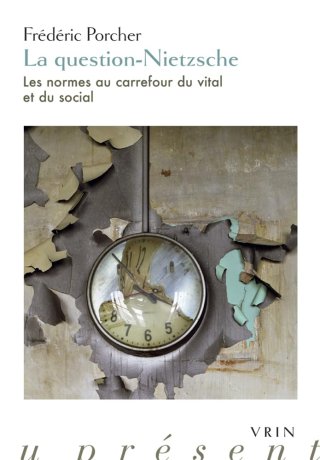
About: Frédéric Porcher, La « question-Nietzsche ». Les normes au carrefour du vital et du social, Vrin
About: Frédéric Porcher, La « question-Nietzsche ». Les normes au carrefour du vital et du social, Vrin

|
Avoiding the disastrous alternative between an apolitical Nietzsche and a “highly political” (as Jacques Bouveresse puts it) or “entirely political” (in Domenico Losurdo’s words), Frédéric Porcher examines Nietzsche’s legacy in various schools of social philosophy that (at least partially) claimed him as an influence. Rather than proposing an internal exegesis of Nietzsche’s thought, Porcher considers, rather, his appropriation by two philosophical traditions: the Frankfurt School and critical theory, as developed by Jürgen Habermas, Max Horkheimer, Theodor Adorno, and Axel Honneth, which analyzes the pathologies of the social; and the French tradition of social philosophy that lies at the intersection of the philosophy of norms, the philosophy of biology, and the history of sciences, from Gaston Bachelard to Gilles Deleuze by way of Georges Canguilhem and Michel Foucault.
Porcher does not seek to find the “true” Nietzsche lurking beneath potential misinterpretations but asks what kind of critical social philosophy the German philosophy inspired. For him, the “Nietzsche question” does not refer to the eschatological ideal of a conclusive exegesis, but to his readers’ affective and dispositional horizons (p. 9). This is why this critical genealogy of the “Nietzsche question” begins with an account of the dispute it provoked between the first two generations of the Frankfurt School, before examining how it carried over to France.
Nietzsche and the Frankfurt School: A disputed legacy
Through a close reading of The Dialectic of Enlightenment (1944), Porcher shows how, within the Frankfurt School, Nietzsche’s legacy was embraced by Adorno and Horkheimer but rejected by Habermas. While Adorno embraced Nietzsche, he was quick to note Nietzsche was insufficiently dialectical, notably in his subversive rhetoric. This position also led Adorno and Horkheimer to argue that Nietzsche was not a conservative thinker, as his critical force and rootedness in the Aufklärung were grounded in a Kulturkritik that testified to a desire for social change. Yet due to a lack of sociological analysis, Nietzsche blinded himself to genuine domination, incorporating it into a medical paradigm that viewed it as one of life’s pathologies.
If some critical theory has grown disaffected with Nietzsche, it is primarily because of the critique of his thought by Habermas, the preeminent representative of the Frankfurt School’s second generation. Nietzsche and his postmodern heirs are, for Habermas, destroyers of reason and enemies of the Enlightenment. Habermas specifically sees Nietzsche as participating in the backlash to the Enlightenment. Seeing reason as merely a power configuration, Nietzsche abandons modernity, if one accepts Habermas’ premise that “only modernity enables norms that make its own self-criticism possible” (Porcher, p. 65). Consequently, rather than using reason to critique an emphatic and self-aggrandizing perversion of reason, Nietzsche passes over to reason’s other.
It is on this last point that Foucault takes the opposite position of Habermas. While he recognizes that the Frankfurt School belongs to his philosophical family, he diverges from it on a crucial point. Foucault rejected the approach that consists in determining knowledge’s misconception of itself, which implies that reason can determine what is true and false. Yet it is unclear if the dialectic of enlightenment rests on a unitary conception of reason that allows it to judge the past. Foucault, to the contrary, defends the idea of a contingent history of rationality, and places at the center of his analysis the problematic of power, which does not consider subjectivity as the social ontology’s main ingredient. As the heirs of Marxist humanism, the Frankfurt theorists still considered the subject as essential. Foucault, to the contrary, reinserted (but did not dissolve) the subject into power relations, so that liberating the individual no longer meant freeing it from power but transforming subjectivity. [1]
Foucault thus renewed Aufklärung as a critical gesture, in which the object of critique lies not outside the subject, but within its constitution. This is why Foucault was surprised that Habermas considered him anti-Enlightenment. [2] Far from accepting the Habermasian idea that modernity consists in a rational normative substrate, Foucault maintained that rationality is pluralistic. Even so, he acknowledged that critical theory had the merit of calling attention to reason’s emancipatory power, “provided that it manages to free itself from itself.” [3]
The Nietzsche question in Foucault and French epistemology
Indeed, ever since Auguste Comte, the French tradition has sought to bolster social philosophy in order to restrain the revolutionary appetites of social reformers, using the history of sciences as an insurance policy. Rather than seeing reason, as did the Enlightenment, as the other of religion and power, it sought to mobilize critical rationality against a form of dogmatic rationalism. This was done, each in his own way, by Auguste Comte, Gaston Bachelard, Georges Canguilhem, and Foucault. [4] The specificity of the French approach appears in the way that it reappropriated a crucial passage of The Genealogy of Morality(II, §12), in which Nietzsche emphasizes the discontinuous nature of history—a claim that was embraced in various ways by Bachelard, Canguilhem, Foucault, and Deleuze.
A quiet history: Bachelard. It is in opposition to a continuous history of scientific progress that Bachelard, invoking Nietzsche, judges the Enlightenment quite severely from the standpoint of scientific values (L’activité rationaliste, p. 24). While the historian is forbidden to judge the past, the epistemologist uses the present to judge historical change: "The history of science is historians’ science; it is less concerned with facts than values (p. 117). The history of reason is no longer the historian’s history, but a critical and reflective history, precisely the kind that Nietzsche called for in section 8 of the second essay of Untimely Considerations.
A vitalist ontology: Canguilhem. For Canguilhem, Nietzsche’s thought also plays an important role, albeit a discreet one: life’s value becomes a criterion for evaluating science’s values and particularly disciplines that aspire to produce scientific knowledge of the living. The history of the life sciences can thus be understood as a history of norms. Consequently, its object is not given in advance. This is what we see in the paradigmatic case of the concept of health, which, for Canguilhem, as for Nietzsche, is not a condition so much as “the power to put all values and all desires to the test.” [5] Health is thus defined in Nietzschean terms as the ability to institute different norms than the current norms, while sickness is the inability to be normative:
Man feels in good health—which is health itself—only when he feels more than normal—that is, adapted to the environment and its demands—but normative, capable of following new norms of life. [6]
Where Comte’s positivism imposed the normal individual at the expense of the normative individual, resulting in a social philosophy of order that rejected any deviation from the norm, Canguilhem reversed this perspective, making the breaking of rules foundational: the philosophy of the normal and the pathological gives his social philosophy an unexpected ability to conceptualize freedom on the basis of normative power.
A History of Power Relations: Foucault. As Canguilhem himself acknowledges when discussing the concept of episteme in a famous article (“Mort de l’homme ou épuisement du cogito?,” Critique, 242, 1967, p. 612, quoted on p. 153), Foucault seems to achieve the same gesture by interrogating everything up to and including the historicity of the truth itself, while situating himself outside the history of science. Examining knowledge’s relationship with itself, Foucault describes this relationship not as epistemological, but historical. Yet in contrast to what some oversimplifying readings imply, the historicization of truth does not mean that Foucault abandons any truth norm. Rather, Foucault distinguishes between what is said to be true, that is, what is considered plausible and thinkable in each episteme, and what is true beyond various veridiction contexts. This means that “before it can be predicated as true or false from within a discipline, a proposition must have been integrated into a discipline’s discursive space” (p. 157). For Foucault, knowledge becomes the object of a conflict between a system of rules and obligations within knowledge domains determined by relations of force of a political or social character.
Vitalizing politics and politicizing power: Deleuze’s Nietzscheanism
From his earliest writings, Deleuze was sensitive to the fact that the so-called philosophy of values—which at the time was associated with Louis Lavelle and René Le Senne, as well as Canguilhem (!)—had served more to bolster the established order of values than to challenge it. Yet in Deleuze’s reading of Nietzsche, it was the latter that interested him (p. 191). Deleuze interprets Nietzschean biology as a method for discovering and inventing new possibilities for life [7]—that is, unsuspected bodily powers. It is in this sense that Deleuze understands Nietzsche’s discourse about disease: as a symptomatology that identifies whether thought is healthy or not, suggesting that its practitioner is engaged in a struggle against thought’s tendency towards mystification. What Deleuze valorizes through Nietzsche is not the organic body, but vitality defined as a qualitative disposition towards knowledge and evaluation that is the function of a multiplicity of affects. In this way, the active person is not the absolute other of the reactive person. They are someone who can act on their reactions, [8] while a reactive person only feels their reactions. [9]
On this basis, Deleuze and Guattari’s “social philosophy” distinguishes itself from critical theory’s project not only by placing reactionary forces for preserving order in opposition to revolutionary forces for social change, but especially by promoting a form of analysis concerned not with “society” but configurations of domination. To this end, it relies on several of Nietzsche’s posthumous texts that use the concept sovereignty formations [10] (Herrschaftsgebilde). Deleuze’s vitalism is focused not on society, but on social life. These formations result from what A Thousand Plateaus calls a power of transference, which means that a social form is always the product of a reconfiguration of earlier powers, consistent with the genealogy of power formations that Nietzsche theorized in The Genealogy of Morality (II, §12).
The rationalism of social philosophy: Intellectual self- surveillance
All the interpretations of Nietzsche in the French tradition of social philosophy consist in appropriations of the key text in which Nietzsche addresses the specific historicity of the will to power: §12 in the second essay of The Genealogy of Morality. One can only admire Nietzsche’s exegetical subtlety and the quality of his information, which contributed to the specificity of the genealogical line of his French disciples—who are more than disciplines, in the sense that they deterritorialize him in a productive way, as their interpretations wield the active force that he wanted wielded against him. If a phenomenon only makes sense in light of the powers that control it, as Nietzsche wrote, then a social form is always contingent and transformable. This means that these interpretations of Nietzsche are not just interpretations: as appropriations, they obey Marx’s eleventh Feuerbach thesis, becoming genuine discursive practices.
Furthermore, if, as Deleuze wants, it is as desiring energies that these appropriations become active forces, this means that it is always possible for individuals, groups, or readers of Nietzsche to become reactionaries after having been revolutionaries. Neither term applies in some ossified way to specific “positions” on the political spectrum, but refer to the direction of power as it is exercised: there exists a reactionary tendency that is unique to revolutionary groups when the latter submit to a single life norm—so much so that it can become a subjected group, whereas the distinctive feature of the active forces of a revolution lies in the appropriation of life norms that differ from the dominant ones, resulting in new forms of subjectification. This consideration should encourage a greater genealogical caution among those readers of Nietzsche who seek to draw him into the orbit of one of these poles—revolution or reaction—just as it should as it should inspire those who believe they have reached the peak of the history of reason or revolutionary action to take that antidote against self-mystification that Bachelard soberly and efficiently dubbed “intellectual self-surveillance.” [11]
Frédéric Porcher, La « question-Nietzsche ». Les normes au carrefour du vital et du social (The “Nietzsche Question”: Norms at the Crossroads of the Vital and the Social), Vrin, 2023, 250 p., 23 €, ISBN 9782711631049
by , 6 January
Share this article
Find us here :


To quote this article :
Arnaud Sorosina, « Social Nietzscheanism », Books and Ideas , 6 January 2026. ISSN : 2105-3030. URL : https://booksandideas.net/Social-Nietzscheanism
Nota Bene:
If you want to discuss this essay further, you can send a proposal to the editorial team (redaction at laviedesidees.fr). We will get back to you as soon as possible.
You might also like


Footnotes
[1] “The conclusion would be that the political, ethical, social, philosophical problem of our days is not to try to liberate the individual from the state and from the state’s institutions but to liberate us both from the state and from the type of individualization which is linked to the state.” Michel Foucault, “The Subject and Power,” Critical Inquiry, vol. 8, no. 4, 1982, pp. 777-795, at 785. Cited by Porcher, note 4, p. 87.
[2] See Antoine Lilti, L’héritage des Lumières, Seuil, 2019, p. 363.
[3] Foucault, Dits et écrits vol. II, Gallimard, 2001, p. 1586.
[4] See, for example, Foucault, “Piéger sa propre culture,” Dits et écrits I, p. 1250.
[5] Georges Canguilhem, “La santé,” in Écrits sur la médecine, Vrin, 2021, p. 55, cité p.130.
[6] Canguilhem, On the Normal and the Pathological, Reidel, 1978, 200.
[7] Gilles Deleuze, Nietzsche et la philosophie, Presses Universitaires de France, 1962, p. 115.
[8] This is Porcher’s interesting formulation. See p. 202.
[9] The author poses once again the classic problem of Nietzscheanism: how do reactive forces win? Is it not because they, too, betray a will to power willing to go to its logical conclusion? The problem is that such a force can be interpreted in two different ways, depending on whether one asserts that these forces have an active destiny in which they will affirm their difference (active forces) or denies that which is different from us (reactive force). The individual who asserts their difference creates their own norms, allowing for the possible emergence of new forms of life, while the individual who is content to live while refusing all that is different from them remains bound by preexisting norms.
[10] Porcher cites FP XII 5 [61] ; 2 [87], 9 [8] ; FP XIV 13 [3], 14 [138].
[11] See the chapter bearing this name in Bachelard, Le rationalisme appliqué, Presses Universitaires de France, 1949.
Our partners


Sections
Keep in touch
© laviedesidees.fr - Any replication forbidden without the explicit consent of the editors. - Mentions légales - webdesign : Abel Poucet