


How are television series written? Muriel Mille’s study sheds light on a collective process based on a division of labor and time constraints. It represents a total break with the auteur ideal of New Wave cinema.
Serial writers
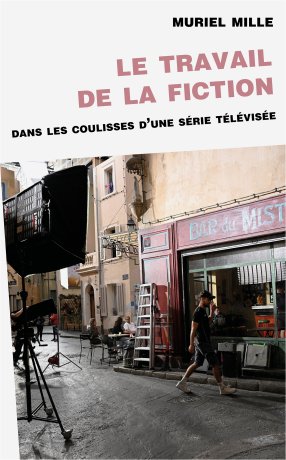
About: Muriel Mille, Le travail de la fiction. Dans les coulisses d’une série télévisée, Presses Universitaires de Vincennes
About: Muriel Mille, Le travail de la fiction. Dans les coulisses d’une série télévisée, Presses Universitaires de Vincennes

|
Muriel Mille’s book is a deep dive into the production practices of television series, focused on the representative case of Plus belle la vie, the sprawling French TV show that aired from 2004 to 2022. The book, which is based on a doctoral dissertation defended in 2013, belongs to the burgeoning literature on television series, which are now examined as research topics in various disciplines, most of which “seek to analyze the series’ subject matter, emphasizing how these fictions describe reality” (p. 6). Through a rigorous sociological approach, Mille seeks to decenter our perspective on the work conditions of TV professionals and the social dynamics that inform the creation of popular fiction. Her on-the-ground study, carried out over several years, is based on interviews with various creative actors (screenwriters, directors, prop masters, and so on), as well as direct observation of the production process. Sidebars allow her to skillfully connect the material to analysis and grasp the multiple facets of a protean topic.
This methodology allows Mille to identify how successful series are made, emphasizing economic and organizational factors as well as interactions between broadcasters, producers, and creative personnel. “Fiction work” is presented, in this way, as an eminently collective process, in contrast with the iconic figure of the auteur – a legacy from French New Wave cinema – or that of the showrunner.
The “art worlds” of a TV series
One of the books notable features is its analysis of the division of labor, which draws freely on American “writer’s rooms,” and notably the way two different workshops operate: the “sequencer,” which focuses on narrative arcs and plot twists, and “dialogue,” which turns the story into words and feeling (p. 93). Mille brilliantly shows how tasks are divided up between a wide range of professionals, each making their specific contribution to the collective oeuvre. Screenwriters play a central role, even though they are subject to intense creative and time constraints to keep the plot going. She identifies an internal hierarchy that assigns a major role to the sequencer screenwriters and that arises from struggles for “professional territory” in a context in which the “distribution of tasks corresponds in the first instance to a form of sexual division of labor, in which women are responsible for dialogue – that is, psychology – and emotions while men take care of action and plot twists” (p. 103). Finally, while the profession does not see working for a series as a vocational ideal, it nonetheless occupies a pivotal place in screenwriters’ professional trajectories.
The workshops thus serve as a kind of training ground for fledgling writers who see the experience as “a first career step, before they write or direct their first film or launch their own series” (p. 151), while established screenwriters see the series as an insurance policy against “the ups and downs of film projects and a way of ensuring regular income” (p. 155). Mille takes a broader perspective and sheds light on the distinct and decisive place that series occupy despite their lack of legitimacy among professionals, emphasizing the way that “considering the trajectories of screenwriters for Plus belle la vie allows one to grasp the difficulties of surviving an artistic career” (p. 133).
Creating under pressure
Mille also scrutinizes the work conditions of TV series professionals. Audience demand and tight deadlines result in a frantic work pace, requiring each episode to be quickly produced while maintaining high narrative and technical standards. This tension inevitably has an impact on the series’ form and content. It might be described as “fiction made under pressure” (p. 187). The screenwriters’ goal is to craft an “imagined public” that, “in their mind, is equated with French society in its entirety, but in which the working class is dominant” (p. 195).
The goal of ensuring viewer loyalty is crucial and is evident in the writing of scripts: plots ask the public to remember earlier stories while cliffhangers at the end of each episode encourage them to return (p. 205). Finally, the expectation that viewers are volatile and have fluctuating attention spans impacts dialogues, as screenwriters “seek to ensure that following the plot is easy and watching the show comfortable by focusing on the clarity and coherence of dialogue” (p. 216). The economic constraints that prevail in production also carry over into how individual episodes are directed, with an emphasis on recurring sets to reduce costs. Plot settings give rise to intense negotiations between various creative actors. Thanks to detailed first-hand narratives and filming anecdotes, Mille carefully transcribes the consequences for participants, who must often juggle creativity and economic considerations, even as they try to gauge the expectations of their imagined public.
A TV series in the public sphere
The book’s analysis of the way Plus belle la vie represents social reality is another one of its strengths. Mille examines the way that current events function as a kind of “set” for the plot, notably thanks to the close attention the screenwriters pay to the media. While some stories are specifically based on current events, unexpected coincidences also bolster the screenwriters’ sense of the “spirit of the times.” Mille next turns to the ways in which the show’s representations of society function. Screenwriters’ prior socialization and ideological orientations seem to shape the material, at the risk of “erasing the working classes” (p. 290). The positions taken by the screenwriters assign the story a twofold function. While it starts with representing the social world, it morphs into “an analytical tool that can promote greater critical distance than TV news is expected to offer” (p. 238). Mille notes that the series’ representation of reality is shaped by the personal experiences and social trajectories of the screenwriters, but also by the economic and time constraints that limit prior research. These elements create an environment in which professionals must navigate between creative aspirations and production constraints, often resulting in contradictory challenges. Mille’s in-depth analysis of these dynamics reveals the originality of her approach, which sheds light on how such factors influence the creation of TV content.
The book stands out for the wealth of information it presents and for its highly relevant sociological analysis. Mille’s work manages to explain the complexity of TV production processes while remaining accessible to a broad reading public. By focusing on work relationships and power dynamics in the Plus belle la vie ecosystem, Mille provides new insights for scholars and students in sociology and media studies. The book also asks us to rethink the place of TV series in popular culture, as well as their role in modeling the social world and framing public issues. Finally, the originality and interest of this monograph, devoted to a case study that has since become very successful, lies in its comprehensive perspective on TV series, examining the continuum of production, content, and reception.
Muriel Mille, Le travail de la fiction. Dans les coulisses d’une série télévisée (The labor of fiction: Behind the scenes of a TV series) Saint-Denis, Presses Universitaires de Vincennes, 2024, 342 p., €19, ISBN 9782379244124.
by , 12 March
Share this article
Find us here :


To quote this article :
Héloïse Boudon, « Serial writers », Books and Ideas , 12 March 2026. ISSN : 2105-3030. URL : https://booksandideas.net/Serial-writers
Nota Bene:
If you want to discuss this essay further, you can send a proposal to the editorial team (redaction at laviedesidees.fr). We will get back to you as soon as possible.
You might also like


Our partners


Sections
Keep in touch
© laviedesidees.fr - Any replication forbidden without the explicit consent of the editors. - Mentions légales - webdesign : Abel Poucet