


Can the defense of human rights be reconciled with guerilla warfare? David Copello offers an in-depth reinterpretation of the history of these complex struggles that have shaken Argentine society to its core.
“Che, 2e partie : Guerilla”, Steven Soderbergh (2008)
Rights by Force of Arms
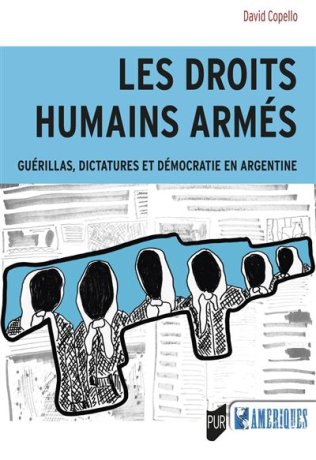
About: David Copello, Les droits humains armés. Guérillas, dictatures et démocratie en Argentine, Presses universitaires de Rennes
About: David Copello, Les droits humains armés. Guérillas, dictatures et démocratie en Argentine, Presses universitaires de Rennes

|
Right from the title, this new book by political scientist David Copello invites the reader to look beyond common assumptions through a skillfully crafted contrast. Les droits humains armés. Guérillas, dictatures et démocratie en Argentine (Armed human rights: Guerrillas, dictatorships and democracy in Argentina) deconstructs these representations by drawing connections between human rights and armed struggles. Although surprising, this association—in the form of an oxymoron—invites the reader to reflect on how the ideas and ideals espoused by revolutionary groups have evolved in different times and contexts.
Argentina’s turbulent sociopolitical environment of the 1960s and 1970s—marked by the outlawing of Peronism following the “Liberating Revolution” of 1955, three coups d’état (1962, 1966, 1976), popular uprisings, armed actions carried out by revolutionary organizations, and the fight against “subversion” [1]–provided an ideal setting for observing the reversal of a purely pacifist vision of human rights. By linking these events to the demands of the armed revolutionary movements that were severely repressed, particularly after the 1976 coup d’état, Copello reconstructs what he calls the “discourse of revolutionary human rights” (p. 15, hereafter DRHR), with the aim of shedding light on the “ideological and militant hybridizations [that] took place between revolutionary movements supporting armed struggle and the cause of human rights” (p. 15). The evolution of the relationship between left-wing human rights activists and democracy is then traced from a political perspective that “contrasts with much of the social science literature” (p. 13). Accordingly, the trajectory of DRHRs is analyzed using the tools of the social history of political ideas, based on various collective works by the “Duhalde group” [2]—a group of legal professionals who played a pivotal role in the intertwining of the two discourses from the 1960s through their institutionalization in the twenty-first century. The book’s structure also gives readers a glimpse into the behind-the-scenes details and complexities of the author’s research process, which draws on a wide variety of sources: interviews, unpublished press archives, and accounts from both individual and collective actors.
The new lefts and human rights
Taking a linguistic approach, the political scientist examines the revolutionary uses of the concept of human rights within the Argentine left. Enriched by a series of highly informative appendices, his presentation of the DRHR also invites a two-part reading, ranging from the emergence and consolidation of the “new left” to the reconfiguration of the “post-new lefts” following the democratic awakening in Argentina.
Human rights became part of the revolutionary cause against a backdrop of instability marked by recurring political crises that gave rise to various forms of mobilization and organizations up until 1983. The concept of the “new left” is thus associated with a fairly broad, transnational anti-imperialist movement that, in the 1960s and 1970s, drew inspiration from the Cuban Revolution while challenging classical communism and traditional Marxism, with the goal of establishing a new social order and system of political representation. Accordingly, Argentina’s “new left” encompasses a wide range of socio-political, cultural, and revolutionary protest movements (whether armed or not). Perceived as “a fast track to political and social transformation,” the physical violence perpetrated by these revolutionary groups (murder, kidnapping, torture, etc.) appears to “play a primarily symbolic role” (p. 30) as “acts of armed propaganda” (p. 29). Although the concept of the “new left” remains contentious in the Argentine context, particularly due to political divisions and the role of Peronism—characterized by “its blurring of traditional ideological boundaries” (p. 20)— Copello rightly embraces this “heuristic” label (p. 22), which allows him to bring together and analyze the trajectories of various revolutionary movements using the criteria of social liberation, national liberation, and revolutionary violence—a trend that accelerated from 1969 with the Cordobazo civil uprising. In particular, it traces the history of two guerrilla groups whose members came from diverse backgrounds but unanimously rejected pacifism: the Montoneros (mostly Peronists) and the members of the Revolutionary Workers’ Party–Revolutionary People’s Army (PRT-ERP, largely Marxists), who embodied “two distinct poles within the new Argentine left” (p. 25). A diagram (p. 32) places these two groups within the context of the new left, providing a better understanding of their complex evolution based on their ideological positioning and the strategies they adopted in their armed struggle.
This critical context gave rise to numerous political mobilizations and led to a “desectorization of the social sphere” (p. 33): activists’ appropriation of legal discourse and, conversely, the use of political rhetoric by legal professionals, who characterized prisoners’ trials as “political.” By “making use of legal tools” (p. 34), armed revolutionary organizations thus adopted a legal defense strategy that went hand in hand with “the rise of violence in politics” (p. 34). The term “human rights” took on new meaning through the actions of radicalized lawyers beginning in the early 1970s. In this shifting landscape, the creation of the Argentine Human Rights Commission (CADHU)—which formed around the Duhalde group and its network from 1976 to 1978, primarily abroad—marked the culmination of the fusion between revolutionary activism and human rights advocacy. “Detached from politico-military organizations” (p. 75), the CADHU “denounced […] political repression on the international stage” (p. 59) while “promoting a revolutionary struggle rooted in the working-class base” (p. 64).
The author analyses how the political use of law crystallised, drawing on a rich corpus of previously unpublished correspondence and internal documents. With the gradual disbandment of revolutionary groups, the concept of “state terrorism,” championed by Eduardo Luis Duhalde, emerged around 1978 within the CADHU and became increasingly distinct from that of fascism because it “arose […] during a defensive phase by the forces of the bourgeoisie to curb the intensification of the masses’ struggle and subjugate the working classes” (Duhalde, quoted by Copello, p. 79) within a new version of the state of exception characterized by clandestinity, crime, and terror. By calling out “the state monopoly on violence […] that is the root cause of systematic violations” (p. 66) and expressing a “radical critique of Argentine capitalism” (p. 83), the phrase “state terrorism” became a central pillar of the discursive repertoire of human rights activists.
Fighting for human rights in a democracy
Research into the evolution of DRHRs seeks to understand how “the pursuit of a radical policy, initially expressed under a dictatorship, was reshaped […] in a (developing) state governed by the rule of law” (p. 86). Within this context, two decrees issued in December 1983 and signed by the newly elected President Raúl Alfonsín set in motion, firstly, the trial against the military juntas and, secondly, the trial against the armed revolutionary groups. Building on the prologue to the CONADEP [3] report, the “two demons” narrative emerged, equating the systematic violence of the dictatorship with the revolutionary struggle of armed groups. In a journey that takes us from the “accusatory” symmetry of the 1980s to the “exculpatory” parallelism of the 1990s, Copello highlights a series of interesting paradoxes: the persecution of activists under Alfonsín and the various reactions to the amnesty decreed by Menem.
With the return to democracy, a “post-new Left” restructured itself around editorial projects. Drawing on a corpus of press articles, Copello reframes the tensions and debates within the Duhalde group regarding the implications of the trial of the juntas, which emerged as an “incomplete” symbol (p. 92). The post-new Left criticized the role of the judiciary as a neutral third party, arguing that, in addition to the criminal aspect, the political dimension of judicial rulings should be taken into account. This revolutionary use of human rights was thus based on the “politicization of the trial” (p. 103)—demanding the release of all political prisoners, the return of exiles, and rejecting the demonization and criminalization of activists—and, paradoxically, on the “delegitimization of political uses” (p. 103) by the opposing side. The enactment of the “Ley de Punto Final” (Full Stop Law) and the “Ley de Obediencia Debida” (Due Obedience Law), which exonerated a large portion of the military, exposed “the broad maneuvers aimed at limiting democracy” (Mattarollo, quoted by Copello, p. 109).
Furthermore, the author situates the failed uprising of the Tablada military regiment in 1989, led by the “Movimiento Todos por la Patria” (All for the Fatherland Movement), within the context of a “renewed epic and revolutionary imagination” (p. 142), which was embraced by a segment of the post-new Left, despite differing views on violence. Gradually, the ties between democracy and revolutionary human rights grew stronger after the HIJOS victims’ association was founded in 1995. But it was Néstor Kirchner who, upon coming to power in 2003 and seeking popular support and a political identity, invoked the country’s setentista legacy—the political and revolutionary traditions of the country’s 1970s left—and appointed Eduardo Luis Duhalde as National Secretary for Human Rights. The DRHR thus reached its peak and became a matter of state policy with the emergence of a new discourse and new practices surrounding human rights and memory: the rewriting of the CONADEP’s preamble and the opening of trials against military personnel, among other measures.
New debates, broader perspectives
Breaking with traditional historiography, David Copello’s study reveals the complex evolution and hybrid nature of the DRHR—from the revolutionaries’ armed struggle during periods of unrest, through the use of the law in a democracy as a means to combat “state terrorism,” to the implementation of public policies of reparations during the Kirchner era. The political scientist thus traces the common thread linking human rights struggles in Argentina—whether currently underway or still in the making—and skillfully provides, amid disruptions and continuities, essential insights for overcoming dichotomies.
Serving as an observatory of contextualized thought, this book revives the debate on the diverse and evolving uses of the DRHR through the lens of “actors [who] interpret and articulate society” [4]. In a deeply polarized political context where struggles for human rights are the focus of controversy [5], it is likely that “the [formerly] oxymoronic phrase [‘armed human rights’], presented as a conflict that is openly acknowledged by its speaker,” [6] will be viewed less and less as a contradiction. Thus, armed human rights movements become a fundamental landmark in the recognition of the role played by the new Argentine left in these multifaceted armed struggles—revolutionary, legal, and political—which David Copello brings to light and clarifies in his study of the social history of political ideas. For this reason, a Spanish translation of the book in the near future would be very welcome.
David Copello, Les droits humains armés. Guérillas, dictatures et démocratie en Argentine, Rennes, PUR, 2025, 240 p., 24 €.
by , 22 October
Share this article
Find us here :


To quote this article :
Maria Gabriela Dascalakis-Labreze, « Rights by Force of Arms », Books and Ideas , 22 October 2026. ISSN : 2105-3030. URL : https://booksandideas.net/Rights-by-Force-of-Arms
Nota Bene:
If you want to discuss this essay further, you can send a proposal to the editorial team (redaction at laviedesidees.fr). We will get back to you as soon as possible.
You might also like


Footnotes
[1] According to the armed forces, the “subversives” were enemies of the nation and a threat to social order; this label could be applied just as easily to “guerrillas who carried weapons and carried out attacks […], those who were active in left-wing political organizations, [as well as] those who spoke out publicly in defense of specific political ideals, whether they were students, journalists, lawyers, etc.”. Marina Paola Casartelli; “Abyección y subversión ¿Sinónimos sí o no durante la última dictadura militar en Argentina?”, Actas publicadas. Ensenada, Buenos Aires: School of Humanities and Education Sciences, 2022, p. 7. The term “subversion” thus takes on an accusatory tone which, while implying a disruption of the legal, moral, or other order, legitimizes its suppression by the armed forces.
[2] Named after Eduardo Luis Duhalde, a lawyer and central figure in the group, who was often accompanied by Rodolfo Mattarollo and Carlos González Gartland.
[3] The National Commission on the Disappearance of Persons (CONADEP) drafted the report Nunca Más: Informe sobre la Desaparición de Personas, Buenos Aires, EUDEBA, 1984 (6th edition).
[4] Chloé Gaboriaux, “Lire et dire la société : de l’histoire conceptuelle du politique à l’histoire sociale des idées politiques” in Chloé Gaboriaux, Arnault Skornicki (eds), Vers une histoire sociale des idées politiques, Lyon, Presses Universitaires du Septentrion, 2017, p. 278.
[5] In particular, with the downgrading of the Secretariat for Human Rights to a sub-secretariat under the Ministry of Justice in May 2025.
[6] Marc Bonhomme, “La rhétorique des figures : entre formalisme et énonciation,” Protée, 38(1), 2010, p. 71.
Our partners


Sections
Keep in touch
© laviedesidees.fr - Any replication forbidden without the explicit consent of the editors. - Mentions légales - webdesign : Abel Poucet