


By adopting a child’s perspective, Camille Mahé shows that younger children perceived the Second World War differently than adults.
Raised Among the Ruins
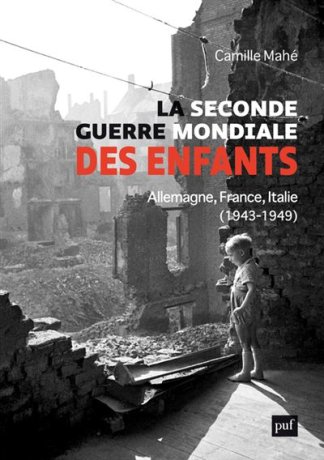
About: Camille Mahé, La Seconde Guerre Mondiale des Enfants, Allemagne, France, Italie (1943-1949), PUF
About: Camille Mahé, La Seconde Guerre Mondiale des Enfants, Allemagne, France, Italie (1943-1949), PUF

|
The ongoing Russo-Ukrainian and Israeli-Palestinian conflicts highlight the impact that wars have on children in the modern era. According to UNICEF figures, in 2023, more than 460 million children were living in conflict zones, and 43.3 million of them had been forcibly displaced. This is the highest number ever recorded since the end of the Second World War.
Camille Mahé’s recent book, La Seconde Guerre Mondiale des Enfants, Allemagne, France, Italie (1943-1949) (Children and the Second World War. Germany, France, Italy (1943-1949)), analyzes how the image of children as war victims was constructed in the aftermath of the Second World War, and revisits the process of “victimization” (p. 23) to which they were subjected. Contrary to popular belief, Camille Mahé shows that, while the war did indeed take its toll on children, not all of them were necessarily traumatized. This dissonance between the “almost iconic figure of the child victim of war” and the “accounts given by children who grew up during the 1940s” led to a question that “formed the starting point for comparative historical research into children’s experiences at the end of the war in France, Germany, and Italy between 1943 and 1949”: “To what extent did the Second World War impact and transform childhood in Western Europe?” (p. 16).
Young people and the coming out of war
Mahé focuses specifically on children of “school age,” i.e., those between the ages of 6 and 14. While most studies are centered on “the history of Jewish children who were hidden, rescued or persecuted” (p. 18), the author is interested in children who were not “exposed to the most extreme forms of violence” (p. 19). She chooses these three geographical areas (France, Italy, and western Germany) on account of their similar material and institutional contexts, and because these three countries were, “albeit at different times and to varying degrees” (p. 28), on the losing side. The author has chosen to focus on western Germany (Federal Republic of Germany) rather than eastern Germany (German Democratic Republic) given “the specific issues affecting eastern Germany and the desire to use comparable sources” (p. 28).
The chronological markers were chosen to be “consistent with events that were meaningful to children” (p. 29) and therefore do not necessarily coincide with diplomatic or political timelines. The year 1943 thus marked the beginning of the “Liberation” in the three areas covered, while 1949 saw a return to “material stability and security” (p. 30) in France and Italy with the end of rationing (one year later in the Federal Republic of Germany). More broadly, the late 1940s saw the end of “political, institutional, material, nutritional, and familial instability” (p. 30) and symbolized the dawn of an era of peace.
Finally, the expression “coming out of war” (sortie de guerre) was chosen over “post-war” (après-guerre), a term that “creates a binary opposition between war and peace.” In contrast, the coming out of war is defined as “a complex, sometimes unfinished process of transitioning to peace that impacts society as a whole” (p. 20). Although the period following the war has attracted historians’ attention since the early 2000s, childhood remains the “poor relation” (p. 22) of research on this subject. Camille Mahé’s book fills this gap by examining the fate of children at the end of the Second World War in the three regions studied.
How children experienced WWII differently
First, the historian looks back at “the coming out of war from a child’s perspective” (p. 42) in the three countries. Drawing on sources produced by children themselves (drawings, school essays, etc.), Mahé shows that not all children were terrorized. While some of them expressed “feelings of pain and horror,” others displayed “carelessness, fascination, and even joy” (p. 44). These unexpected reactions can be explained by children’s physical distance from the conflict due to evacuations, the creation of an “appealing image of war” (p. 47) through books and toys, and the fact that the exceptional nature of war for adults was part of everyday life for many children growing up during this period. Fear and anxiety nevertheless surfaced when the conflict entered the private sphere of children, for example when a loved one was killed or wounded.
Political and diplomatic events that are significant for adults are not necessarily meaningful for children. Indeed, the official end of the conflict in Europe on May 8, 1945, did not necessarily mark the end of the war for the youngest members of society. The presence of allied armies, landscapes scarred by war—particularly ruins—and the slow cultural demobilization [1] of children all contributed to keeping them in a state of war. Rather, it was the events that were significant in the eyes of children that marked the beginning of peace for them. What mattered was the “material reconstruction of their social spaces” (p. 121), that is, “finding a roof over their heads, returning to school every day,” as well as the end of shortages, which meant the end of “painful experiences of hunger and cold” (p. 121). Finally, it was above all “the return of those who had been absent” (fathers, brothers, uncles, etc.) that enabled “the rebuilding of family and emotional ties” (p. 121) and marked the transition from conflict to peace for children in the late 1940s.
The conflict’s impact on children
Mahé also questions the idea that young people were the primary victims of the conflict. By comparing the voices of children with those of adults, the historian analyzes the “effects that the war had on them” (p. 39). The coming out of the Second World War was indeed an unprecedented “moment of emulation” “in terms of the production and circulation of knowledge about childhood on a transnational scale” (pp. 167-168). Never before had young children attracted such intense attention from so many experts (nutritionists, psychiatrists, teachers, educators, psychologists, pediatricians). This “nebula” of childhood experts was instrumental in “establishing the image of the child as the quintessential victim of war after 1945 and in constructing the new norms of childhood suffering that resulted from it” (p. 168). The war did indeed have an impact on young people’s physical, psychological, moral, and intellectual well-being, although there were significant disparities depending on geographical origin (children in towns suffered more from hunger than those in rural areas), social background (the wealthy classes suffered less than the working classes), and age (teenagers were more affected by the war than children).
Above all, Camille Mahé emphasizes that “while children aged 6 to 14 suffered, the cost of the war was, on the whole, less severe for them than for other population groups” (p. 252). Most experts note that by the end of the 1940s, “for most school-age children in Western Europe, the effects of the conflict had largely dissipated” (p. 252). So where did the idea come from that young people were the primary victims of the conflict? Humanitarian iconography, which highlighted child suffering in its representations, is one of the primary explanatory factors. However, it alone cannot explain why this phenomenon became so prevalent. Another factor to consider is “the development of new forms of intolerable behavior — in this case, violence against children” (p. 254) since the nineteenth century, which reached a peak in the 1940s. From the introduction of preventive legislation against “violence inflicted on children by persons in a position of authority over them” (p. 269) in the nineteenth and twentieth centuries, to the regulation of child labor in Europe, protective laws for children proliferated in the decades leading up to the Second World War. Finally, this idea was also used by political actors to legitimise the crucial process of material and institutional reconstruction in France, Italy and West Germany. Because aid to children who are victims of war “embodied a form of action that was a priori disinterested and altruistic, it strengthened their moral foundation and thus constituted a powerful asset for increasing their legitimacy” (p. 278). For example, the US authorities in Germany used it as “a tool to justify their presence” in the face of hostility from some quarters and to “entrench the American way of life in the face of the communist threat” (p. 278).
“Saving children” in the coming out of war in Europe
The historian also analyzes the measures that the three regions adopted with the aim of “saving” European children from the remnants of “Fascism, Nazism, and Vichyism” (p. 39). The first step was to “re-educate children in peace and democracy” by counteracting “the influence that authoritarianism may have had on the youngest members of society” (p. 298). Schools played a crucial role in this process, and were at the heart of the measures introduced, through the implementation of new school curricula and innovative teaching practices. For example, self-government and referendum practices are introduced in French, Italian, and German schools to teach children about democracy. Since school was considered “a miniature society,” the authorities were keen to “teach students the tools of democracy (voting, a sense of responsibility, etc.), because what is practiced in the school environment is replicated in adulthood in local and national politics” (p. 329). It also involved purging schools of certain members of staff under policies designed to remove all Nazi, fascist, or Vichy influences.
Next, the various governments sought to contribute to “children’s physical and moral recovery” (p. 343). This involved promoting “wholesome leisure activities” (p. 344), mainly through toys and literature, which constituted “children’s material culture” (p. 345). Policies also aimed to intervene in the private sphere in order to save the family institution, which appeared to be in crisis during the coming out of war, as it was considered “essential for the moral and even psychological recovery of children” (p. 358). Finally, the physical rehabilitation of the youngest victims formed the third pillar. This mainly involved implementing preventive policies in schools and rehabilitating mutilated children to foster their integration into society as future citizens. This physical rehabilitation also served an economic purpose: these children, as the adults of tomorrow, would one day work and help rebuild the country. Even young people with disabilities benefited from “vocational rehabilitation” (p. 379) measures, which trained them in certain trades (baker, butcher, etc.) so that they too could contribute to rebuilding the country and be socially integrated.
A comparative study of war experiences from a “child’s perspective” [2]
Camille Mahé’s book is enlightening on several levels. First, in terms of archival research, it draws on sources produced not only by adults (reports from international organizations, press articles, correspondence) but also by children. Since the early 2000s, childhood historians have increasingly turned to children’s sources, which are essential for understanding the perspective of very young people. Schoolwork, personal diaries, letters, and drawings make up the bulk of this corpus. When combined with adult sources, these allow us to look at things from “a child’s perspective” and understand how children experienced the conflict.
The comparative approach is also particularly insightful. Skillfully juggling between the three chosen geographical areas, Mahé demonstrates that young West Germans, French, and Italians had largely similar experiences during this period. More than (or at least as much as) nationality, it was social and geographical origins, religion, and gender that influenced school-aged children’s experiences of the conflict. In addition, the comparison also provides an opportunity to “revisit a well-known event” (p. 25) and proves that research on the Second World War has not yet been exhausted.
In this respect, Camille Mahé’s book fills an important historiographical gap. Until recently, few researchers had taken an interest in the experiences of younger children who were not exposed to extreme violence. While there is still work to be done on the fate of nomadic children, numerous studies have focused on the experiences of Jewish children (those who were hidden, deported, or rescued) during the conflict [3]. Without denying the specific nature of the genocide perpetrated against these young people and the particularities of Jewish children’s experiences of war, the historian nevertheless argues that “by targeting specific categories of children, historiography tends [...] to compartmentalize experiences, even though they also intersected and/or overlapped” (p. 19). Thus, Jewish children shared common experiences with girls and boys of the same age who “also experienced bombing and hunger on the Western Front, handled explosive devices that could injure them, or forged ties with the Allied armies” (p. 19). This book thus complements existing works that focus more narrowly on the unique experiences of children targeted by extreme violence during the conflict. By offering a more comprehensive approach that also considers the fate of non-Jewish children, Camille Mahé breaks down the barriers of historiography and offers a fresh approach to a subject that resonates powerfully with current events. [4]
Camille Mahé, La Seconde Guerre Mondiale des Enfants, Allemagne, France, Italie (1943-1949), Paris, Presses Universitaires de France, 2024, 464 pp., €24, ISBN 9782130859888.
by , 5 March
Share this article
Find us here :


To quote this article :
Charlotte Canizo, « Raised Among the Ruins », Books and Ideas , 5 March 2026. ISSN : 2105-3030. URL : https://booksandideas.net/Raised-Among-the-Ruins
Nota Bene:
If you want to discuss this essay further, you can send a proposal to the editorial team (redaction at laviedesidees.fr). We will get back to you as soon as possible.
You might also like


Footnotes
[1] A concept coined by historian John Horne to describe the slow and ritualized de-escalation of conflict in societies transitioning out of war. John Horne, « Démobilisations culturelles après la Grande Guerre », special issue of 14-18, Aujourd’hui, Today, Heute, Paris, Éditions Noésis, 2002, pp. 45-53.
[2] Manon Pignot, « À hauteur d’enfant : Le défi historiographique des expériences de guerre enfantines et juvéniles ». L’Autre, 2020/2, Vol. 21, 2020, pp. 142-150.
[3] Other notable works include: Deborah Dwork, Children with a Star: Jewish Youth in Nazi Europe, New Haven: Yale University Press, 1991, 400 pp.; Katy Hazan, Les orphelins de la Shoah, Les maisons de l’espoir (1944-1960), Paris: Les Belles Lettres, 2000, 418 pp.; Ivan Jablonka, L’Enfant-Shoah, Paris: Presses Universitaires de France, 2014, 382 pp.; Daniella Doron, Jewish Youth and Identity in Postwar France. Rebuilding Family and Nation, New Haven: Indiana University Press, 2015, 309 pp.
[4] This approach, which aims to break down the barriers between the experiences of Jewish and non-Jewish children during the Second World War, was previously adopted by historian Nicholas Stargardt when focusing on young Germans in his book Witnesses of War: Children’s Lives Under the Nazis, London: Jonathan Cape, 2005, 509 pp.
Our partners


Sections
Keep in touch
© laviedesidees.fr - Any replication forbidden without the explicit consent of the editors. - Mentions légales - webdesign : Abel Poucet