


How does justice vanquish force? Simone Weil’s thought unifies politics and religion while proposing a radical conception of power, understood not as domination but as retreat, in a world in which violence gives way to obedience.
John Singleton Copley, Ascension, 1775
Power’s retreat
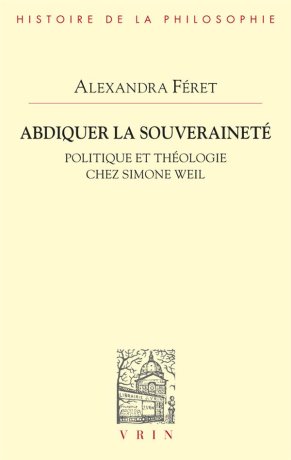
About: Alexandra Féret, Abdiquer la souveraineté. Politique et théologie chez Simone Weil, Vrin
About: Alexandra Féret, Abdiquer la souveraineté. Politique et théologie chez Simone Weil, Vrin

|

The recent conclusion of the publication of Simone Weil’s complete works (in 2019) is an invitation to read her writings by considering their chronology, which consists undeniably of major existential, historical, and political breaks, but while also noting her relentless conceptualization, which allows one to trace the theme that was always central to her work: the dramatic interplay between justice and force in the world. How is one to explain, at a political level, the permanent nature of social oppression despite its evident injustice? And how is one to imagine an emancipated society without renouncing a realistic description of social relationships? From a theological perspective, how is one to understand the inextricable nature of evil, which seems to place limits on goodness or the Creator’s power, to the extent that He allows or fails to prevent it?
Politics and theology in Simone Weil
Alexandra Féret’s book shows that while these two questions have different origins, they cannot be considered separately. To do so would be to ignore the rigorous coherence of Weil’s thought. Her political theory and religious metaphysics are not two disconnected moments of her oeuvre, but two dimensions in which the reality of violence and the demand for justice can be grasped. Moreover, the interpretive principle Féret proposes is that only the articulation of politics and theology offers an alternative to spontaneously unjust forms of human action. Thus concerns about mechanisms of social oppression and the critical analysis of politics are not brushed aside by religious metaphysics but achieve their deepest significance when they are brought back to ontology’s most fundamental categories.
Yet doing justice to the originality of Weil’s thought means not equating her views about power with the theological-political analogy between God’s reign and human government or its contemporary reformulations. If the analogy is to remain an adequate framework for understanding how power is exercised on earth as well as heaven, it is not by focusing on sovereignty but rather on the paradoxical idea of a withdrawal of sovereign power, of which the act of divine creation is a model. Theological reflection guided by political categories can bring to light a different configuration of power relations, which provides human action with an alternative to the uncontrolled and necessarily unjust use of force. In this way, connecting politics and theology is neither a detour required to understand social relations nor a transformation of philosophical concepts under the influence of religion, but an opportunity for grasping politics at its limits, from the standpoint of a transcendence that we must, like Roberto Esposito, call impolitic, and which must be understood through the paradigm of abdication—the guiding thread of Féret’s interpretation.
For a metaphysics of power
Through an attentive reading of Weil’s work, Féret emphasizes the centrality of the concept of power, which makes it possible to grasp her entire oeuvre from a single standpoint: that of the violence inherent in the sovereign exercise of force. In the tradition of Thucydides and Machiavelli and attached, like them, to the principle of political realism, Weil recognizes that force cannot not appear in the world, in whoever’s hands it finds itself and to whatever degree it manifests itself. It is the shared root of state imperialism and social oppression. All forms of domination have their anthropological foundation in the inevitability of the struggle for power—that is, for the sovereign exercise of force, which leads existing forces to perpetuate the inequality of the relationships in which they stand opposed, despite the blatant injustices and suffering to which they lead. This analysis clarifies Weil’s relationship to the tradition of political philosophy: the insight that no one can renounce the pursuit of power condemns to failure contractualist theories, for which the formation of a polity depends on the voluntary renunciation of the natural tendency to wield force. By the same token, the concept of force used in Marxist analysis of social relations is also inadequate (chapter one).
Thus justice, which is not a futile ideal but an imperious demand, seems achievable only at the price of a renunciation of power. Yet a renunciation of this kind can only be understood in supernatural terms, as it is alien to this world, in which natural relationships based on force and weakness prevail. Divine abdication provides a model of such renunciation. It was intuited in pagan religions by way of sacrificial conceptions of the divine and achieved its truth in the Christian doctrines of the Creation and the Incarnation. Féret’s analysis does not recoil before the radicality of this position, as it does not attempt to limit God’s omnipotence by arguing that God is impotent or that he can limit His own power. Rather, she claims that the refusal to intervene in the world is an irreversible abdication of God’s absolute sovereignty. The true God is thus a God who is all-powerful yet not domineering, who in His supreme freedom retreats to allow a world to exist over which He will have not exercise the authority that is rightfully His. The analysis and proof of this claim entail a return to the study of divine attributes and a reformulation of the problem of theodicy, which Féret compares to other contemporary metaphysics of divine power, most notably that of Hans Jonas (chapter II).
The standpoint of abdication
But what about the human response to divine omnipotence, if the latter abandons the traditional form of the sovereign ruling as absolute master over a flawless Creation in favor of abdication and a world that God knows is bad? Human action must be understood against the background of a metaphysics of Creation that accounts for the existence of evil and prescribes for the sinful creature an attitude of obedience and conversion. Weil’s concept of “decreation,” often mentioned to explain the correlation between God’s voluntary retreat and the dissolution demanded of man, is in this book considered from the standpoint of abdication. Féret shows that this concept comes slightly later but is just as fundamental and better able to clarify the ontology of subjectivity and action theory. Because autonomous existence is already sinful, human creatures are called upon to renounce themselves. This does not mean self-destruction but recognizing the self’s limits and embracing human plurality and coexistence with others.
Such are the necessary conditions for a conception of action that emphasizes attention and obedience to necessity rather than the autonomy of will. The abdication paradigm thus makes it possible to undertake a genuine critique of practical reason, whose fundamentally negative orientation does not prevent one from grasping the positivity of effective action, to which Weil remained committed without reservation. Though the model of abdication leads to prioritizing abstention as a restraint on the use of force, Weil does not advocate inaction but seeks rather to limit the sphere of necessary action (chapter three).
Once the concept of abdication emerges as the theological-political concept par excellence, it leads to the examination of the relationship between politics and religion in a secularized world in which what matters is no longer grasping power so as to understand relationships based on force but to fight their most unjust iterations. Weil sees the autonomy of politics in relation to religion as the effect of the sacralization of the social, which can be attributed to Durkheim’s sociology, and the divinization of the state and the nation—new idols that leave nothing to the true God and condemn peoples to the spiritual impoverishment resulting from the ersatz faith of ideology. Political idolatry, she believes, has troubled origins: she sees it as a rejection of the paradigm of divine abdication, which she blames harshly and problematically on Israel as much as Rome. Féret makes her concerns about this claim clear.
In our own time, secularization does not just mean the retreat from authentic religious life but also the depoliticization of society, as it succumbs ever more to the state’s absolute power. Society’s salvation thus depends on the struggle against politics become an absolute end onto itself and a reintegration of religion into the social fabric through a form of mysticism that does not so much exalt individual religiosity as union with the absolute good—a promise of supernatural justice that places the good higher than politics and leads to the definitive renunciation of the use of force (chapter four).
Written in sharp and precise prose, aware of the current editorial status of Weil’s oeuvre, and informed of the latest research about her, Féret’s book provides a remarkably coherent interpretation of the problem of power, keeping the rich and nuanced articulation of politics and theology in focus until the end. Particularly admirable is the emphasis on conceptualization found throughout her study, which establishes the distinctions required to better understand the problem and to emphasize the radical singularity of the abdication thesis, while also clarifying or discounting less precise interpretations. By approaching Weil’s work by way of the theological-political question, Féret explains the ongoing power of a philosophy in which force yields to grace and violence to obedience.
Alexandra Féret, Abdiquer la souveraineté. Politique et théologie chez Simone Weil (Abdicating sovereignty: Politics and theology in Simone Weil), Paris, Vrin, 2024, 256 p., €27, ISBN 9782711631650
by , 3 September
Share this article
Find us here :


To quote this article :
Emeline Durand, « Power’s retreat », Books and Ideas , 3 September 2026. ISSN : 2105-3030. URL : https://booksandideas.net/Power-s-retreat
Nota Bene:
If you want to discuss this essay further, you can send a proposal to the editorial team (redaction at laviedesidees.fr). We will get back to you as soon as possible.
You might also like


Our partners


Sections
Keep in touch
© laviedesidees.fr - Any replication forbidden without the explicit consent of the editors. - Mentions légales - webdesign : Abel Poucet