

How can we move beyond the double deadlock of state socialism and market capitalism? For Lea Ypi, returning to Kant and the Enlightenment offers a perspective to provide a new ground to freedom as social responsibility, and to open up towards a cosmopolitan horizon against the authoritarianism of profit.
Interview Philosophy Video Interviews
Moral Socialism
An interview with Lea Ypi
by ,
18 February
|
As a guest of the Collège de France for the 2025-2026 academic year, holding the annual chair The Invention of Europe through Languages and Cultures, Lea Ypi offers an unequivocal diagnosis of our times. Drawing on her unique experience of the collapse of communism in Albania, she describes how the promises of freedom associated with the arrival of capitalism ran up against new forms of “horizontal” oppression, in a world where everything is for sale and human relationships are transformed into economic transactions. Devoting her lecture series to the idea of “moral socialism,” she begins with a plain observation: liberal societies have progressively emptied the concept of freedom of its substance, reducing it to a succession of individual choices constantly conditioned by advertising, algorithms, and the logic of profit. A freedom of choice that no longer questions the very conditions under which those choices are made.
Lea Ypi therefore proposes a return to the legacy of the Enlightenment to rethink socialism on moral foundations. Her project of moral socialism stands in opposition both to the state socialism of the 20th century, whose oppression and end she experienced firsthand, and to democratic socialism, which remained trapped within the national framework, responding to the challenges of globalization through mere compromise. By revisiting a lesser-known philosophical tradition–that of the Neo-Kantians and Austro-Marxists of the early 20th century–she shows how Kant’s categorical imperative–“never treat others merely as a means” –simply cannot be realized in a capitalist society. This moral imperative, applied to migration, inequality, or European integration, calls for moving beyond national frameworks to conceive a truly cosmopolitan project.
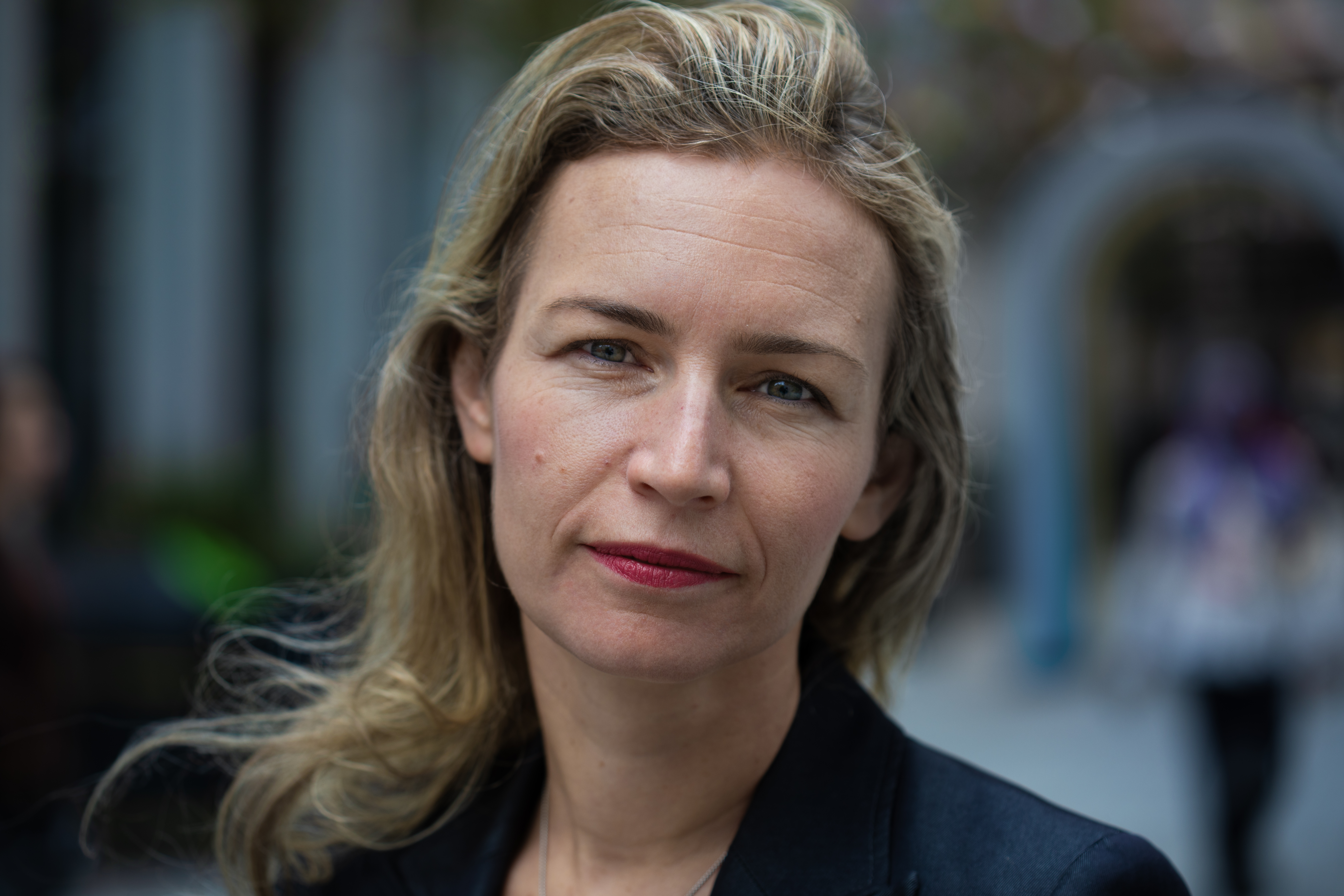
Albanian philosopher and political scientist Lea Ypi is Professor of Political Theory at the London School of Economics. A Kant specialist, her work seeks to re-establish a politics that reconciles the demands of individual liberty and social justice. She is the author of Global Justice and Avant-Garde Political Agency (Oxford University Press, 2011) and The Architectonic of Reason (Oxford University Press, 2021). Her autobiographical book, Free: Coming of Age at the End of History (Allen Lane, 2021) recounted her adolescence amid the fall of communism and the dashed hopes of capitalism. This autobiographical exploration continues with the novel Indignity (Penguin, 2025), dedicated to her grandmother’s youth. She holds the 2025-2026 annual chair The Invention of Europe through Languages and Cultures at the Collège de France, in partnership with the French Ministry of Culture.
Books & Ideas: You began your lecture course by discussing the “age of unreason.” What are its characteristics, and how can the philosophy of the Enlightenment respond to this context?
Lea Ypi: The age of unreason is the opposite of the age of reason, also known as the Enlightenment. The Enlightenment was defined by the German philosopher Immanuel Kant as humanity’s departure from a self-imposed tutelage. It is an age that tries to emancipate human beings from authoritarianism and from belief in dogmas.
I think these dogmatic beliefs define many phenomena of our time: whether it be social media influencers, the power or economic forces that shape political life, politicians who only consider their own interests when defining public policies, or even the resurgence of the prospect of war.
I think all of this can be understood with the term “unreason” because it involves a profound irrationality in politics. The Enlightenment can therefore help us rethink how to find the courage to think for ourselves.
Books & Ideas: To build an alternative, you start from a double failure, that of state socialism and that of capitalism, both of which betray the idea of freedom. How does this “Enlightenment freedom” differ from the freedom reduced to limited choices that you critique (along the lines, for example, of Sophia Rosenfeld)?
Lea Ypi: Yes, it is a double betrayal. The betrayal of state socialism, of real socialism, in relation to the idea of socialism that aimed to overcome the limits of capitalism and realise an idea of freedom for all. We see that state socialisms were a form of oppression by parties and bureaucracies, where the ideals of freedom that characterised socialist movements in opposition to capitalism have not been realised.
On the other hand, after the fall of communist countries, we saw a return to ubridled capitalism, where economic power concentrates everything, where there is a political return to austerity, where social-democratic parties lose the concept of social emancipation that characterised socialism and are content to focus on the legal implementation of capitalism, to facilitate profit for a few. So it is also a system where one cannot find the possibility of realising freedom for all.
I believe that the freedom of the Enlightenment, the freedom of reason, is a freedom that tries to connect the individual to the social, to the collective. It is a freedom understood as moral responsibility, and not merely as the freedom of selfishness that establishes itself as a system, as we find in capitalist systems.
Books & Ideas: Your proposal is an alternative you call “moral socialism.” What does it consist in?
Lea Ypi: Moral socialism is an effort to rethink the world by drawing inspiration from the philosophy of the Enlightenment, while also offering a critique of either capitalism or state socialism. It is an effort to think about freedom and radicalise our conception of freedom, by considering the social consequences of this Enlightenment critique.
We can speak of moral socialism, just as we can speak of egalitarian liberalism or radical democracy–and if some people are uncomfortable with the term “socialism,” that is not very important. What matters is making a diagnosis of the same issues and seeing the same direction towards change. For me, moral socialism is a project that returns to the conception of freedom as moral and social responsibility, and that finds a new way of thinking about the world, a way that transcends the limits of capitalism and state socialism.
Books & Ideas: How is it rooted in the Enlightenment, and how would you respond to those who might see it as a distortion of Kant through the lens of Marx?
Lea Ypi: The philosophy of the Enlightenment is a philosophy for thinking about crisis. The Enlightenment was an era of great scientific and technological transformations, but also of a crisis of authority and an effort to return to morality and reason as the centre of everything, understanding that reason is either the source of all error or the source of hope. I also think that for the Enlightenment it is not only about abstract ideas; it is also a social philosophy.
Moral socialism has a philosophical tradition that was crushed by the state socialism of the 20th century. It is an effort to recover this lost tradition, with very important figures in early 20th-century German philosophy, who drew inspiration from Kant’s thought and who show us that there is a critique of capitalist society influenced by the Kantian moral conception. In Germany, we find this in the thought of Hermann Cohen, neo-Kantians like Paul Natorp, or Eduard Bernstein. In Austria, this involved figures known as the Austro-Marxists: Max Adler, Otto Bauer, Karl Renner. There too, the aim was to demonstrate how the Kantian moral conception–and one of the most important formulations of the categorical imperative, which is never to treat other human beings merely as means but always as ends in themselves–cannot be realised in a capitalist society. A profit-driven society, where the prevailing tendency is to treat all human beings as means, as sources of digital data, as something to be exchanged for profit. The moral socialists, therefore, sought to draw the consequences of this Kantian thought for the critique of society.
Books & Ideas: You emphasise that the philosophy of the Enlightenment makes it possible to overcome contemporary irrationality. Concretely, how does this framework help us to analyse current political phenomena?
Lea Ypi: The Enlightenment sought to understand how unreason infuses into political institutions, how authoritarianism is born and how it can be overcome. In the Age of Enlightenment, this took the form of the authoritarianism of religion or monarchy. But in our era, it takes the form of the authoritarianism of the market, of social trends adopted without thinking, and also of a political authoritarianism that offers no alternative system.
Moral socialism is an alternative vision for a globalised world where the limitations of both capitalism and the nation-state are becoming apparent. It is about situating this perspective of change within a cosmopolitan and peaceful context, where it is crucial to make an effort to change institutions: either to control the market from a democratic perspective, or to understand that it is not possible to control the market through nation-states alone.
Here again, the Enlightenment helps us, because its philosophy was a philosophy for a world in crisis, but also a philosophy for the world, a philosophy of globalisation, where the first projects for perpetual peace and international institutions that transcend the principle of power becoming law began to take shape. It tries to understand legal relations and relations of freedom within a context of international institutions, where one sees the limitations of both individualistic interpretations and nationalist ones.
Books & Ideas: In the current context of platform capitalism and populist waves, how can this project be realised? Can moral socialism then respond to the fractures and oppositions within Europe itself?
Lea Ypi: To achieve moral socialism today, I think it is important to consider the dimensions of freedom and the complexity of identity. It is also crucial to inscribe this within a cosmopolitan project, a project of peace. For Immanuel Kant, we must understand freedom as something that does not belong only to the individual, but which requires social conditions for its realisation. So something like the freedom to own property, for example, will be understood within a legal framework that is national, international, and also cosmopolitan.
Immanuel Kant believed that this project of building cosmopolitan institutions would emerge from war, because he thought that at a certain point, human beings would grasp the irrationality of war. He had a kind of prophecy, and believed that nature would reveal to humanity what reason had not yet been able to make them understand. This project was very important in inspiring the original projects of the European Union. For example, in the Ventotene camp, which was a prison camp in fascist Italy, the democrats Altiero Spinelli and Ernesto Rossi wrote a manifesto for a cosmopolitan and post-capitalist Europe that later inspired European institutions.
This is very interesting because recently, the Italian Prime Minister Giorgia Meloni said in the European Parliament, citing the Ventotene Manifesto: “If this is your Europe, it is not mine.” And she was right, because the Europe that the right wing is trying to build is a Europe of the strongest that crushes the weakest. It is a Europe of security, of deporting immigrants, and it is a Europe very far removed from the post-capitalist federalist project of the Ventotene Manifesto. This is also where the inspiration of the Enlightenment appears, in this effort to rethink socialism for a transnational and cosmopolitan community, but which also considers alternatives to the capitalist market.
Books & Ideas: How does your own experience illuminate this necessity?
Lea Ypi: I think it is important to consider freedom from two perspectives. The perspective of macrohistory, what one might call the history of leaders, geopolitics, and the major forces of history. But also microhistory, the history of subjects, of people who live their lives and are affected by these dynamics, whether socialism or capitalism. I lived in Albania, where we witnessed the communist regime, freedom, and oppression. We experienced the oppression of a system that was a vertical oppression by the party, the bureaucracy, and the surveillance system. And this was replaced by another type of oppression: a horizontal oppression by the market, by the complicity of consumers, by a dynamic where one finds no responsible individuals, but where we still see that freedom is not for everyone. It is from this dual life experience that we must rethink socialism and the alternatives to contemporary society.
by , 18 February
Share this article
Find us here :


Further reading
Photo © Mihaela Noroc
To quote this article :
Julien Le Mauff, « Moral Socialism. An interview with Lea Ypi », Books and Ideas , 18 February 2026. ISSN : 2105-3030. URL : https://booksandideas.net/Moral-Socialism
Nota Bene:
If you want to discuss this essay further, you can send a proposal to the editorial team (redaction at laviedesidees.fr). We will get back to you as soon as possible.
You might also like


Our partners


Sections
Keep in touch
© laviedesidees.fr - Any replication forbidden without the explicit consent of the editors. - Mentions légales - webdesign : Abel Poucet