


Marx misunderstood Proudhon: he criticized him for neglecting the relations of production, when in fact the French anarchist was interested in the political subjugation that, in his view, private property inevitably causes.
In Praise of the Unpropertied
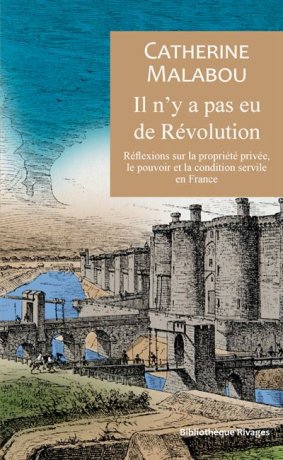
About: Catherine Malabou, Il n’y a pas eu de Révolution, Payot & Rivages
About: Catherine Malabou, Il n’y a pas eu de Révolution, Payot & Rivages

|
Catherine Malabou’s book Il n’y a pas eu de Révolution (There Was No Revolution) is a brilliant and thought-provoking essay. It takes an original approach to some of the most topical issues in critical political thought: challenging neoliberalism, investigating the commons, and denouncing colonial domination. The author does this through a reflection on property and dispossession inspired by a fruitful reading of Proudhon. Her thesis is both clear and subtle, as it is, in a single stroke of the pen, an exegesis of Proudhon’s What Is Property? (1848) and a more general statement on ways of achieving the anarchist ideal. The book should therefore be read not as a linear treatise, but as an invitation to navigate and draw connections between intertwined themes and theoretical fields.
A proposed reading of Proudhon
The book is presented, first and foremost, as a novel re-interpretation of the most famous work by the anarchist philosopher Pierre-Joseph Proudhon. It seeks to understand why he asserts in What Is Property? that there was no revolution. According to Proudhon, during the French Revolution the people “fell back into privilege and servitude, always by imitation of the Ancien Régime. […] There was progress in the granting of rights; there was no revolution” (Proudhon, quoted on p. 10). The phrase is enigmatic, and much of the discussion is devoted to clarifying it.
To this end, Malabou’s main argument centers on an analysis of property law. Contrary to Proudhon’s analysis, one might think — following Rafe Blaufarb, and as the author herself insists — that private property, stripped of its feudal trappings by the French Revolution, marked a truly revolutionary break with the Ancien Régime. Indeed, under the Ancien Régime, land was a vehicle for political hierarchies and domination. However, with the abolition of privileges and the nationalization of clergy property in particular, land ownership lost all political value. As a result, the end of feudalism coincided with the affirmation of private property.
However, strangely enough, Proudhon asserts that there was no revolution. Malabou eloquently explains that this is because an essential feature of feudal power remained: the droit d’aubaine. The term, as Catherine Malabou points out in an original and illuminating way, is borrowed from feudal law: it was the right reserved by the feudal lord to confiscate the property of foreigners who died without heirs, and was therefore a right of dispossession. It was at this point in particular that the continuity between the Ancien Régime and the post-revolutionary period came into play, as the right of dispossession by the ruling class remained in place. The division between exploiters and exploited, between rulers and ruled, was not abolished but continued, albeit in a different form.
This is precisely what enabled Proudhon to come up with another of his paradoxical phrases: “property is theft.” For Proudhon, the droit d’aubaine in the post-revolutionary period referred to rental income, interest paid on a loan, rent paid for the use of a field, and the profit made by the owner of the means of production from workers’ labor. In short, all contemporary forms of dispossession carried out by proprietors by virtue of the dominant position conferred on them by property.
Defense and critique of the commons
In her work, Malabou revisits Marx’s ambivalence towards Proudhon. After praising some of Proudhon’s analyses, Marx criticized him for the naivety of his analytical categories and for failing to fully appreciate that these categories are themselves the result of historical processes determined by the relations of production. Malabou, however, contrary to Marxist economic reductionism, considers that anarchism resists criticism by asserting the relative autonomy of politics in relation to economics. What mattered to Proudhon, like Kropotkin, was not economic mechanisms, but political subjugation. Accordingly, “politics is the denunciation of the dynamics of domination and enslavement present in all regimes, whether ‘old’ or ‘revolutionary,’ dynamics that economic science will never be able to explain fully” (p. 98). Proudhon was not, therefore, interested in the origins of private property, but rather in private property as a political fact that enabled dynamics of domination, and he focused primarily on the critique and abolition of these dynamics.
How, then, to achieve anarchism thus conceived? Malabou first invites us to be wary of those who, like Jeremy Rifkin, have predicted the disappearance of property in favor of access-based logic and made capitalism the chief gravedigger of private property. In his celebrated book The Age of Access, Rifkin argues that consumption patterns have changed radically, with people seeking less and less to acquire goods in favor of accessing the experiences or functionalities that those goods enable. Access without appropriation would replace the exchange of property. However, the author believes this to be an illusion, as the physical infrastructure that enables access to the experiences or functionalities of resources must belong to someone. This new structure of capitalism does not, in reality, abolish property or unearned advantage, but creates new rents and new dependencies, as Cédric Durand so aptly analyses for GAFAM under the name of techno-feudalism [1]. The droit d’aubaine, once again, does not disappear but is transformed.
Far from the mirages of neoliberalism, another path appears to be unfolding: that of the commons and self-government. Indeed, the theoretical and political movement of the commons questions the reduction of the economy to appropriation by proposing ways of owning, producing, and working together that are free from proprietary forms of domination and economic diktats. Within the paradigm of the commons, the economy, subject to self-government, becomes political. Yet, what is both appealing and disturbing about the commons is that, while they certainly make it possible to think about community self-governance, in doing so they risk making us abandon the fundamental anarchist belief that no one belongs to anyone, not even to the community. Hence, anarchism rebels against all forms of totalization: “No one belongs to anyone. No one can be shared. This ‘belonging to no one,’ which is never analyzed in theories of the commons or in reflections on communism, can never become a principle. Otherwise, it would belong to itself.” (p. 224).
The phenomenon of dispossession as an anarchist paradigm
One final theme in the reflection concerns servitude and forms of dispossession in general. Despite its condemnation of slavery, the author admits that What Is Property? does not seem to provide any basis for thinking about this type of dispossession. However, she suggests referring to Robert Nichols’ book, Theft Is Property!, to explore the theme further. Its title reverses Proudhon’s formula: it is theft that creates property. This allows Malabou to reflect on the complex forms taken by colonial dispossession, where theft was not preceded by any form of property. For it was indeed dispossession— colonial theft — that in turn produced a sense of what was once one’s own and was taken away, that which is now denied to a people. The question of dispossession also gives her the chance to explore the position of marginalized people, those who were deprived of social identity and access to inheritance, whose status was liminal: non-citizens, serfs and bastards, outsiders, foreigners, and the disinherited, all of whom posed a challenge to an egalitarian society — linked, negatively, to the property of those who do not have the status to enjoy it. From this perspective, it is “necessary to understand what theft is by focusing more on deprivation than on property.” (p. 258).
This digression also allows us to return to a point often perceived as a contradiction in Proudhon’s thinking: the way in which the anarchist philosopher re-establishes his defense of free property against the logic of feudalism in The Theory of Property (1862). Such free property, which feudal law called alleu or “allodial land” — that is, land not subject to taxation — could indeed guarantee individual independence without enabling the resurgence of domination. However, the revolutionary promise of property for all was betrayed and social cleavages remained. Thus, the realization of anarchism would lie less in the search for and establishment of an ideal form of government than in the fulfillment and deepening of the revolutionary gesture. Anarchism, in this sense, would rebel against any “attempt to control the anarchist space” by circumscribing and defining it within a single political ideal (p. 273). In reality, anarchists must refuse to impose any political ideal that would constitute a “domination of anarchism itself.” Anarchists must therefore accept the inherent aporia of their commitment and become “the voice of all the non-citizens, serfs, bastards, and workers, while remaining outsiders, questioning the stolen memory of servitude without creating a servile memory or obedient disciples. Remaining the Other, unassignable and ‘unpropertied.’” (p. 272).
This review of Catherine Malabou’s essay offers a suggested path through its interwoven themes, which awaken in the reader an invigorating pleasure in reading. While we may sometimes be left wanting more, wishing that a particular theme had been explored in greater depth, we also inevitably realize that a more laborious development would have caused the book to lose much of its liveliness. Malabou thus endeavors to remind us of the inchoative nature of all anarchist engagement. Those seeking a definitive normative response to the political challenges of our time may be disappointed by the aporia that concludes the book, but they cannot deny that this affirmation of the continuation and deepening of the revolutionary process is indeed characteristic of anarchism. Anarchism never offers scholarly discourse, of an economic nature for example, that could resolve an issue, but, being politically opposed to anything that reproduces forms of domination, it outlines a political space that constantly renews the question of the conditions for achieving real equality between free individuals.
Catherine Malabou, Il n’y a pas eu de Révolution, Paris, Payot & Rivages, 2024, 320 pp., €20, ISBN 9782743662448.
by , 26 March
Share this article
Find us here :


To quote this article :
Pierre Crétois, « In Praise of the Unpropertied », Books and Ideas , 26 March 2026. ISSN : 2105-3030. URL : https://booksandideas.net/In-Praise-of-the-Unpropertied
Nota Bene:
If you want to discuss this essay further, you can send a proposal to the editorial team (redaction at laviedesidees.fr). We will get back to you as soon as possible.
You might also like


Footnotes
[1] Cédric Durand, Techno-féodalisme. Critique de l’économie numérique, Paris, La Découverte, 2020.
Our partners


Sections
Keep in touch
© laviedesidees.fr - Any replication forbidden without the explicit consent of the editors. - Mentions légales - webdesign : Abel Poucet