

The French government’s approach to religious pluralism cannot be easily summarized, given its diversity and complexity, as well as its dependence on the contingencies of politics.
France and Its Religions
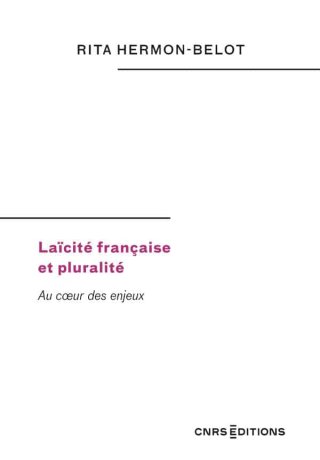
About: Rita Hermon-Belot, Laïcité française et pluralité. Au cœur des enjeux, CNRS Éditions
About: Rita Hermon-Belot, Laïcité française et pluralité. Au cœur des enjeux, CNRS Éditions

|
Over the past ten years in France, there has been no shortage of publications on the history of secularism. Some examples include books by Philippe Portier (2016), Philippe Raynaud (2019), Éric Anceau (2022) and Valentine Zuber (2023), and Jean Baubérot’s three-part work (2019, 2021 and 2024). Rita Hermon-Belot herself already devoted a 2015 study to this topic, entitled Aux sources de l’idée laïque (The origins of the secular idea). The question is therefore posed right from the introduction (p. 12): Is there anything left to write about laïcité [secularism]? The result of four years of work, this comprehensive and richly detailed volume answers that question with a resounding “yes.” Three key features characterize the author’s approach: a strong focus on the diversity of public action (rather than on discourse), an emphasis on the contingent nature of the “laïque idea,” and, consequently, a cautious stance in the controversies associated with it. The basic idea is that laïcité can only be properly understood and evaluated if it is viewed in the context of its connection to the pluralism that has historically characterized French society.
Public action in all its forms
The historical approach does not seek here to align itself with the “work of the sociologist” (p. 18), as espoused in particular by Philippe Portier and Jean Baubérot. The process of laïcisation [secularization] cannot be reduced to categories (“thresholds” or “stages”) that would allow us to definitively identify trends, discern shifts, and thus distinguish between periods. The question of “paradigm shifts” is not entirely absent: chapters 11 and 12, which focus on the law of August 24, 2021 reinforcing respect for the principles of the Republic (known as the “separatism law”), address it explicitly. However, not only does it not receive a clear answer, but, more importantly, the overall thrust of the study tends to highlight its undecidable nature. In contrast to a teleological interpretation of the history of laïcité (as exemplified by Marcel Gauchet), Rita Hermon-Belot seeks to document the enormous diversity of public policy on religious pluralism in France, at both the national and local levels, focusing as much on legislation as on regulatory acts, administrative directives, circulars, and case law. The complexity of the resulting proliferation of forms of public action helps to prevent laïcité from being reduced to what is expressed in political and media discourse, which often focuses on a few high-profile cases (the visibility of religious symbols, in particular). The emphasis on the “republican discourse” of laïcité, while by no means devoid of analytical value (Joan Scott, 2018), can in fact distort perceptions of the public authorities’ real actions, artificially reinforcing the impression that the French system is unique on the international stage.
Nearly half of the book is therefore devoted to the role of public services. It examines both the law of March 15, 2004 (prohibiting the conspicuous wearing of religious symbols or attire by students in public schools) and the law of October 11, 2010 (prohibiting the concealment of the face in public spaces), as well as the tangible effects of lesser-known policies aimed at “supporting ‘catch-up,’ that is, reducing the gap in conditions of religious practice between religious groups” (p. 338). For example, the policies promoting the construction of places of worship for non-Catholic religions are detailed as follows (p. 340 et seq.): while the use of administrative long-term leases appears to be gradually bringing their situation in line with that of the Catholic Church—which is a recipient of state and municipal ownership of churches and cathedrals built before 1905—the expiration of these century-long leases nevertheless has significant consequences (what funds will be available to maintain these new public buildings? Will a local government have the power to change their use as a religious site?). The book documents (pp. 349 ff.) the efforts of hospital, military, and prison administrations to appoint Muslim chaplains, whose rapid expansion may, however, encounter resistance—particularly in prisons—due to mistrust (as inmates sometimes view chaplains as “collaborators”). It also describes (pp. 357 ff.) the tension between the formal prohibition on religious discrimination in public cemeteries and the numerous incentives given to mayors—often through circulars from the Ministry of the Interior—to maintain religious groupings, which has created a certain degree of “legal uncertainty” (p. 360).
The contingency of the “laïque idea”
This presentation, with its “almost excessive meticulousness” (p. 20), not only corrects the distorting effect but also has the advantage of “restoring an element of contingency” (p. 25) to the “laïque idea.” This brings us to the second distinctive feature of the book’s approach. As Rita Hermon-Belot points out in the introduction and conclusion, no law in France provides a definition of laïcité or allows its exact scope to be determined. The often-cited law of December 9, 1905, is neither a necessary condition—it does not apply in the northeastern region of Alsace-Moselle or in most of France’s overseas territories, a fact to which the Constitutional Council raised no objection in its decision of February 21, 2013 (p. 90)—nor a sufficient condition—the laws governing public schools perhaps better reflect its “spirit” (p. 498). The author also questions the validity of a characterization that reduces laïcité to state neutrality—that is, to a principle of non-interference by the government in order to preserve religious freedom (as expressed in the first two articles of the 1905 law).
Article 1: The Republic ensures freedom of conscience and guarantees the free exercise of religious worship, subject to restrictions enacted only in the interest of public order.
Article 2: The Republic neither recognizes, nor salaries, nor subsidizes any religion. Consequently, from 1 January following the promulgation of this law, all expenses related to the exercise of worship shall be removed from the budgets of the State, departments, and municipalities. However, those expenses related to chaplaincy services and intended to ensure the free exercise of religion in public institutions such as schools, colleges, hospitals, asylums, and prisons may be included in the said budgets.
While this liberal interpretation has become increasingly prevalent—particularly through the case law of the Conseil d’État after World War II (pp. 89–90)—it may obscure a historical pattern that is “exactly the opposite: the state dismissing—and at times expelling—the religious institution, in this case the Catholic Church, from entire spheres of citizens’ lives that the Church had played a major role in establishing, such as schools, healthcare, social services, and prisons” (p. 88).
However, the fact that there are no clear conceptual boundaries for laïcité raises a methodological question: how to define the scope of the historical investigation? Hermon-Belot has chosen to take religious pluralism as her starting point, treating it as a factor that gives rise to specific “problems” that the government must address. The author acknowledges that, sociologically speaking, the concept of a “problem” is itself problematic. However, using it as a guiding principle—while taking significant precautions (describing it as precisely as possible and quantifying it)—offers us “a path that brings us as close as possible to the experience” (pp. 16–17). It is important to note that religious diversity in France is hardly a new phenomenon; rather, it has a long history. Whether it be the Jewish presence in Roman Gaul (p. 28 ff), the presence of Muslims within the Frankish kingdom, the violent clashes between Christians over heresies (the Albigensian Crusade), the schism in the Eastern Church, or the advent of the Reformation, religious homogeneity in France has never been anything more than a myth. Focusing in particular on the turbulent circumstances surrounding the adoption of Article X of the Declaration of the Rights of Man and of the Citizen during the 1789 French Revolution and its aftermath (pp. 33 ff.), Hermon-Belot also shows that, contrary to a sometimes persistent misconception, discretion in religious expression is far from being a sufficiently ingrained feature of French culture for the problem of the public display of religious worship to be a major source of conflict among members of parliament. Public order is thus invoked in a wide range of different ways, including preventing non-Catholic religious services from being held openly, requiring Jews to take an oath renouncing any communal status in order to obtain citizenship, or denying them the right to vote in eastern France.
The more contemporary issues fall into two categories: those relating to religious expression—inequalities in the practice of worship, discrimination, public hostility, and violence—and those that religious expression may cause with regard to the functioning of various public services (health care, the justice system, schools and higher education), sports organizations and businesses, the resolution of political and social conflicts, and threats to the integrity and safety of individuals. There are many examples—well-documented and sometimes little known to the general public—such as the issue in condominiums of building access controlled by electronic systems, which prevent those who observe the Shabbat from entering (p. 144), or the question of vaccination coverage for students at schools affiliated with the Fraternité Saint-Pie X or Steiner-Waldorf schools (p. 219). These problems are numerous and intertwined, as seen in a series of concrete cases where the line is blurred between what infringes upon—or is perceived to infringe upon—a religious group’s legitimate freedom of expression, and what places an undue burden on public authorities or compromises other freedoms. This makes it possible to expose the “solutions” proposed by public authorities for what they are: an often disparate (or even contradictory) set of actions taken by a variety of public officials, which amount more to a series of trial-and-error attempts than to the necessary, organic application of a universal principle.
A cautious denunciation of abuses
The contingent nature of the “laïque idea” and the policies that may be linked to it does not detract from its value, but rather makes it necessary to assess it on a case-by-case basis. This is the third characteristic of Hermon-Belot’s approach: avoiding taking sides in debates or controversies over secularism from the outset by rejecting “falsifications” or “distortions”. Indeed, the conclusion clearly underscores the author’s argument in favor of a “pluralistic culture” (p. 489) in public discourse, one that gives particular attention to the effects of policies on all religious groups—or, as the author puts it, “what English-speakers call ‘the big picture’” (p. 490). With this in mind, she criticizes the 2010 law as being “ineffective and counterproductive” (p. 279). Similarly, she takes issue with the overly restrictive legal definition of religions—which is influenced by the monotheistic model—arguing that it has hindered the development of Buddhism (pp. 435-436). Furthermore, the discrepancy between rhetoric and action has led to “attempts to unlawfully extend the principle of neutrality” (p. 333): for example, denying a city council member the right to speak because they are wearing a cross, removing alternative meal options from school cafeterias, and disciplining a veiled student at a nursing college. However, the author is wary of the prospect of a “change of course” (p. 494)—that is, a more assertive alignment with the US model, where she believes a clearer recognition of pluralism unduly favors the most conservative choices: for example, the 2022 overturning of the Supreme Court’s Roe v. Wade decision, which protected the right to abortion at the federal level. To accept such a “narrowing [of] the scope” of secularism (p. 497) would undermine the principle of equal treatment for all.
Conclusion
Some reservations may be raised on this last point, stemming from the first two characteristics of the approach. The move away from the use of sociological categories or legal definitions of laïcité undermines the robustness of a normative discourse that is not purely pragmatic. Thus, the author’s call for a review of the 2010 law stands in contrast to her continued support for the 2004 law, considered more effective because of the small number of disciplinary proceedings resulting in expulsion (pp. 151 and 269–270). The study by Éric Maurin (2021) is also cited (p. 481), revealing a correlation between the enforcement of restrictions on students’ wearing of religious symbols—beginning in 1994—and the academic performance of those most impacted by these restrictions. Similarly, she has a favorable view of the ministerial directive dated August 31, 2023, prohibiting the wearing of abayas and qamis, given the small number of students who failed to comply (p. 486). However, the author’s justification for this—promoting “civic cohesion” (p. 487)—seems open to question if, as she acknowledges and laments, these measures are finding less and less support among younger generations (so much so that she speaks of a “generational divide,” p. 493), foster a sense of stigmatization, and lead students to abandon public schools in favor of the private school system (a choice in which the “religious factor seems […] to play a decisive role,” p. 157). In short, although it is debatable whether stability alone is sufficient to establish the validity of a law, the regular challenges it gives rise to (such as, among others, the “violations of laïcité” recorded by the Ministry of Education) may, on the other hand, call into question the claim that it is effective.
Finally, the characterization and assessment of the French model, as compared to the “American approach” (p. 492), seem to us to be insufficiently substantiated here. Firstly, saying that only the former protects non-religious convictions runs counter both to the extensive writings of North American and British liberal philosophers (Charles Taylor and Jocelyn Maclure, Ronald Dworkin, Cécile Laborde), who oppose the idea that only religious individuals should benefit from accommodations—in other words, the possibility, under certain conditions, of being exempt from the application of a general rule. And secondly, it runs counter to the case law of the US Supreme Court, which as early as 1970 (Welsh v. United States) recognized the status of conscientious objectors not affiliated with any religious tradition. The reference to Roe v. Wade is a little misleading, as the Supreme Court’s first ruling predated the Veil Act by two years.
These few issues in no way detract from Rita Hermon-Belot’s fascinating book, which, through its depth and precision, makes a significant contribution to contemporary discussions of laïcité policies.
Rita Hermon-Belot, Laïcité française et pluralité. Au cœur des enjeux, Paris, CNRS Éditions, 2025, 504 p., 26 €.
Further reading
Bibliography
– Éric Anceau, Laïcité, un principe, Paris, Passés composés / Humensis, 2022.
– Jean Baubérot, La Loi de 1905 n’aura pas lieu, Paris, Maison des sciences de l’homme, 2019 (tome I), 2021 (tome II), 2024 (tome III).
– Rita Hermon-Belot, Aux sources de l’idée laïque, Paris, Odile Jacob, 2015.
Éric Maurin, Trois Leçons sur l’école républicaine, Paris, Seuil, 2021.
– Philippe Portier, L’État et les religions en France, Rennes, Presses universitaires de Rennes, 2016.
– Philippe Raynaud, La Laïcité, Paris, Gallimard, 2019.
– Joan Wallach Scott, La Religion de la laïcité, trad. J. Marelli, Paris, Flammarion, 2018.
– Valentine Zuber, La Laïcité en débat, Paris, Le Cavalier Bleu, 2023.
by , 5 November
Share this article
Find us here :


To quote this article :
Thibaut Héry, « France and Its Religions », Books and Ideas , 5 November 2026. ISSN : 2105-3030. URL : https://booksandideas.net/France-and-Its-Religions
Nota Bene:
If you want to discuss this essay further, you can send a proposal to the editorial team (redaction at laviedesidees.fr). We will get back to you as soon as possible.
You might also like


Our partners


Sections
Keep in touch
© laviedesidees.fr - Any replication forbidden without the explicit consent of the editors. - Mentions légales - webdesign : Abel Poucet