


Mickaëlle Provost seeks to understand oppression through lived experience, in all its uniqueness. She also shows how shared awareness of this suffering and the ways in which it is erased can create solidarity and pave the way for collective resistance.
John Ford : Sergeant Routledge (1960)
Discrimination as a “test”
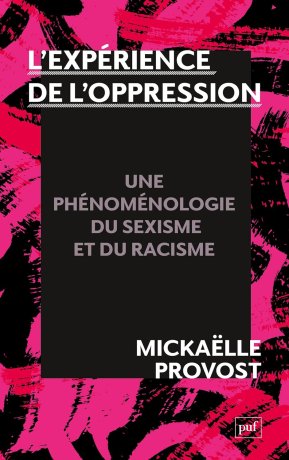
About: Mickaëlle Provost, L’expérience de l’oppression. Une phénoménologie du sexisme et du racisme, Puf
About: Mickaëlle Provost, L’expérience de l’oppression. Une phénoménologie du sexisme et du racisme, Puf

|
In the very first lines of L’expérience de l’oppression, the reader encounters the forceful words of the feminist poet and philosopher Audre Lorde, illustrating the insidious ways in which oppression often manifests itself, through gestures, facial expressions, and words that, over time, are internalized by the oppressed. In this way, Mickaëlle Provost understands oppression as a network of violent dynamics supported by a state-based, capitalist, racist, and patriarchal system (p. 19) but that is, at the same time, experienced by sensitive, living, and suffering subjects (p. 9). For this reason, Provost proposes to approach oppression through phenomenology, a branch of philosophy that considers the essence of perceived phenomena as they are experienced and described by those with first-hand knowledge of them. She thus examines the subjective effects of racist and sexist oppression, taking as her starting point not existing social structures, norms, and institutions, but lived experience.
To this end, Provost brings the work of Frantz Fanon and Simone de Beauvoir into conversation, while also drawing on literature, which offers rich, first-person descriptions of oppression. Yet because she does not wish to reach the pessimistic conclusion that oppression inevitably locks subjects into immobile situations from which escape is impossible, Provost ends her book with a discussion on the liberatory potential of the transition from individual suffering to collective resistance.
Describing oppression “from within”
One might wonder if it is appropriate to respond to a question that is primarily political with a phenomenological analysis of individual accounts of violent experiences that are tied, in particular, to race and gender. The answer is deeply connected to the relationship between oppression and lived experience. It is important to grasp how oppression relates to experience, as it is because of daily, often normalized, and repeatedly endured violence that oppression imposes on sensitive and suffering subjects.
Provost first asks: under what conditions is an experience felt to be oppressive, and how can a subject clearly express this feeling? In other words, to theorize oppression, an experience must first be intelligible, that is, it must be “perceptible, recognizable, and thinkable; it must become a problematic object” (p. 49). A single, isolated event does not make an oppressed subject: violent experiences are sedimented and internalized over time. The purpose of describing first-person experiences of oppression is not to rank or compare different types of oppression-related violence. On the contrary, the point, as Provost explains, is to propose new theoretical tools that can “elicit new experiences—of injustice and oppression—that could not previously be experienced as such due to a lack of available (discursive, descriptive, and conceptual) interpretations” (p. 44). This is why Provost seeks to provide new interpretive frameworks through which oppression as it is experienced can become visible and recognizable to subjects, who thus become capable of describing them.
In philosophy, this interest in the lived experience of oppression is not new. By bringing de Beauvoir and Fanon into conversation, along with their respective phenomenological accounts of sexism and racism, Provost emphasizes the ambiguous character of any embodied subject, which is partly determined by their circumstances, but which also makes freedom possible. Action, in other words, is only possible on the basis of specific “social,” “moral,” and “political” circumstances (p. 73). Even so, subjects remain free to respond to the various impositions that the world places on them. Inspired by de Beauvoir and Fanon, Provost shows how oppression functions precisely by putting this ambiguity “to the test” and by twisting together the strands of experience of the individuals it affects (p. 75). The phenomenological description of the experience of sexist and racist violence thus reveals that the ambiguity inherent in any embodied experience is transformed, for all oppressed subjects, into a contradiction (p. 132).
Obstructed subjectivity
In their analyses of how subjects are affected by sexism and racism, de Beauvoir and Fanon were both influenced by Merleau-Ponty’s conception of the body. For Merleau-Ponty, the body is our way of entering the world—in other words, the way all experience becomes possible. Because the subject is always already embodied in the world, there is an element of experience that is irreducible to social, economic, historical, and biological conditions, but which is also constantly oriented towards its projects. Yet Provost observes that the ambiguity of the relationship between the subject and the world, which philosophy originally conceived as positive, is negatively determined by the experience of oppression. For example, a racialized person orients themselves in a world structured “by and around white bodies” and is subordinated to the “rules of the racial-colonial world” (p. 127). The relationship between self and the world is, for the oppressed person, always already the target of an “essentializing reduction” (p. 97), as it must constantly confront the image of itself that the other has constructed. Through the other’s gaze, words, and gestures, women or racialized persons are reduced to the image assigned to them and to which they must relentlessly return. They thus become a product of their socio-historical circumstances rather than a creative response to them. In this vein, Provost maintains that, according to Fanon (though the claim also applies to sexism): “Racism shuts down the unpredictable interrogations, ambiguities, and variations inherent in the body-expression” (p. 131). Yet while oppression can make even the simplest of daily gestures unbearable, the openness characteristic of any embodied existence persists, and it is essential to enabling resistance and, perhaps, rethinking and changing oppressive dynamics. For this to occur, oppression must be perceived for what it is—which, needless to say, does not always happen.
Why is this violence, which affects every aspect of the lives it targets, often not seen for what it is, making possible paths of resistance difficult to discern? Fanon would reply that “the literally hellish character of the colonial situation saps the desire to live and realize one’s humanity to such an extent that it becomes difficult to experience violence as a negation.” [1] Like Fanon, Provost is interested in the mechanisms that erase the suffering found in relationships between oppressors and the oppressed, which occurs exclusively in situations in which only the dominant group’s world has “meaning and legitimacy” (p. 251). Hence it is difficult for individuals who have experienced oppression to describe the violence and suffering of which they have been subjected, as the only epistemological tools available to them belong to the dominant class.
Provost thus sheds light on the contradiction experienced by people who are targeted by oppression and find themselves in a kind of “epistemic malaise” (p. 153): because they can only explain their experiences in the terms of dominant epistemological frameworks, they are unable to problematize their experience—and even doubt that a problem exists. This is why, for example, the image of the “dangerous” black man is ultimately internalized by the latter, since he is constantly confronted with an image of himself that is completely fabricated by the white world, which monitors every one of his gestures. In other words, “white suspicion” (p. 154) is transformed by the black man into self-doubt, resulting in endless uncertainty as to which gestures are appropriate, what can be said, and so on.
Provost shows that consequently, the relationship between the subject and the world is fundamentally changed: the world of the oppressed is deprived of all meaning, as it is confined to the margins of the dominant class’s world. Indeed, oppression forms a continuum with individual existence and compels subjects to live in an “eternalized present” (p. 236), totally isolated from the “open temporality of political struggles” (p. 235). Provost offers the example of Jeanne, the young woman in the film Jeanne Dielman, 23, quai du Commerce, 1080 Bruxelles, 1975: a single woman living with her son, whose life consists of the continuous repetition of the same daily tasks. According to Provost, the film illustrates the temporality of oppression, which is not linear but circular, condemned to repetition, isolating the subject and contributing to the individualization of suffering. In other words, the oppressed subject feels absent from the world, making it hard to form bonds with others and share distinctive experiences of oppression to find similarities. Provost asserts: “Exclusion resulting from this condition of oppression tends to dissolve the most inventive and collective forms of revolt, as it undermines efforts to create a shared world, to come together and build solidarities” (p. 258). In other words, being deprived of a world also deprives the oppressed subject of shared worlds, from which collective resistance could emerge.
From lived to collective experience: Towards resistance
How then does one transition from individual experiences of oppression to collective resistance movements? This “assumption of the experiential and subjective dimension” of the political phenomenon of oppression makes it possible, according to Provost, to propose a new answer to the question. She focuses on how people politicize their individual experiences of oppression-related suffering: “[phenomenology] makes it possible, first, to grasp resistance not as phenomena that are in the first instance collective and organized, but as unique experiences whose resonances create solidarities and make possible a pooling of forces, mobilization, and resistance to oppression” (p. 267).
In the book’s final section, Provost shows that collective resistance movements, like the American feminist movement, particularly the second wave of the 1960s and 70s, which first incorporated that voices of racialized women, are created when aspects of lived experience connect and blend together, so that they can draw new and collective attention to the real experience of oppression. This is why shared experiences within an oppressed group, such as music, are so important: they contribute to this new consciousness, such as the blues for American Black women from the 1920s to the 1940s, which denounced and narrated the oppressive violence to which they had been subject. Put differently, collective experience makes it possible to create spaces in which individuals affected by oppression begin to see their reality in ways that are new and shared. In the transition from the individual to the collective, the point is not to argue that the subjects’ individual experiences disappear and dissolve themselves into a collective and homogeneous experience of oppression. On the contrary, it is at the individual level, following an exchange with the other, that perceptual and affective transformations occur that demonstrate that oppression is a shared experience. Understanding the experience of oppression from the standpoint of lived experience, as Provost does, sheds light on the “lines connecting affects, thought, and perspectives on the world in order to shape a collective experience directed at ending oppression” (p. 305).
Provost has undertaken a colossal task: to understand oppression’s effects on the subject by taking as her starting point not the structures of institutions but the lived experience of oppressive violence for embodied subjects, sensitive, and living subjects. In this way, she sheds new light on the emergence of collective resistance at the intersection of lived experiences of suffering that are as different as they are unique.
After finishing the book, one question lingers, however, concerning the relationship between different forms of oppression. Throughout the book, Provost makes parallel use of de Beauvoir and Fanon to speak alternately of sexist and racist oppression and to show that both authors formulate positions about the lived experience of oppression that resemble and complete one another. Yet it would seem relevant to theorize the effects when these two forms of oppression are experienced simultaneously. Some thinkers, notably intersectionality theorists, maintain that they cannot be understood in isolation.
Mickaëlle Provost, L’expérience de l’oppression. Une phénoménologie du sexisme et du racisme (The experience of oppression: A phenomenology of sexism and racism), Paris, PUF, 2023, 344 p., 24 €.
by , 9 September 2025
Share this article
Find us here :


To quote this article :
Frédérique Jean, « Discrimination as a “test” », Books and Ideas , 9 September 2025. ISSN : 2105-3030. URL : https://booksandideas.net/Discrimination-as-a-test
Nota Bene:
If you want to discuss this essay further, you can send a proposal to the editorial team (redaction at laviedesidees.fr). We will get back to you as soon as possible.
You might also like


Footnotes
[1] Frantz Fanon, Peau noire, masques blancs, Paris, Seuil, 2014, p. 138.
Our partners


Sections
Keep in touch
© laviedesidees.fr - Any replication forbidden without the explicit consent of the editors. - Mentions légales - webdesign : Abel Poucet