


In a stimulating and well-informed essay, Sandra Hoibian refutes the idea that French society is becoming fragmented and suggests ways to measure a vague concept: social cohesion.
“L’ouvrier mort”, Edouard Pignon (1936)

Can social cohesion be measured?
About: Sandra Hoibian, La mosaïque française. Comment (re)faire société aujourd’hui, Flammarion
About: Sandra Hoibian, La mosaïque française. Comment (re)faire société aujourd’hui, Flammarion

|
Is French society inevitably becoming fragmented self-isolating communities, as Jérôme Fourquet contends in his highly successful essays? Sandra Hoibia, [1] the director of Crédoc (Research Center for the Study and Observation of Living Conditions [Centre de Recherche pour l’Étude et l’Observation des Conditions de vie]), a research center, uses the resources acquired in her organization’s studies (notably the Conditions de vie et aspirations des Français [French People’s Living Conditions and Aspirations]) to refute Fourquet’s claims and call attention to the opportunities and challenges faced by a society undergoing profound individualization—a society that has been damaged, she maintains, by generalized competition and the meritocratic ideology that justifies it rather than by the relegation of the population to mutually impermeable groups.
A (counter) narrative
Using the metaphor of a mosaic, Hoibian proposes an alternative to archipelago, the image Fourquet uses to describe French society and its tensions. Fourquet’s thesis, which has been widely discussed by journalists and politicians, presents a grim picture of French society’s direction, emphasizing the emergence of separate communities following the decline of the Catholic (and Communist) matrix that structured post-World War II society.
The interest of Hoibian’s essay, which began as a dissertation directed by Michel Forsé, is that it relies on Crédoc’s annual study of the living conditions and aspirations of the French people, making it a “unique and multi-themed essay on the ways of life, aspirations, and major opinion trends in French society over the past forty years,” as the organization’s website puts it. These annual studies are one of the most valuable sources for understanding long term trends about attitudes towards poverty and other indicators of social cohesion. Because they make it possible to include context-specific topics (like the Yellow Vest movement), the studies provide, moreover, a finetuned image of the sense of integration or lack thereof that characterizes our society.
The book puts forth two bold theses. Far from it being the case that individualism undermines social bonds, the individualization of values and behavior enhances them. Individualization shapes representations and forms of life in their entirety, from employment, work, family, friendship, leisure, belonging to civic and social activism. This individualization, which enables autonomy and never threatens robust social relations, is, however, highly ambivalent, as it testifies to the onset of an era of generalized competition that leaves few material and symbolic resources to competition’s losers, who are condemned to bear individual responsibility for their failure, just as winners are presumed responsible for their success.
Hoibian’s other bold thesis is that French society can recover its unity and cohesion by integrating its various components. The wager of the mosaic is greater acceptance—which rests, as the phrase implies, on a wager—of diversity and an assertive struggle against discrimination. Hoibian can, of course, level against Fourquet’s thesis data showing that “only 7% of the population claims to belong to a single community based on religion or country of origin” (p. 51) and that the more a religion is practiced, the more it is associated with the sense of having multiple identities. The feeling of belonging to a community does not imply isolation, but trust in others. This leads Hoibian to advocate for a form of social cohesion focused on fighting discrimination and promoting equality through difference. In her view, the republican conception of equality, which is indifferent to difference, is ill-suited to an age of individualization and the assertion of uniqueness. Her arguments are solid and clearly based on the communitarian philosophical tradition (associated with Michael Walzer and Charles Taylor), which favors a recognition of identities. Yet while her position is coherent, it downplays, perhaps, the obstacles to fighting discrimination as well as the disproportional political and symbolic weight of older population cohorts, which generally favor the republican assimilationist model and reject the politics of recognition.
Substantively, the book’s thesis recalls the book recently published by Vincent Tiberj, [2] even if, formally, it calls attention to an important editorial choice that signals a shift in intellectual production. Like Fourquet’s books, which her book opposes substantively, her essay takes a step beyond the academic realm, in which general narratives are proposed about social change in France. This trend is not universal, as Vincent Tiberj’s book attests, but is symptomatic of a reaction to academic specialization and professionalization. In practice, these trends prevent research from engaging in this kind of work, limiting the tasks of proposing synthesis and broad thesis-based conclusions to actors with access to data and government positions. One problem with this trend is limited cumulativity: the individualization highlighted by Hoibian has been previously noted and its limits abundantly criticized. Conversely, many academic works would benefit from considering its data and incorporating it into their own data sets, given how likely this information is to result in a reassessment of key issues. [3].
That being said, while it is regrettable that Hoibian’s response to Fourquet results in a counter-discourse that may be excessively reassuring and over general in its theoretical references, her book is full of important lessons, particularly thanks to its dialectic of aspirations and conditions, which is well suited to understanding French society’s dynamics. The study of aspirations and living conditions allow one to approach social life by combining data on practices with information on subjective representations of these practices, as well as policies and sociability, resulting in a fine-grained reading of the social, which relies, moreover, on long and often unmatched series (as with opinions about social benefits).
Between aspirations and conditions
Hoibian presents a picture of French society that results directly from Crédoc’s rich data. “The Living Conditions and Aspirations of the French” is a study that has been conducted every year since 1978 on a representative sample of France’s population. It provides Hoibian with remarkable wealth of information that, on many topics, is without equivalent. Its analyses provide extremely rich information on the state of French society, notably because it relies on a dialectic of aspirations and conditions, in which resources and ways of life are conceived in terms of their compatibility or—alternatively—their tension with the expectations, ambitions, and anticipations of various social groups.
Having denounced the excessively pessimistic vision of a society based on individualism and a retreat to ethnic communities, Hoibian maintains that individualization can lead to individual autonomy and social cohesion, as well as growing expectations and generalized social competition. The development of greater physical abilities, the rise of micro-entrepreneurs, and the expansion of digital communities are three notable instances of these trends. The book is, in this way, very cautious in describing the opportunities for expression, reflexivity, and more evenly distributed power relations that arise with the digitization of social interactions. She rejects the notion of information bubbles through a well-informed and optimistic analysis of the social implications of technological development, even as she recognizes its dangers and negative effects, such as heightened feelings of loneliness, on the one hand, and new opportunities for aggression and greater violence resulting from greater visibility, on the other. Revenge porn is a perfect example of hostile visibility aimed at destroying other people. Regrettably, the book does not consider the implications of the dematerialization of public services and ruptures in social cohesion.
Her analysis next considers forms of social decohesion and disconnection, with examples that make the most of her data. To illustrate her claims about generalized competition and commodification, Hoibian emphasizes occupancy status in housing as an important marker of social status. She explains the social dynamics that have resulted in this form of consumption becoming the largest household budget expense, as well as, in direct proportion to these budgets, the rise in household contributions to housing costs, which has canceled out gains in purchasing power, with all the attendant frustrations. She calls particular attention to the obstacles encountered by young working-class and middle-class households, who are often excluded from the housing market now as it has become increasingly oriented towards reselling rather than first-time homeowners. The generalization of property values, on the one hand, and high levels of social selectivity associated with acquiring a primary residence, on the other, result in a system that is fatally selective. The data is striking: 81% of households in the last income quintile (the richest 20%) are now homeowners, compared to 65% in 1988. Conversely, 27% of the poorest 20% are currently homeowners, compared to 47% in 1988. The college degree has become a social boundary, as is being a two-income household. The price of entering the middle class has risen considerably. Homeownership is a class marker that produces a sense of comfort and a calmer attitude towards the future that, all things being equal, creates an incentive to consume. [4] The Yellow Vest protests provided another opportunity to assess the limits of a society oriented towards competition from the standpoint of 1) the value of merit, b) mobility, and c) responsibility for failure. The Yellow Vests rejected a conception of personal merit disconnected from social conditions and the barriers that working-class people face. The barriers mentioned by residents of exurban and rural areas include mobility, which is highly stigmatized by environmental taxes even though these demographic groups rely on thermal cars. Finally, the Yellow Vests were quicker to attribute responsibility for success or failure to society than to the individual, in contrast to prevailing values, of which President Macron’s ideology is a significant and—in their eyes—violent example.
Ideas that merit discussion
Hoibian concludes her analyses with considerations of a more normative nature. She mentions the concept of the gift and its capacity to serve as the foundation of a respectful social order. This point seems limited and a little idealistic, given the underlying violence that Marcel Mauss associated with gift-giving. Her case for broader cultural references and greater tolerance, which draw on the Taylor-Bouchard report and the notion of reasonable accommodation between identity groups, is based on recognizing a generational divide between older citizens, who remain attached to “color-blind” republicanism, and younger people, who prefer a more open model. While the substance of this proposal is not in dispute, it fails to recognize that those who are opposed to recognizing social pluralism have the ability to shape opinion.
Yet Hoibian does not stop there. She considers her analysis’ potential for analyzing society as such through the measures she proposes. She formalizes a method for grasping social cohesion as commonality, using data that is very well adapted to the state of French society. The fact that she relies on an extensive data series relating to the state of French society and the aspirations of French people provides her with solid arguments to imagine the end of neoliberalism and a form of personal autonomy that is not anchored in individual responsibility—one that would allow individuals to experiment with activities and values without being held responsible for resulting failures but benefiting from social support and integration. In this way, the book provides clues to understanding decohesion and social division while, conversely, formulating criteria and indicators of social cohesion, giving this widely used quasi-concept a typology and a degree of measurability—one that is open to criticism and revision, but that is proposed to collective consideration and that in itself constitutes a significant contribution. [5] The following chart appears in the book in a more extensive and detailed form:
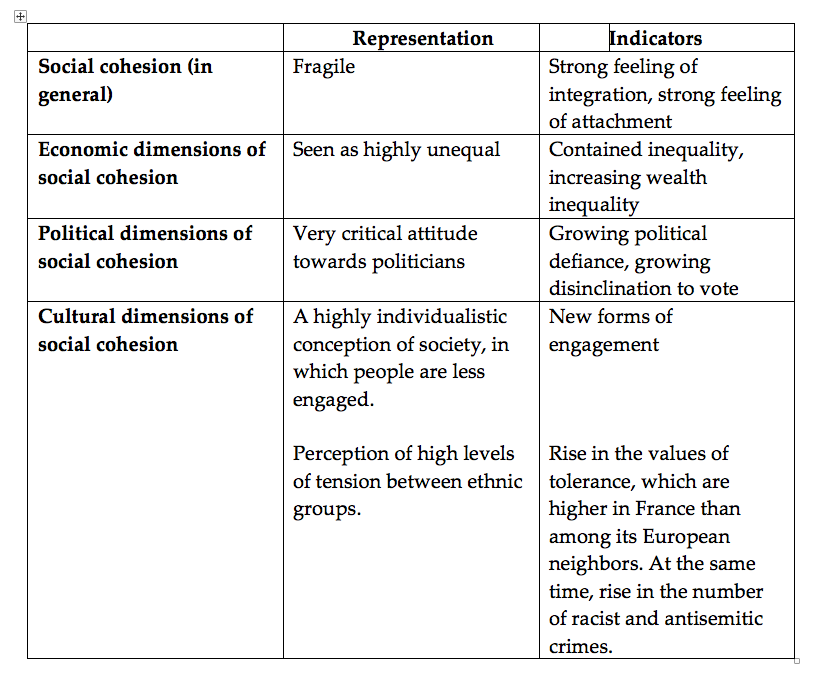
Source: Hoibian, 2024, p. 47
Hoibian makes a useful contribution by proposing a helpful tool, to which public figures can refer, like the opinion barometer of the French Ministry of Health and Solidarity or more qualitative measures (such as the barometer of the National Council for Policies Fighting Poverty and Social Exclusion [Conseil National des politiques de Lutte contre la pauvreté et l’Exclusion sociale]). Such formalization of the concept of social cohesion can inform reflection about this question, particularly relating to the criteria for determining what the associative and philanthropic sectors contribute to society. The question of a form of assessment that is pluralistic, participatory, and based on general indicators is of central concern to social actors, [6] who are understandably dissatisfied with social impact as the sole criterion. The “France Is Engaged” Foundation (Fondation “La France s’engage”), which seeks to anchor civil society actions in narratives [7]; the qualitiative barometer of the National Council for Policies Fighting Poverty and Social Exclusion, which strives to complement the aggregate picture of society with feedback from actors from throughout the country; or the use of the concept of “imprint” to better characterize the diffuse effect of a project aimed at social innovation and transformation—all these are interesting resources for a collective discussion that, at present, remains embryonic, though it is crucial for a time of radical questioning about the government impotence and the way out of it.
Sandra Hoibian, La mosaïque française. Comment (re)faire société aujourd’hui (The French mosaic: How to (re)make society today), Paris, Flammarion, 2024, 260 p., 21 €, ISBN 9782080456533.
by , 5 February
Share this article
Find us here :


To quote this article :
Nicolas Duvoux, « Can social cohesion be measured? », Books and Ideas , 5 February 2026. ISSN : 2105-3030. URL : https://booksandideas.net/Can-social-cohesion-be-measured
Nota Bene:
If you want to discuss this essay further, you can send a proposal to the editorial team (redaction at laviedesidees.fr). We will get back to you as soon as possible.
You might also like



Footnotes
[1] Jérôme Fourquet, L’Archipel français. Naissance d’une nation multiple et divisée, Paris, Seuil, 2019. See, too, Fourquet and Jean-Laurent Cassely, La France sous nos yeux, Paris, Seuil, 2021.
[2] Vincent Tiberj, La droitisation en France: mythes et réalités, Paris, PUF, 2024.
[3] The same can be said of the opinion barometer of DREES, which the Credoc studies resembles and complements. For an example of its use by academics, see Nicolas Duvoux and Adrien Papuchon, “Qui se sent pauvre en France, Pauvreté subjective et insécurité sociale,” Revue française de sociologie, 2018/4, 607-647.
[4] Nicolas Duvoux, L’avenir confisqué. Inégalités de temps vécu, classes sociales et patrimoine, Paris, Presses Universitaires de France, 2023.
[5] One finds these results on pages 47 and 213-216.
[6] See Nicolas Duvoux and Sylvain Lefèvre’s conclusions in Philanthropie et démocratie, enjeux et perspectives pour les fondations, Observatoire de la philanthropie, Fondation de France, 2023.
[7] La France s’engage, Récit d’impact 2014 – 2024; see, too, the Cahiers de l’Injep, “Les processus d’évaluation des associations : prendre la mesure du travail collectif,” n°63, December 2024. These considerations are particularly illuminating in that they incorporate the structural effects of French institutions in available comparative frameworks on social welfare states and, to refer to the question that interests us, the different typologies according to which civil society can be structured in a context in which conceptions of the public interest are being transformed and dissolved into concepts that incorporate the role of the non-profit and for-private private sector. See Mathieu Hély and Maud Simonet, eds.,, Monde associatif et néolibéralisme, Paris, VDI-Puf, 2023.
Our partners


Sections
Keep in touch
© laviedesidees.fr - Any replication forbidden without the explicit consent of the editors. - Mentions légales - webdesign : Abel Poucet