

Backed by Raymond Aron and Manès Sperber, the French publishing house Calmann-Lévy championed anti-communism and the fight against totalitarianism from the end of World War II.
An Anti-Totalitarian Publisher
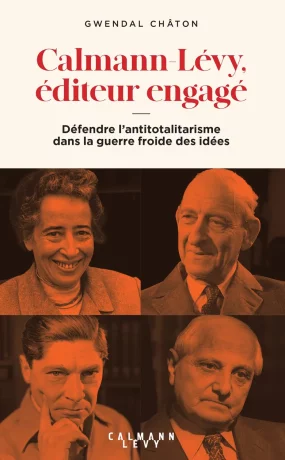
About: Gwendal Châton, Calmann-Lévy, éditeur engagé. Défendre l’antitotalitarisme dans la guerre froide des idées, Calmann-Lévy
About: Gwendal Châton, Calmann-Lévy, éditeur engagé. Défendre l’antitotalitarisme dans la guerre froide des idées, Calmann-Lévy

|
The book Calmann-Lévy, éditeur engagé, published in 2024 by the eponymous publisher, offers a glimpse into both the history of political thought and the history of French publishing. Its author, Gwendal Châton, a political scientist and specialist in the work of Raymond Aron, provides an account of this publishing venture spanning nearly half a century, beginning in the aftermath of World War II and ending almost with Aron’s death in 1983.
Centering on a study of the series created and curated by the author of The Opium of the Intellectuals, this book provides a clear account of how the series developed, how its identity was constructed, and the tensions that ran through it amid the historical upheavals of the last century. Drawing primarily on the archives of Calmann-Lévy and Aron, accompanied by interviews with intellectual actors of the period in question, the author seeks to strengthen his work with empirical material. The decision to focus on a publishing house is thus justified by the desire to go beyond a mere study of the canon of major theoretical works from a given period.
Rebuilding and establishing the publishing house
The book begins with an account of the publisher’s origins, specifically its emergence from World War II, a period during which the firm was shaken by its “Aryanization” (p. 19). As a family business led by brothers Robert and Pierre Calmann-Lévy, the company was facing the challenge of rebuilding itself in the aftermath of the historical tragedy that had led to the family being stripped of its assets. Returning to France after a period in exile in London, the two brothers were shaped by their involvement in the Resistance, which left a visible mark on the ideological orientation of their company.
In the French publishing landscape of the period, Calmann-Lévy, though weakened by the economic crises that had affected it, nevertheless enjoyed a long-standing prestige thanks to the renowned titles it had published in the nineteenth century. Eager to restore the reputation of their business, the Calmann-Lévy brothers were supported in their initial endeavor by two key figures: Raymond Aron, whom they had met in England, and Manès Sperber, an Austrian intellectual and contemporary of Aron, who introduced him to the brothers. Both men shared, albeit for different reasons, not only the experience of living abroad but also a sense of disappointment with communism—a sentiment they would come to share with Arthur Koestler, the author of the group’s first major publication, a French translation of Darkness at Noon entitled Le Zéro et l’Infini. The publication of this “first major anti-communist novel” (p. 33) contributed to Calmann-Lévy’s rapid success—a welcome development given the economic difficulties that were looming.
This first bestseller was followed five years later by a second, with the French translation of The Diary of Anne Frank. These first two major books served as a blueprint for the publishers; two converging themes began to take shape that would permeate the history of their catalog, where Soviet horrors mirrored Nazi atrocities. Moreover, it was the forward-looking nature of these works that earned Calmann-Lévy symbolic prestige, as they anticipated the broader questioning of the USSR and, on another level, engaged in an examination of Europe’s historical conscience in the aftermath of the Holocaust. Immediately, Koestler’s book “gave the series a new political slant” (p. 33); historically conservative, it had now effectively taken an “openly anti-communist” stance (p. 33). This early opposition to communism thus placed Calmann-Lévy at the center of the intellectual debates of the Cold War. Châton clearly demonstrates how the publishing house was shaped by the international climate, from the political freeze of the 1950s to the détente of the 1960s. Furthermore, Aron seemed the natural choice to embody this combative anti-communism when he accepted the Calmann-Lévy brothers’ offer to edit the Liberté de l’Esprit series. By accepting the role, Aron not only provided the publishing house with theoretical ammunition, but also with his extensive network of contacts. By meticulously reconstructing the transnational networks surrounding Aron—as exemplified at the Congress for Cultural Freedom held in Berlin in June 1950—Châton illustrates how ideas circulate in situ, adopting an approach that is often lacking in traditional intellectual history.
Confronting history’s tragedies
Within these circles, the first trends that Calmann-Lévy would go on to promote began to take shape, centered around a staunchly partisan anti-communist stance. At the heart of the hardline faction, determined to pursue military confrontation, stood, alongside Koestler, the American James Burnham, a prolific author in Aron’s series. Conservative, deeply pessimistic, and alarmist with regard to the outcome of the Cold War, Burnham sparked the beginning of the “militant stances taken in the political essays published by Calmann-Lévy” (p. 70). Conservative, deeply pessimistic, and alarmist with regard to the outcome of the Cold War, Burnham sparked the beginning of the “militant stances taken in the political essays published by Calmann-Lévy” (p. 70). In this climate of international hostility, Burnham’s numerous publications definitively positioned “Calmann-Lévy and Aron’s series clearly on the right” (p. 79) and also highlighted the strategic dimension of Aron’s decision to choose as an ally an author who was far more conservative than he was in his anti-communism. Châton thus points out that the paradoxical introduction of such a radical author—whose ideas were unlikely to find an audience in postwar France—served to “justify, by contrast, more moderate positions” (p. 88).
The late 1950s, marked by growing international tension, coincided with a shift in the publishing house’s editorial direction, as it had to adapt to the changing circumstances by redefining its political identity—one of “broad but relatively circumscribed liberal anti-totalitarianism” (p. 99). Its ideological openness thus allowed it to include authors classified as left-wing who had broken with Marxism, such as Michel Collinet, author of La Tragédie du marxisme. This recruitment of former communists who had become opponents of real socialism was hardly surprising given the group’s DNA and the disillusioned communists leading it (Sperber first and foremost): this self-critical impulse to reflect on political failures greatly interested Aron, who summarized it in his famous work The Opium of the Intellectuals. The form of liberal anti-totalitarianism in question followed a clear logic of a circumstantial ideological coalition. The publication of the Khrushchev Report, by finally bringing to light the failure of the communist project of emancipation, simultaneously led to the “obsolescence of anti-communist criticism” (p. 114). However, the collapse of the socialist dream in parts of Western Europe was not enough to end Aron’s struggle, which intensified on the military and strategic fronts with a series of publications on geopolitics and reflections on the nuclear threat. But after Stalin’s death, these military concerns became less pressing, unlike the search for a positive identity: political liberalism.
Defined by its defense of pluralism and negative liberty, the liberalism championed by Aron in his series was slow to gain traction in terms of explicit publications; it was not until the 1954 publication by Salvador de Madriaga, a controversial liberal author, that this political preference was articulated. This liberalism found expression, on the one hand, in a somewhat nuanced defense of the European project (publications by Crane Brinton and Maurice Allais) and, on the other hand, in a “sort of soul-searching” with regard to antisemitism (p. 161). Deeply influenced by the personal history of its leaders on this issue, the publishing house released Léon Poliakov’s Bréviaire de la haine (later published in English as Harvest of Hate by Syracuse University Press), “the first work to systematically examine the policy of exterminating the Jews” (p. 164). This willingness to “reflect on antisemitism after the Holocaust” (p. 161) materialized through the creation of the “Diaspora” series, “dedicated to Jewish themes” (p. 222) and destined for lasting significance, featuring works by authors such as Isaiah Berlin, Michael Walzer, and, of course, Hannah Arendt.
Liberalism and its nuances
The publication of Arendt’s books in French was another masterstroke by Aron, who commissioned the translation of The Human Condition. Indeed, Arendt’s work was quite consistent with the themes emphasized in the series during the 1960s. First, because of her reflections on totalitarianism, she was enlisted in the anti-communist campaign—which contributed to her being portrayed as a conservative philosopher to French-speaking readers. This struggle, though tempered by the easing of tensions, continued notably with the publication of Jacob Talmon’s controversial book The Origins of Totalitarian Democracy. Second, Liberté de l’esprit furthered Arendt’s desire to revitalize political theory, as evidenced by the inclusion of Bertrand de Jouvenel in the catalog—a liberal author who was significantly less progressive than the editorial orientation prevalent at the time. Third, Calmann-Lévy presented its readers with a series of works questioning “the human and social effects of abundance” (p. 188), exemplified by books such as those by Vance Packard. This theme, typical of the pre-May 1968 atmosphere, tied in with the “Atlantic tropism” (p. 188) embraced by publishers during the decade, in which praise for the West was coupled with a critique of its way of life.
Following the events of 1968, Calmann-Lévy shifted toward a more conservative stance, expressing concern and criticism of the social upheaval, as embodied by Aron’s famous The Elusive Revolution and the works of Raymond Ruyer and Jacques Ellul, another defector from the left who was hostile to the revolutionary aspirations. In the wake of the May events, the publishing house needed to find a “new identity” (p. 211), not least because it had to prepare for the handover to a new generation. As well as toning down its critical stance toward consumer society (as reflected in Georges Elgozy’s books), the publisher shifted its disciplinary focus, gradually replacing Liberté de l’Esprit with Archives des sciences sociales as its flagship collection. The renewed interest in the historical and social sciences was a response to the rise of structuralism, which Calmann-Lévy was determined to counter by publishing very right-wing authors such as Pierre Chaunu and Alain Besançon, alongside the crucial introduction of authors who were less politically aligned but whose scholarly standing would prove enormously influential: Norbert Elias and Robert Paxton.
This conservative stance was also evident in the inclusion of Carl Schmitt in the series, yet another example of the tactic of publicizing radical ideas as a countermeasure to a political and intellectual climate hostile to right-wing views. The passing of the torch, which came to an end with Aron’s death in 1983, was brought about by another liberal, anti-totalitarian movement, embodied by François Furet and resulting from the general realignment of the French left in the 1980s. In the middle of the decade that saw François Mitterrand come to power, the Liberté de l’Esprit series “passed into the orbit of the Saint-Simon Foundation” (p. 249), a crucial ideological hub of the period founded by Furet.
Ironically, the year of Aron’s death also marked the liberal turning point of the Socialist Party’s five-year term in office, as if his lifelong struggle to bring all facets of the right to the fore had partly come to fruition before he could see the results—a development that helped to cement the prophetic image his most ardent supporters had crafted for him. However, by examining this publishing history through the lens of the figure of Aron, Châton presents a more realistic, albeit ambiguous, portrait of an intellectual entrepreneur subject to the constraints of multiple conflicting spheres (intellectual, political, and commercial), thereby framing the flow of ideas championed by Calmann-Lévy within the gravity of the political climate and economic imperatives, well beyond the scholastic realm in which they are so often confined.
However, while the author does point out the uncertainties inherent in the intellectual endeavor in question, it would have been helpful to link them more closely to the political and conceptual ambiguity of the category of antitotalitarianism. Looking at the history of ideas through the lens of anti-totalitarianism certainly has the advantage of bringing together diverse ideas, ranging from the left-wing libertarian tradition to traditionalist conservatism. But it must be acknowledged that criticism of totalitarianism evolved both as a protest and as a political tool: the need to raise awareness of the horrors of the Gulag was coupled with a tactical interest in undermining any hope for socialism (since fascist ideas were deeply discredited after the war). Compelled to bring in authors whose radicalism leaned to the right in order to counter the radicalism denounced on the left, Calmann-Lévy also encountered the internal limits of the anti-totalitarian stance, in a flexibility that bordered on contradiction when Carl Schmitt and Hannah Arendt were published in the same series. Readers will appreciate the author’s repeated emphasis on the challenges of coherence involved in this editorial endeavor, in a work that will be invaluable to anyone interested in totalitarianism and its reception.
Gwendal Châton, Calmann-Lévy, éditeur engagé. Défendre l’antitotalitarisme dans la guerre froide des idées, Paris, Calmann-Lévy, 2024, 250 pp., €20.50, ISBN 9782702186480.
by , 16 April
Share this article
Find us here :


To quote this article :
Robin Freymond, « An Anti-Totalitarian Publisher », Books and Ideas , 16 April 2026. ISSN : 2105-3030. URL : https://booksandideas.net/An-Anti-Totalitarian-Publisher
Nota Bene:
If you want to discuss this essay further, you can send a proposal to the editorial team (redaction at laviedesidees.fr). We will get back to you as soon as possible.
You might also like


Our partners


Sections
Keep in touch
© laviedesidees.fr - Any replication forbidden without the explicit consent of the editors. - Mentions légales - webdesign : Abel Poucet