


Our understanding of nature differs from that of the Greeks and Romans. From the “month of the ox” to “the forest goddess,” the ancients never thought to separate humans from the flora and fauna around them.
The Origins of Environmental History
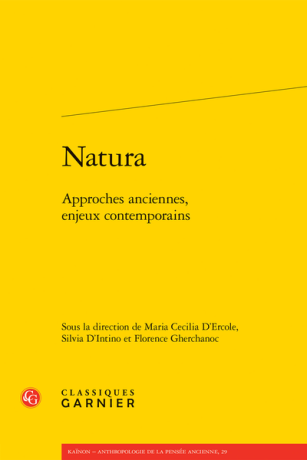
About: Maria Cecilia d’Ercole, Silvia d’Intino, Florence Gherchanoc (dir.), Natura. Approches anciennes, enjeux contemporains, Classiques Garnier
About: Maria Cecilia d’Ercole, Silvia d’Intino, Florence Gherchanoc (dir.), Natura. Approches anciennes, enjeux contemporains, Classiques Garnier

|
“Nature” is one of those concepts we use without ever questioning the worldview from which it stems. The word seems obvious, simple, immutable, natural. Yet, like any concept, it is the product of a history, a language, and a culture that have gradually built it up.
In 2005, anthropologist Philippe Descola—now a professor at the Collège de France—published Par-delà nature et culture, an ethno-anthropological and philosophical work inspired by his experience with the Achuar people of the Amazon. He concluded that our concept of nature and all that it entails has a Western and modern dimension: a radical divide between humanity and what defines it (culture, society, art), and the mineral, plant, and animal kingdoms.
When combined into a single, overarching whole, nature is thus conceived as something radically other, whether the aim is to protect oneself from it, to dominate it, or to preserve it. Historians, anthropologists, and philosophers of the environment or of the living world—useful concepts for establishing the necessary distance from the concept of “nature”—have since sought to examine its origins, contours, foundations, and limits.
Stars and plants
Such is the idea behind the book edited by Maria Cecilia d’Ercole, Silvia d’Intino, and Florence Gherchanoc and co-authored by nineteen other researchers from the ANHIMA (Anthropology and History of Ancient Societies) Center. Specializing primarily in Greek and Roman civilizations, the authors examine the concept at its source, in an era when it had not yet acquired its current meaning: Antiquity. In doing so, they contribute to the development of environmental history, a field that is only a few decades old—and even younger when applied to ancient history.
This collective work is intended neither as a synthesis of past research nor as a blueprint for future research. Instead, it offers a kaleidoscopic overview of the insights that environmental history can offer into the relationship between our ancestors and what we call “nature,” and into the questions this relationship raises for us today. Despite the direct etymological link, our modern definition of nature does not align with what the Romans called natura and the Greeks called phusis (φύσις).
The latter term first appears in the Odyssey, when Hermes gives Odysseus a plant that will protect him from Circe’s spells and reveals to him its phusis, or protective properties. For the ancients, “nature” initially referred to the nature of things and, above all, that of plants: their intrinsic ability to grow and display their characteristics.
A shift in meaning then occurred. In the sixth century BCE, Empedocles, Parmenides, and Heraclitus—the pre-Socratic philosophers who were interested in the origins of the world and its functioning (what we would call its “physics”)—applied this term to the heavenly bodies and the elements, whose growth and properties they studied. Their contemporaries Thales, Pythagoras, and Anaximander built on this, proposing a comprehensive system in which these elements are born, grow, and decay. In his treatise On Nature (Peri Phuseos), Anaximander explains that certain elements are formed out of others. Aristotle merely completed the process of systematizing nature, seeing it as a tangle of multiple causalities: every natural phenomenon can be explained by the inherent properties of the elements that comprise it.
Society, politics, and religion
However, the Greeks and Romans did not extend this reasoning to the point of cutting themselves off from nature, which had become their domain. In the fifth century BCE, the first Greek physicians expanded on the plant metaphor by applying it to the human body—and, initially, to its growth in the womb. Concerned about the effects of climate on the human body, they also believed it influenced social customs and even political institutions. The historian Thucydides, who chronicled the Peloponnesian War, outlined the idea of a “human nature” that shapes the behaviors he describes. Nature and humanity gradually came into being, but according to a distinction that is based more on continuity than on dichotomy.
For the ancients, “nature” was no more opposed to what we today regard as its opposites: society, politics, culture, institutions, etc. For Cicero and the Stoics, justice did not derive primarily from laws written by humans to regulate society. Rather, it was a “natural” ideal, innate and predating civilization, to which human law was supposed to conform, but which it sometimes transgressed—for example, by legalizing slavery. Ancient jurists such as Marcian (third century CE) inferred from this same natural law the right of every individual to exploit nature. Even the Epicurean Lucretius, author of the treatise On the Nature of Things (De rerum natura), did not pit his reflections on nature against those on society. The “things” (rerum) that interested him were etymologically related to the very same realities that interested philosophers, historians, and mythographers. The human sciences and the natural sciences were seemingly inseparable.
On a religious level, the Christianization of the empire brought about another dichotomy distinct from our own, as illustrated by one of the controversies between Christians and polytheists. In 384, Ambrose, the Bishop of Milan, responded to the polytheist Symmachus, who blamed the abandonment of traditional cults for causing droughts and famines. The bishop asserted that nature had indeed been created by God, but that He had ceased to intervene in it, and that the world’s imperfections were simply the consequence of original sin. Nature was separated from God, but not from humanity.
The “month of the ox”
This idea of continuity between humanity and nature was also expressed in the writings and arts of Antiquity. The olive tree, symbol of Athens, was closely associated with the city and its inhabitants. As the emblem featured on the city’s coins and the shields of its defenders, it inspired the myth of the hero Erichthonius, who was born from the earth in the form of a tree and was considered the ancestor of all Athenians. The Greeks of Boeotia held similar beliefs about the ox, which was central to their agricultural practices and featured prominently on their shields, in the names they gave their children, and even in their calendar and its “month of the ox”.
In the arts, separating humans from nature seemed almost impossible, as in the scenes painted by the Romans in the early centuries of the Common Era, dozens of examples of which were preserved by the eruption of Mount Vesuvius. Shepherds, animals, heroes, gods, ruins, trees, and mountains come together in these timeless, idyllic scenes. On Greek vases, plant motifs do more than simply delineate the areas to be painted: they represent a space in a simplified way (such as a tree for a forest) and situate the action within nature.
The poet Ovid, who believed that the luxuries of his time were not such a bad thing, did not pit art against nature, but considered that art enhanced nature by elevating its fruits, whether they were a prepared dish or a well-dressed woman. Even Greek children, who played with pebbles, nuts, or bones (and sometimes had fun mimicking adult rituals by sacrificing apples), cheerfully defied categorization.
How the ancients interacted with nature
The ancients’ daily interactions with nature constituted another form of discourse—implicit, yet equally revealing. The environment of ancient societies forced them to constantly adapt, much like the marshy, inhospitable coasts of Latium, which demanded changes such as seasonal transhumance, planting vineyards on slopes, raising roads, and drainage works, among others. The Atlantic Ocean and its tides were the subject of changing attitudes and practices. The Roman general Scipio Aemilianus praised Neptune for giving his fleet a helping hand, while Julius Caesar, a century later, delayed launching his own assault to take advantage of a more favorable tide.
The ancients also sought to adapt their environment, from attempts to build the future Corinth Canal to the transformation of the Syracuse peninsula into an island. Setbacks, divine condemnation, and the quintessentially Greek distrust of the hubris of which men were thus guilty did nothing to change this.
The consumption of meat and its two associated activities—hunting and livestock farming—compelled the Greeks and Romans to examine the relationship between humans and animals. Despite some dissenting voices condemning (even then) animal suffering and the moral risk inherent in violence, philosophers such as Plato, Xenophon, and the rhetorician Pollux theorized a primordial war between wild beasts and early humans. Unable to defend themselves, humans came to regard themselves as superior to animals through their social, political, and civic organization based, consequently, on the victors’ right to control the defeated and subjugated animals, which became part of the history of human warfare.
Toward a reconciliation?
In terms of scope, then, the nature of the ancients was not so different from our own. It differed, however, in its relationship with humans. Unlike our modern separation, the ancients preferred a formless yet omnipresent continuity. Even the few chronological or geographical digressions presented in this book confirm this.
In the Ṛigveda, a founding text of Hinduism, the goddess of the forest is not merely the antithesis of the village and the civilized world. She is also the bountiful, fragrant earth that embraces the ascetic and enables his initiation. In ancient Mesopotamia, where a distinction was made between the city, the cultivated countryside, and the desert, the sun god Šamaš—god of politics, fertilizer of the soil, and master of the scorching desert—roamed and connected these three spaces. In the 1930s, when the Greek-French art historian, critic, and collector Christian Zevros was developing the editorial line of the review Cahiers d’art, he asserted that Greek art, both past and present, owed its remarkable beauty and unity to Greek nature, as beautiful as it is unchanging.
Western societies are now rediscovering their connection to nature, from which they once believed they could detach themselves through technology and the definition of the concept itself. The growing popularity of the term “environment”—which is less dichotomous—is indicative of this shift. Despite the chronological, cultural, and technological distance that separates us from them, the example of ancient societies can assist us in this rediscovery, and perhaps even in the reconciliation between humanity and the natural world, which the ancients never viewed as fundamentally separate from us.
Maria Cecilia d’Ercole, Silvia d’Intino, Florence Gherchanoc (dir.), Natura. Approches anciennes, enjeux contemporains, Paris, Classiques Garnier, 2025, 236 p., €25, ISBN 9782406174851
by , 28 April
Share this article
Find us here :


To quote this article :
Kevin Bouillot, « The Origins of Environmental History », Books and Ideas , 28 April 2026. ISSN : 2105-3030. URL : https://booksandideas.net/The-Origins-of-Environmental-History
Nota Bene:
If you want to discuss this essay further, you can send a proposal to the editorial team (redaction at laviedesidees.fr). We will get back to you as soon as possible.
You might also like


Our partners


Sections
Keep in touch
© laviedesidees.fr - Any replication forbidden without the explicit consent of the editors. - Mentions légales - webdesign : Abel Poucet