


Could Argentina, instead of being the modern country we know, have developed into fourteen independent states engaged in never-ending competition? From the “disunited province” of Rio de la Plata to the affirmation of a single nation-state, a new book describes a quest for unity that lasted five decades.
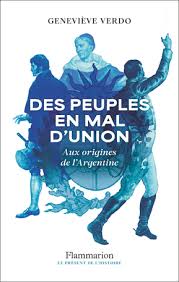
Reviewed: Geneviève Verdo, Des peuples en mal d’union. Aux origines de l’Argentine (Peoples without unity: The origins of Argentina) Paris Flammarion, 2025.
Drapeau de la Confédération argentine, années 1840
Argentina’s complex origins
About: Geneviève Verdo, Des peuples en mal d’union. Aux origines de l’Argentine, Flammarion
About: Geneviève Verdo, Des peuples en mal d’union. Aux origines de l’Argentine, Flammarion

|
The unravelling of Spain’s American empire in the early nineteenth century resulted, after a long and sinuous emancipatory process (1808-1824), in the creation of independent states. This period gave way, in turn, to another, equally slow and difficult process in the second half of the nineteenth century, characterized by the rise of a coherent and peaceful political community. Geneviève Verdo’s book, which focuses on Argentina, extends her previous study, L’indépendance argentine, entre cités et nation (1808-1821) (Argentine independence between city and nation, 1808-1821) and sheds new light on the forms of political construction in nineteenth-century South America, in which the nation-state was only one of several possible outcomes.
Argentina originated with the vice-royalty of Río de la Plata, [1] on the periphery of the Spanish colonial empire. Created in 1776 to strengthen the empire’s defense against the Portuguese threat in Brazil and reorganize trade with the metropole, the crown’s presence in the region remained discreet. The viceroyalty consisted of towns (pueblos), [2] governed for the most part by the corporations that comprised them, particularly the municipal councils (cabildos). After the dynastic crisis triggered by Napoleon after the Abdications of Bayonne in 1808, Río de la Plata, like other territories in the the empire, underwent a revolutionary process that culminated in an official declaration of independence by the “United Provinces of the Río de la Plata” at the Congress of Tucumán in 1816.
The book analyzes the process of political construction that occurred from 1816 to the creation of the Argentine Republic in 1853. In the interval, unlike in the rest of South America, there existed no unified state, but rather fourteen provincial republics. The book is also the history of these poorly known entities and their constant effort to form a federation. While the desire for union remained the shared ambition of their respective leaders, it was also considered essential that the incessantly debated constitutional framework preserve their communities and ensure peace amongst them. This problem shows the discrepancy between these entities and a nation-state, which, in Europe and America of this period, was still a work in progress. To understand the story of Argentina’s political construction, the study is divided into two thematic parts.
Fourteen provincial republics
Part one (“Community Making”) considers these provincial republics as original political forms. Created in 1820 following the dictatorship’s collapse, the entities preserved the imperial towns, inheriting the renewed dynamism of territorial corporations and their role in the revolutionary process. They founded institutions that could govern their jurisdictions, while “executive power,” entrusted to a governor, and a house of representatives shared the task of governing. Challenging the idea of the separation of powers, these provincial republics were founded on the distribution of functions and the “principle of authorization” by the houses, which explains the trend towards the concentration of gubernatorial power and recourse in the 1830s to “extraordinary faculties” to end potential troubles. They were also notable for their recurrent aspiration to preserve their “existence” while also trying to recreate the political unity they experienced during the Spanish empire and at the beginning of the revolution. Federalism, unanimism, and domestic power over rural spaces were the pillars of these provincial republics, which, despite adopting such revolutionary principles as popular sovereignty and related organizational forms displayed, beginning in the 1830s, a profoundly anti-liberal streak.
The quest for union
Part two (“Body” or “corps making”) analyzes the exchanges between these territorial entities from the creation of the viceroyalty to Argentina’s foundation. It shows how the administrative reorganization of the Spanish empire in the eighteenth century, the “English invasions” (1806-1807), and the revolution and war of independence simultaneously created a hierarchy between the cities and mutual dependence and solidarity between them. With the “May Revolution” of 1810, new relationships came into being between Buenos Aires, the viceroyalty’s former capital, and other towns in its jurisdiction. They were based on solidarity among the pueblos, with the role of guiding assumed by the capital and its junta, [3] which was seen embodying the whole while being deliberately conflated with the revolutionary regime. The junta used the capital’s primacy to negotiate pacts with the towns that guaranteed the territorial cohesion of most of the viceroyalty—Upper Peru (Bolivia), Paraguay, and the Eastern Band (Uruguay) lay beyond its authority—while directing both the course of the revolution and the conduct of war. But the effect of these new relations was to politicize transversal relations between communities and to provide a foundation for political unity.
Since the junta’s foundation in 1810, the representation of the pueblos was conceived on the principle of sovereignty substitution. At the same time, the idea emerged that political power could be organized through a constitution, which would give the new state structure. Yet despite several constitutive assemblies during the first revolutionary decade, the resulting texts had no more than a provisional value. The writing of a definitive constitution ran into cultural obstacles relating to the very definition of the text, as well as political factors pertaining to the difficulties of defining who embodied sovereignty: on the one hand, Buenos Aires favored a centralizing conception, which maintained that sovereignty consisted in a nation comprised of individuals, while the federal vision, embraced by most of the provincial republics, embraced the idea of a shared government that could be the arbiter of interprovincial relationships. After 1820, the “disunited provinces” of the Plata persisted as a “shared horizon” that the actors sought to implement from a constitutional perspective through various congresses. Even so, the second revolutionary decade was marked by lack of agreement and a constitutional impasse (1821-1829).
At the same time, an alternative process of political construction during the same period occurred through pacts and treaties endorsed by the governments of the provincial republics (1820-1841). These bilateral accords were efforts to construct regional unions while waiting for a broader framework. Despite being vigorously proclaimed, the sovereignty of these entities was mediocre at best. On the one hand, it simply referred to the rights and customs that governments sought to preserve; on the other, it corresponded to relations with other republics. In short, the construction of a supreme authority, whether federal or confederal, can be seen as the culmination of a process that pushed the republics to align themselves with other provincial entities to organize their mutual relations, pacify their conflicts, and prevent aggression.
Conclusion
Reading this book conveys the difficulties that Argentina encountered in constituting itself as a coherent state through much of the nineteenth century. This makes the country a special case in the story of the postrevolutionary Atlantic world. For more than thirty years, Argentine leaders constantly tried without success to build a coherent entity, before agreeing to a federal republic, following the example of the United States of Mexico, Venezuela, and Brazil. This “anarchic” and “barbaric” period, which is condemned by Argentina’s “official” history (Historia Patria), has been compared by one of its practitioners, Domingo Facundo Sarmiento, to the “Israelites’ crossing of the desert.” As Verdo notes, while much of Río de la Plata’s land—which until 1831 was the United Provinces, before becoming first the Argentine Confederation, then the Argentine Republic—ultimately resulted in the foundation of a progressive nation state in 1853, it might have led to the creation of fourteen independent states, comparable to those along its periphery (Bolivia, Paraguay, and Uruguay). A comparison with Central America, which was organized as a federal republic between 1824 and 1840 before imploding into five separate nation states, suggests a path for this “future that never happened.”
Geneviève Verdo, Des peuples en mal d’union. Aux origines de l’Argentine (Peoples without unity: The origins of Argentina), Paris, Flammarion, 2025, 368 p., €24,90, ISBN 9782080474216
by , 11 June
Share this article
Find us here :


To quote this article :
Gonzague Espinosa-Dassonneville, « Argentina’s complex origins », Books and Ideas , 11 June 2026. ISSN : 2105-3030. URL : https://booksandideas.net/Argentina-s-complex-origins
Nota Bene:
If you want to discuss this essay further, you can send a proposal to the editorial team (redaction at laviedesidees.fr). We will get back to you as soon as possible.
You might also like


Our partners


Sections
Keep in touch
© laviedesidees.fr - Any replication forbidden without the explicit consent of the editors. - Mentions légales - webdesign : Abel Poucet