


What is the nature of the distinctive rationality that underpins Cleisthenes’ reform, which many see as the birth of Greek democracy? What social mechanisms, civic experiences, and forms of vernacular knowledge made this new system of political organization possible?
The people who count
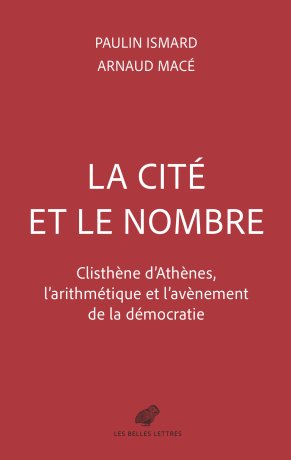
About: Paulin Ismard et Arnaud Macé, La Cité et le nombre. Clisthène d’Athènes, l’arithmétique et l’avènement de la démocratie, Les Belles Lettres
About: Paulin Ismard et Arnaud Macé, La Cité et le nombre. Clisthène d’Athènes, l’arithmétique et l’avènement de la démocratie, Les Belles Lettres
by ,
19 May
translated by
|
This book, coauthored by Paulin Ismard and Arnaud Macé, who both study antiquity—the former as an historian and the latter as a philosopher—explores the arts of organization and classification, social practices that were common among the citizenry that made possible the vast reorganization introduced by Cleisthenes’ reforms in 508-508 BCE. This reform consisted in replacing a civic body organized into four tribes with a new system based on geographic distribution, notably to prevent the return of tyranny.
The book is fascinating on many levels, for those unfamiliar with this foundational event as well as for specialists, as it takes clear positions and is well documented. La Cité et le nombre, which situates Cleisthenes’ reform in the context of multiple efforts to reorganize the civic body in the archaic period, effectively address the historical questions relating to exactly how it operated (p. 34-37) and grapples with sources that present social practices such as booty distribution, the pairing of opponents during athletic competitions, and the organization of armies. At the same time, Ismard and Macé adopt a “realistic approach to the reform,” by considering these vernacular knowledges as the domain of a rationality (p. 48-49). While the book clearly lays out the historiographical debates that underpin it and extends these debates to the very idea of political rationality, readers may also be tempted to find in the book insights of contemporary significance relating to how democracy functions, the conditions for political change, and the nature of civic cohesion. Through an examination of the conditions of possibility of Cleisthenes’ reform, the book asks how one should conceive the agency of the civic body as a whole during democracy’s emergence and examines the social anchoring required for profound political change.
Reform by numbers
One must first recall the specifics of Cleisthenes’ reform, which the book does briefly (p. 21-25; 144-152). Drawing on the Pseudo-Aristotle’s Constitution of the Athenians, 21, Ismard and Macé write:
Cleisthenes wanted the Athenian people to be mixed (anamixis) so that a larger number of citizens would participate in the constitution (politeia) (p. 21).
The reform consisted in dividing Attica’s territory into three geographically distinct areas: Mesogeia, or the center; Paralia, which consisted of the coastal area and border regions; and the asty, or city. These three areas were each divided into ten zones, resulting in thirty groups of demes, or trittys. The ten tribes, each consisting of three trittyes from different areas, determined the selection process for the members of two of Athenian democracy’s essential institutions: the Heliaea (Athens’ court) and the Boule (the Council of Five Hundred), as well as for festivals, rituals, and the calendar. The deme was the smaller territorial unit from which the ten tribes were formed. These tribes reorganized the city’s entire landscape and established a genuine political identity, one that was individual as well as collective, whereas during the time of the tyrants, the four tribes lacked any territorial basis. By “mixing” people, this reorganization promoted greater civic cohesion. If it did not immediately create a democracy, it in any case responded to the fall of the tyrants to prevent their return by reforming the conditions of political participation and access to offices.
The people’s active role
In Clisthène l’Athénien, [1] which contributed to establishing Cleisthenes as the “foundational hero of Athenian democracy” (p. 15), Pierre Lévêque and Pierre Vidal-Naquet not only studied the reform’s Pythagorean overtones, but suggested an interpretation that was “idealist”—the reform was primarily theoretical, with practical application a secondary consideration (pp. 38-39)—and “elitist,” as it avoided active participation on the part of the people. The complexity and sophistication of this spatial reordering of the entire city thus indicates that it was inspired by Pythagorean ideas, as seen in the recurrence of three, five, and ten (p. 46-48). Ismard and Macé call both these claims into question: the abstract ideas on which the reform was allegedly based and the view that Cleisthenes was solely responsible for it.
We wish, in a sense, to turn our gaze from the agora’s steles and the great speeches of the Pnyx and, entering ancient Athens’ shops, to observe often quite basic forms of accounting. They allow us to see forms of practical rationality that shed light on how politics functioned in the world of the city-states (p. 16).
Ismard and Macé begin by recalling the reform’s context, drawing notably on Herodotus. Lévêque and Vidal-Naquet’s “elitist” interpretation overlooks the popular and collective resistance that followed the fall of the tyrant Hippias of Sparta (in 510 BCE) and Isagoras, his Athenian ally and proponent of oligarchy. This popular effervescence in Athens makes it necessary to downplay Cleisthenes’ reform’s vertical dimension as well as its ex-nihilo character (p. 32-39). What were the intellectual and political inspirations of the people, who, we may surmise, were important actors in this complex and sophisticated reform? If one wishes to take seriously the demos’ active role in the city’s reorganization, one must, according to Ismard and Macé, consider vernacular knowledge and communal structures that ensured their transmission.
Our hypothesis is that the existence of a culture of numbers, disseminated in a variety of social practices, allows one to understand the conception, the speed, and the success of a reform such as Cleisthenes’ (p. 54).
Ismard and Macé clearly ask us to explore ancient Greece’s “counter culture” (i.e., its “token culture”), characterized by a “practical continuum” in which numbers are used for concrete operations and take the material form of bones, die, or tokens (p. 56-61). Ancient treatises on tactics, along with the conventional reference to Homer, the poet of war, shed light on the practical mathematics that informed military operations and which could, in more complex forms, be transposed onto the civic order (p. 61-69). By asking how the agency of the Athenian demos should be conceived, the book’s questions extend beyond antiquity and raise the question of the social anchoring of political change. In this way, this coauthored book builds on the individual work of each author. Ismard, for example, has written about the role of communal structures in Athenian democracy and Macé, a Plato specialist, has published on the idea of the “common.”
“Pluralize and structure the experience of the common”
The book examines the functioning of three games discussed in Plato’s Laws as part of a plan for the public teaching of mathematics. Far from the “qualitative aura of numbers” based on a mystique of numbers or a numerological approach based on an axiology of numbers, these games participated, rather, in an “art of basic calculation,” which could inform military arts as well as political organization. Ismard and Macé place these three games under the aegis of, respectively, Odysseus, Agamemnon, and Nestor. The first consists in a distribution (of pieces of food) that includes a possible variation of the dividend with no change to the divider, meaning that certain units must at times be set aside to ensure equal shares. The second game consists in two-on-two pairings (like when one organizes confrontations between wrestlers), and the third in “distributing the members of a heterogeneous group to form homogeneous subgroups” (the way a generic combat structure might mix charioteers and infantrymen of various kinds). After having explained the various ways these three games could be combined (p. 91-99), Ismard and Macé present various city reforms introduced during the archaic period, revealing mechanisms that were similar to and that served as precedents for Cleisthenes’ reform:
By situating the actions attributed to Cleisthenes in a continuum with those of the reformers of Cyrene, Eretria, Corinth, and Thessaly, it becomes clear that Cleisthenes was building on a tradition: that of the application to the city of an art of numbers, the simplest operations of which are Homer’s arrangement of men. In short, Cleisthenes explores different ways that one can combine operations of division, distribution, and pairing to produce civic reorganization, with the principle of territorial division imposing itself as a powerful tool for mixing people. (p. 155)
The use of numbers to reorganize the city was not necessarily tied to the regime’s democratic form. It can just as easily been seen in Plato as in the historic city of Corinth during the archaic age: according to Ismard and Macé, these operations point to a “level that was more fundamental than that which depended on the choice of regime” (p. 127), since it could be used by non-democratic regimes. Yet such a reorganization could also be the necessary condition for democracy. Does this mean that they believe that democracy only secondarily requires specific institutions or forms of office selection? Prior to democracy’s onset, one can identify practices of civic reorganization and mixing (anamixis) the civic body: democracy is thus simply a special instance of systems for arranging and ordering of men. The kind of mixing that these vernacular sciences seem to have normalized acts as the “matrix” (p. 162) of civic mobilization across a range of institutions.
Limits and the unlimited
Rejecting elitist interpretations, Ismard and Macé see the emergence of politics as an autonomous realm as resulting from a gradual sedimentation of the social practices that constituted, among other outcomes, civic identity. The same regulative norms can be found in both domains.
In the epilogue, the book seeks to expand the debate even further. If one identifies practical thought as the stimulus for Cleisthenes’ reform, is this not an endorsement of the tradition of thought that sees social structures as the origins of cosmological ideas? [2] In fact, Ismard and Macé challenge the idea that such projections were unconscious: the numerical practices they study testify, to the contrary, to the agency of the social body. Their conclusion identifies the wide range of objects that could serve as analogies for deciphering the surrounding world. Yet the nature of the social world is not the only key to grasping ancient concepts (p. 172-173). The brevity of the epilogue, inherent in its format, may make it difficult to grapple with such vast issues as Anaxagoras’ cosmology, Plato’s ontology, Plato’s and Aristotle’s politics, and Aristotle’s biology. The art of combining was, according to Ismard and Macé, “the implicit and far too unknown framework of a large part of Greek knowledge.” Without identifying with Vernant and an excessively univocal analytical framework, should one aspire to a unified interpretive key? Moreover, as the examples of Anaxagoras, Plato, and Aristotle make clear, are differences not more significant than a common matrix conceived in such general terms?
These questions only highlight the great interest of this book, which is teeming with ideas while also being precise and carefully documented. By focusing the question of the emergence of democracy on citizenship and the practical social matrix that allowed it to crystallize, its implications go well beyond Cleisthenes the Athenian’s narrow historical context.
Paulin Ismard et Arnaud Macé, La Cité et le nombre. Clisthène d’Athènes, l’arithmétique et l’avènement de la démocratie (The city and the number: Cleisthenes of Athens, arithmetic, and the advent of democracy), Paris, Les Belles Lettres, 2024, 206 p., €19, ISBN 9782251456393.
by , 19 May
Share this article
Find us here :


To quote this article :
Marion Pollaert, « The people who count », Books and Ideas , 19 May 2026. ISSN : 2105-3030. URL : https://booksandideas.net/The-people-who-count
Nota Bene:
If you want to discuss this essay further, you can send a proposal to the editorial team (redaction at laviedesidees.fr). We will get back to you as soon as possible.
You might also like


Footnotes
[1] Pierre Lévêque et Pierre Vidal-Naquet, Clisthène l’Athénien. Essai sur la représentation de l’espace et du temps dans la pensée politique grecque de la fin du VIe siècle à la mort de Platon, Paris-Besançon, Les Belles Lettres, 1964.
[2] See Arnaud Macé, “Une école ’géométrique’ d’anthropologie historique dans le sillage de Durkheim,”Cahiers “Mondes anciens” [online], 13 | 2020, posted on June 10, 2020, consulted on April 14, 2025.
Our partners


Sections
Keep in touch
© laviedesidees.fr - Any replication forbidden without the explicit consent of the editors. - Mentions légales - webdesign : Abel Poucet