


Étienne Anheim and Paul Pasquali examine a key moment in interdisciplinary dialogue: Pierre Bourdieu’s translation and editing of the art historian Erwin Panofsky.
The origins of “habitus”
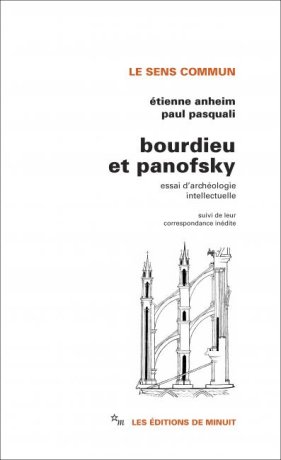
About: Étienne Anheim et Paul Pasquali, Bourdieu et Panofsky. Essai d’archéologie intellectuelle, Les Éditions de Minuit
About: Étienne Anheim et Paul Pasquali, Bourdieu et Panofsky. Essai d’archéologie intellectuelle, Les Éditions de Minuit
by ,
14 July
translated by
|
In May 1967, Pierre Bourdieu published, in the “Sens Commun” collection he had recently founded with the Éditions de Minuit, the first French translation of a book by the art historian Erwin Panofsky, Gothic Architecture and Scholasticism. At the time, Panofsky was seventy-six years old and recognized internationally as an essential reference point in his field. The translation was accompanied by considerable editorial work. To the slender volume first published in 1951, Bourdieu added another text by Panofsky on the Abbot Suger published in 1948, which he translated from English. He added a postface that laid the groundwork for a key feature of his own sociological theory, the theory of habitus. This “publishing event” (p. 11), as Étienne Anheim and Paul Pasquali describe it, had considerable epistemological significance and acquired, for Bourdieu, the status of a genuine foundational moment.
It is these three aspects—translation, editing, and epistemology—that Anheim and Pasquali’s “essay in intellectual archeology” seeks to explore. Éditions de Minuit has published it in the same collection as the original volume. Since Anheim is a medievalist and Pasquali a sociologist, not only does their collaboration apply the principle of multidisciplinarity to the study of Bourdieu’s methodology; it also reproduces the respective positions occupied by Panofsky in art history and Bourdieu’s in sociology. Anheim and Pasquali observe that Bourdieu’s “intellectual project,” which is “indissociable from a conquering conception of sociology, had multidisciplinary aims that encompassed history and anthropology as well as, to a degree, philosophy” (p. 32).
Anheim and Pasquali have thus undertaken the archaeology of an editorial and scholarly field by writing a book that is itself situated on the cusp between sociological holism and an account of the young Bourdieu’s intellectual development. Over six chapters, they reconstruct the context in which this editorial project emerged (chapter 1); what Bourdieu learned through this experience of the editor’s role (chapter 2); and the socialization process he underwent in his relationship with Panofsky (chapter 3), based on his previously unpublished correspondence with the art historian, which has been included in an annex. They describe how Bourdieu planned the translation, a task he undertook for the first and last time (chapter 4); the resulting development of the concept of habitus (chapter 5); and, finally, the book’s critical reception, in sociology and art history as well as over the long term (chapter 6).
Chapter 5 contains what are undoubtedly the most important theoretical and epistemological issues that Bourdieu identified in Panofsky’s two texts. To gauge their significance, a detour is necessary through the final pages of Anheim and Pasquali’s conclusion, in which they consider the object that Panofsky uses—Gothic cathedrals—to establish a homology between architecture and scholastic thought.
“During the interwar period,” the authors write, “the idea circulated that one could interpret European society through the lens of the unique object that is the Gothic cathedral.” The stakes of the latter, they suggest, thus went far beyond “a scholarly problem in art history” (p. 235). This was Panofksy’s more or less avowed goal, and one that naturally interested Bourdieu. “The medieval cathedral,” Anheim and Pasquali continue, “was a matrix, in the etymological sense, for European societies as well as for the subjectification processes of their individual members” (p. 239), from a scholastic as well as a religious point of view.
On the one hand, the cathedral had come to represent a “world that supposedly held together in an organic and harmonious way.” This homogeneity implied the “task of ordering and establishing a hierarchy” that, at the same time, required “the exclusion of heretics, Jews, and Muslims.” On the other hand, the idea of the cathedral legitimated “the domination of lords and clerics” (p. 239). During this process, it as if the clerics had succeeded the priests in the pulpit (cathedra in Latin), enjoyed a transferal of symbolic capital topped up with a little erudition. In other words, discovering homologies between scholastic thought and Gothic architecture, as Panofsky had done, allowed Bourdieu to shed light on the historical determinants of mechanisms of domination on which the fields of art as well as the medieval university were structured.
Yet it is precisely this critical forgetting—“as if the social sciences had metabolized what came before them” (p. 240), as Anheim and Pasquali put it—to which Bourdieu refers through his concept of habitus and that, inspired by Panofsky, he simultaneously invents, in the archaeological sense of the word. Panofsky uses the term “mental habits” (in English) in the text, translating a quote from Thomas Aquinas, while Bourdieu “translates” “mental habits” by the term “habitus,” which Panofsky had not used and which he endorsed reluctantly.
The conditions for the extraction of the concept of habitus—via Thomism, and through it, Aristotle’s hexis, to an expanded conception of art history before arriving in a liberated sociology with emancipatory ambitions—thus contributed to an operational term at the intersection of various human and social sciences. Habitus is thus one of those concepts that itself has metabolized, specifically through scholars who have sought to restore its exploratory and explanatory functions. As Anheim and Pasquali note, Bourdieu himself, once he was “beyond this Panofskian moment,” used the concept of habitus in later work, formalizing it based on his reading of Panofsky but with “less and visible—which does not mean incidental—references” (p. 214).
Conversely, for the many French art historians who had read Panofsky in German or English before Bourdieu, but who ultimately mentioned him infrequently and who were less enthusiastic than their young colleague about translating him, the question became: “to return to Panofsky, how do we forget Bourdieu?” (p. 208). When one considers the cumulative sales numbers mentioned by Anheim and Pasquali, there is no doubt that Bourdieu contributed to making Panofsky known to a far vaster readership than the specialized title of his book would lead one to expect. Yet it must be admitted that a Boudieusian reading of Panofsky did not dominate, or even occur in, the field of French art history. It is also regrettable that an oeuvre of this importance did not give rise to more interpretations that were, if not in the same league, at least as theoretically rich as the now famous 1967 postface.
The main reason for this fruitfulness that has no real equivalent deserves to be emphasized, if only for its methodological lessons. If Bourdieu was extract such fruit from Panofsky’s book, it was not because it contained many layers of knowledge from many different periods and disciplines, but because its interpreter had a multidisciplinary education and that he eagerly read authors—in this case, art historians—who would seem quite distant from his research area. In a sense, disciplinary distance favored conceptualization. In this respect, one of the merits of Anheim and Pasquali’s essay is to insist regularly on Bourdieu’s participation in “writing chains” (p. 92), including one consisting of “an entire editing world’” (p. 107) that resulted in “a hermeneutic chain” (p. 114). Relating to the latter, the authors emphasize how much Bourdieu’s interest in the habitus owed to another Panofsky reader, the medieval paleographer Robert Marichal, to whom he explicitly acknowledges his debt in the postface.
To go even further back, as Anheim and Pasquali do, it becomes clear that Bourdieu was most likely “disposed” to such an approach by the teaching of Maurice Merleau-Ponty, who had a deep knowledge of Panofsky’s work, which he had recommended to Hubert Damisch in the late 1940s. Anheim and Pasquali write that by “putting philosophy in an authoritative position in the reflexive constitution of the human sciences, Merleau-Ponty brought about a considerable shift that simultaneously entailed an epistemology, a theory of action, and an ontology of temporality” (p. 163). Mirroring this trend, the concept of habitus, they maintain, allowed sociology as Bourdieu conceived of it at the conclusion of his philosophical education “to bring together a theory of practice, a reflexive epistemology, and an empirical approach” (p. 165).
It is not so much that Bourdieu borrowed a word from Panofsky’s art history as that he borrowed a term so that he could return it, enhanced with critical and epistemological powers that Panofsky himself had, as it were, kept in reserve. In this way, “the postface, according to Bourdieu, was intended to ’manifest’ the truth found implicitly in the book” (p. 137). It is the responsibility of Panofsky’s followers to keep reclaiming the term and reintegrate it into their vocabulary, just as it is up to Bourdieu’s disciples to continue to read art history books that would appear to be foreign to their discipline so that they, too, may acquire some perspective.
Étienne Anheim, Paul Pasquali, Bourdieu et Panofsky. Essai d’archéologie intellectuelle, (Bourdieu and Panofsky: An essay in intellectual archeology), Paris, Les Éditions de Minuit, 2025, 286 p., €23, ISBN 9782707356369
by , 14 July
Share this article
Find us here :


To quote this article :
Paul Bernard-Nouraud, « The origins of “habitus” », Books and Ideas , 14 July 2026. ISSN : 2105-3030. URL : https://booksandideas.net/The-origins-of-habitus
Nota Bene:
If you want to discuss this essay further, you can send a proposal to the editorial team (redaction at laviedesidees.fr). We will get back to you as soon as possible.
You might also like


Our partners


Sections
Keep in touch
© laviedesidees.fr - Any replication forbidden without the explicit consent of the editors. - Mentions légales - webdesign : Abel Poucet