


Was the Enlightenment already in crisis at the end of the 18th century? This unsettling hypothesis is examined through the lens of several thinkers who diagnosed the collapse of the ideals of peace, liberty, and progress amid empire, revolution and economic ruin.
|
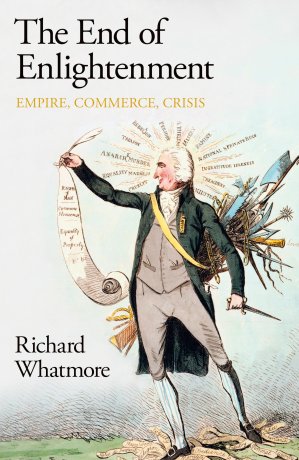
Richard Whatmore tells a counterintuitive story of The End of Enlightenment through eight key thinkers who at the close of the 18th century considered that the promise of Enlightenment values including peace, toleration, progress and democracy had been eroded. This decline was accompanied by revolution, economic downturn, war and competition amongst European powers which sought to maintain and expand their “commercial empires”. Yet the result was bankruptcy, the loss of liberty as monarchies became absolutist and “republics entered a prolonged period of crisis” (p. xxiv).
The American and French Revolutions further disrupted the colonial empires of Britain and France as well as the mercantilist system. As the United States and Haiti gained independence, the universality of Enlightenment values was brought into question as liberty, equality and fraternity tended to apply only to European men. Whatmore’s story is not so much about Enlightenment universality and/or the partial collapse of these two major colonial empires as it is about the decline of Enlightenment values that had been forged over the late 17th to 18th centuries as the European wars of religion came to their end (p. 135) and new ideas of secular political rule developed.
Lamenting the demise of Enlightenment values
Whatmore outlines Adam Smith’s critique of the mercantilist system that entailed a trading monopoly between a colonial power and its colonies, restricted trade, economic growth and vested much power in the “new monied class” whose liquid assets and moveable wealth were not always tied to the public interests of any particular state. This system, Whatmore notes, was “a corrupt nexus of merchants and bankers, who moved capital for trade”; moreover “the politicians they bribed … made legislation for their own profit rather than the good of society” (p. xxvi). Both Smith and Hume denounced it. Their denunciation forms the critical perspective from which Enlightenment thinkers lamented its end.
Whatmore distinguishes two groups of thinkers who grappled with this decline. The first includes Catherine Macaulay, Jacques-Pierre Brissot, Mary Wollstonecraft and Thomas Paine who all thought that “liberty, revolution and republicanism might … restore enlightenment”. The second group comprises William Petty (the second Earl of Shelburne), Edward Gibbon and Edmund Burke all of whom considered “that a Britain turned away from empire, war and commercial excess might become a beacon of moderation and toleration” (p. xxxii). Whatmore’s book presents a chapter on each of these thinkers and considers how they theorised and dealt with the demise of Enlightenment values. These are not the usual thinkers one encounters in a book on 18th century thought and bringing them together around the theme of the end of Enlightenment presents a new understanding of the history of Enlightenment thinking that involves much scepticism and is critical of the economic and political structures of imperialism. The book is very well researched and recounts a complex story of multiple events that contributed to the perception of the decline of the Enlightenment.
The Enlightenment in colonial context

Slaves cutting the sugar cane - Ten Views in the Island of Antigua (1823)
The notion of the end of Enlightenment begs the question: what is Enlightenment? Whatmore opens his book with a brief examination on its meanings and highlights that the concept was contested notably with regard to colonialism, sexism and racism. He cites some of its main critics, noting that those “who rejected the Enlightenment were socialists or Marxists, often inheritors of religious or republican traditions” (p. 4). In an oblique reproach of critics of Enlightenment modernity for “detecting the errors of the past alone while ignoring the deeper and more complex currents that were in play then” and now, Whatmore demonstrates that thinking at this time was not singular and there were debates for and against imperialism and slavery (p. 6).
However, by making such a statement he dismisses some of these critiques – notably those developed in subaltern, postcolonial and critical race theory – which contend that modernity and Enlightenment thinking emerged through the often-violent colonial encounter that entailed conquest, genocide, oppression and enslavement of non-European peoples. Nevertheless, colonialism generated a great deal of wealth that contributed to new ideas, the advancement of the arts, human and physical sciences including moral philosophy in Europe.
The central thesis of Whatmore’s book is that Enlightenment values and thinking were in decline by the end of the 18th century as European powers became more rapacious, corrupt and obsessed or fanatic with the pursuit of liberty, luxury, power and wealth. He underlines the relevance of European colonial empire centred on conquest, commerce (including the trade and enslavement of West Africans), the extraction and exploitation of resources through mining and the plantation economy in the Americas, Asia and Africa (p. xxv). As such, he situates and reads Enlightenment thought in the broader colonial context. Yet the argument that the decline of its thought was about empire may not adequately take into account that Enlightenment thinking itself was not only forged within the context of colonial empire, but was produced by it. To be sure, the greed, violence, and corruption of commercial empire contradicted the values of liberty, equality, fraternity, peace and toleration. This reflects the moral ambivalence of wealthy nations built on the exploitation, oppression, slave labour and extraction of resources of others both then and now.
Contradictions in revolutionary discourses
Many of these contradictions came to the fore question as the enslaved peoples of the French Caribbean revolted against the colonial system before and during the French Revolution. In 1794, the French Convention abolished slavery in its colonies, however, it was never applied [1]. The questions of liberty and slavery were debated in the National Convention and there were both conservative and radical elements in the Revolution: the Massiac Club and the Société des Amis des Noirs. The former wanted to maintain the slave-trade and slavery whereas the latter promoted abolition [2], resulting in multiple wars, skirmishes and shifting alliances between European powers, notably in the Caribbean as St. Domingue revolted against the French in the 1790s, resulting in Haiti’s gaining independence in 1804. Moreover, Napoleon suffered major military losses in St. Domingue and was therefore unable to sustain Louisiana which was sold to the Americans in 1803.
By contrast, the American Revolution rejected mercantilism that restricted with whom it could trade and British imperialism; yet it maintained colonialism, slavery and the exclusion of indigenous populations. Though Whatmore’s book does not always bring these contradictions out, he does note that Catherine Macaulay was unconcerned with chattel slavery as to her it “meant the denial of civil liberty” (p. 124) and that Thomas Paine was neither concerned with chattel slavery nor the oppression indigenous peoples and women (p. 231). The Enlightenment was clearly perceived to be nearing its end due to war over colonial possessions and the corruption of a mercantilist system that was imbricated in the triangular slave trade.
To Whatmore, the British sensed that “enlightenment was ending” and that a “vision of Europe, of the world, built upon the natural development of treaty and trade without empire was dead” (p. 95). He stresses that the mercantilist political economy of the day was outdated and corrupt and that rather than pursue commercial empire, European powers ought to pursue peaceful trade. There was also a desire to restore Enlightenment values, namely peace and toleration (p. 6). Many of the thinkers examined focused on the promise of republican liberty, equality and fraternity; yet this too was dashed by the Terror and rise of Napoleon.
End of an era, or ongoing struggle?
Whatmore makes a complex argument in his book and examines it from various perspectives contending with war, expanding empire in Asia, the collapse of economic and political systems, revolution, public consciousness and the loss of certain values as Britain became more corrupt and France reverted to terror and Caesarism. At the same time, there was cause to be optimistic as issues of slavery and women’s rights were debated even if not rectified. Whatmore compares this moment to our current uncertainty in the world as we witness a rollback on the values of equality and toleration across the world, yet what he characterises as an end may rather be read as a continuation of a long struggle for these values that started well before the Enlightenment in different times and places across the globe.
Finally, more details about the wars fought between European imperial powers and enslaved peoples would situate the reader and nuance Whatmore’s claims as he considers intellectual responses to world changing events in the late 18t century, and how these shaped perceptions of the end of Enlightenment, empire, commerce and crisis. To hold and follow the thread of all of these events in a single book is no small feat. Whatmore has done an admirable job in depicting the end of Enlightenment through the writings of several key thinkers at this turbulent moment in history.
Richard Whatmore, The End of Enlightenment: Empire, Commerce, Crisis. Allen Lane, 496 p. £30,00
by , 27 August 2025
Share this article
Find us here :


To quote this article :
Manjeet Ramgotra, « Modernity’s broken promises », Books and Ideas , 27 August 2025. ISSN : 2105-3030. URL : https://booksandideas.net/Modernity-s-broken-promises
Nota Bene:
If you want to discuss this essay further, you can send a proposal to the editorial team (redaction at laviedesidees.fr). We will get back to you as soon as possible.
You might also like


Footnotes
[1] Louis Sala-Molins, Le Code Noir ou le Calvaire de Canaan, Paris: Presses universitaires de France, 1987, p. 17.
[2] C. L. R. James, Black Jacobins: Toussaint Louverture and the San Domingo Revolution, London: Penguin Books Ltd, 2001 (1938) ; Anna Julia Cooper, Slavery and the French and Haitian Revolutionists, Oxford: Rowman and Littlefield Publishers, 2006 (1925).
Our partners


Sections
Keep in touch
© laviedesidees.fr - Any replication forbidden without the explicit consent of the editors. - Mentions légales - webdesign : Abel Poucet