


Digitally distributed television series are one of the key forms of contemporary entertainment. By analyzing this distinctive form of consumption, it is possible to explain these consumers’ relationship to time, narratives, and decision-making.
|
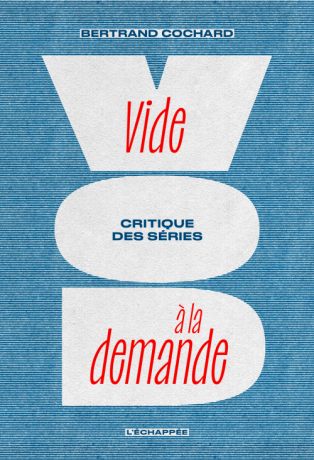
The appeal of the publisher L’Échappée lies in its freedom of tone, its technocritical stance, and the classic authors it publishes: Guy Debord, Albert Camus, Günther Anders, Jacques Ellul, Simone Weil and Karl Marx at his most philosophical. Fans will thus not be disappointed when, perhaps in single sitting, they read the latest book by Bertrand Cochard, a Debord specialist, who draws on this rich theoretical galaxy to examine the phenomenon of television series, advancing an uncompromising argument that is at once daring and original. It is daring because it seeks to unpack a cultural practice that is now well established; it is original, because, in the tradition of critical theory, Cochard relies on explicitly normative claims to denounce, not the quality, but the “mode of consumption” of television series, which he sees as based on a “fluidity” that exhausts viewers through a “constant renewal of never kept … promises” (p. 49).
Three normative reference points
In his critique of television series, Cochard makes three major claims. The first denounces the illusory indifference in which television series place us. To consume a series, he says, produces a “tunnel effect” (p. 56) that can abolish time, making it follow a continuous “flow” (p. 56). As we become completely absorbed with being spectators, we are removed from historical temporality—the realm of political decisions-making—and are immersed in a “pseudo-cyclicity” (p. 85) in which everything seems simply to continue—there is always another episode to watch—even as our life conditions are gradually depleted and we are bombarded with new merchandise that shapes our daily lives with no democratic oversight. Such circumstances confirm the “asynchronicity of social time …. in which part of society … develops, advances, [and] makes history” (p. 84) while everyone else claims to ignore it—even as they are subject to it.
When first laying out his argument, Cochard uses Debord’s distinction between cyclical (or repetitive) time and linear (or historical) time, which he also explores in his book Guy Debord et la philosophie (Guy Deboard and philosophy). [1] Cochard then radicalizes his analysis by maintaining that pseudo-cyclicity, which was already present in the booming postwar years, has recently been degraded to the simultaneous experience of insignificant non-events (“buzz,” scandals, cultural happenings that are celebrated and no sooner forgotten , and so on). The routines of daily life prior to the digital age had, of course, little political impact. Even so, it was meaningful due to the constant back-and-forth between work and leisure. Unfortunately, even the prospects of an accomplished career and well-deserved rest have diminished in postmodern society, giving way to an infinite sequence of unstable projects and uninterrupted production, in which the connected human ceaselessly generates data. This is so much the case that television series have become “pass-times” (p. 100) in the most literal sense of the term, as they take us from one time sequence to another. Separate moments no longer exist. They reshape daily life in a way that simulates “the coherence and … unity that are missing from our fragmented lives” (p. 105).
Whereas Cochard generally focuses on the “series-form” (p. 13), his essay’s third and boldest conclusion concerns this form’s content. He asserts that series subscribe to an implicit anthropology: individuals are essentially defined by the narratives they tell about themselves. In most plots, characters can become “better versions of themselves” so long as they change their self-narrative, an ideology that also lies at the foundation of “personal development” (p. 112). Insofar as spectators’ adhere to this postulate, they surround themselves with as many stories as possible, which correspond to as many possible ways of relating to oneself. Series can easily constitute the setting for such considerations. “As Albert Camus—whom Cochard quotes—observed: “nothing interests [the ordinary man] more than himself, especially his potentialities” (113).
Against this “narrarchy” (p. 121), which prioritizes the authority over narratives over real causes and the unpredictability of action (as emphasized by Hannah Arendt), Cochard maintains—very much against the grain, it must be said—that we should abandon mythmaking. Only then would it be possible to have spontaneous experiences that are not part of a plot that has been determined in advance, and from which could emerge “the voluntary suspension of belief” (121)—a necessary element of any true philosophy.
The qualities of a short treatise
To Cochard’s credit, let us first mention the wide range of examples from television series he cites. Of particular value is his critique, based on an episode of The Good Place, of the monad-like individual that believes that it is possible to be good without contemplating social change (p. 114-115). Furthermore, he refers to a wide-range of recent publications, which go beyond the canonical references. In this way, we quickly learn with whom Cochard agrees (Gérard Wacjman, Jonathan Crary, and Hartmut Rosa) and with whom he disagrees (Sandra Laugier, Dominique Moïsi, Tristan Garcia). He states his positions without being sectarian, describing the positions of other scholars with nuance. Finally, Cochard brings to his analysis refreshing literary references that illustrate his sophisticated arguments, a method that disrupts sociology’s authority in this realm and makes it possible to formulate common sense proposals in a debate saturated with celebrations of pop culture and fanbase creativity. Television series, he observes, “play a dominant role in our dependence on screens” (p. 10). Digital culture is an environmental scandal, and the culture industry’s alleged political content has, for the moment, done nothing but reduce our sleeping time. One is reminded of David Brooks’ argument: the creative class, which he famously dubbed “bobos” and whose moral convictions are persistently illustrated by television series, was supposed to inaugurate an era of respect, integrity, and alternative ways of thinking, but, once it had secured its place in the institutions, engendered “resentment, alienation, and endless political dysfunction.” [2]
A lack of specificity
Once one has finished praising and expressing gratitude for Cochard’s analysis, it becomes apparent that it is hard to grasp what distinguishes television series from other digitally distributed content. Cochard’s use of Marx’s concept of “abstract time” (p. 75) to critique binge-watching, which seeks to explain the “attention time” (p. 75) extracted from the viewer and their sense of disgust upon realizing that the series did not deserve it, is particularly valuable. It lays bare the discrepancy between, on the one hand, what spectators believe themselves to be doing (namely, entertaining themselves) and what they are in fact doing (producing data) and, on the other hand, between the amount of “capital-time” (p. 72) invested and the concrete satisfaction experienced.
Yet communicating for hours a “behavioral surplus” [3] (Zuboff) to Big Tech only to feel that one’s time has been stolen or that one was lied to about an experience’s value is also an experience familiar to MMORPG [4] players. Hundreds of hours of gametime are needed to reach a level that can be attained by paying 20 euros to the parent company. In fact, this contradiction occurs anytime a pastime requires an indecent quantity of hours to obtain a result that could be achieved in a few seconds at minimal cost, such as knowing how a plot plays out or finding the highest level available to one’s hero. Its resolution is contingent on the pleasure one experiences along the way and the skill acquired through regular play. One has more to say about Lost if one has actually watched it, just as one is more skilled at World of Warcraft after an hour’s play. Put simply: every digital service that distributes cultural content tries to achieve the tunnel effect, and television series, many of which are in fact “finite,” are probably not the worst offenders.
The same argument can be applied to the question of decision, which is explored towards the end of the book. No one will deny that television series relieve us of the burden of choosing in a society of abundance in which everyone must constantly rely on themselves. As long as we are watching them, television series “free us from the unbearable burden of individual sovereignty” (p. 132).
Yet this claim can also be applied to subscription video on demand (SVOD) providers (Netflix, Disney+, TF1+, and others). Apps that encourage us to work out and that offer virtual trophies if we run a particular number of hours week; practices of the “Quantified Self,” [5] which promise to enhance our performance through regular assessments of our health; and mechanisms for recommending cultural products (YouTube videos, music on Spotify, Instagram pictures) constantly spare us from having to take a position on what is happening to us (whether it be an activity, eating, or an aesthetic experience). The marketing for Apple Watch largely consists in presenting it as a stimulation provider. It “help[s] you reach your Move, Exercise, and Stand goals every day,” without requiring you to expend endless effort on internal deliberation. In short, it is digital technology, and not television series, that are decision-making machines.
Rethinking TV series’ hermeneutic potential
Lucid in its explanation, creative in its argumentation, and offering a highly relevant critique, Cochard’s essay errs only in presenting television series as “the very essence of how we now live” (p. 10). It would benefit, perhaps, from being seen as a response to the “paradox of choice” [6] (Schwartz) in the specific realm of entertainment or as yet another variant of “solutionism” [7] (Morozov), applied, in this instance, to the problem of “contemporary emptiness” (p. 125), which Cochard’s book describes so well. Throughout the essay, Cochard wavers between a critique of television series and a broader critique of the “technological apparatus” (p. 132) in which we all participate. Perhaps Cochard has, despite himself, reproduced what he denounces in the work of Moïsi, when he concludes that “understanding the world of TV series is to understand the world tout court” (p. 47), albeit at a superstructural level. Save for an excessive faith in his topic’s hermeneutic potential, his essay is flawless.
Bertrand Cochard, Vide à la demande. Critique des séries (Emptiness on Demand: A Critique of TV Series), Paris, L’Échappée, 2024, 171 p., 17 €.
by , 29 January
Share this article
Find us here :


To quote this article :
Jean-Baptiste Ghins, « A Critique of TV Series », Books and Ideas , 29 January 2026. ISSN : 2105-3030. URL : https://booksandideas.net/A-Critique-of-TV-Series
Nota Bene:
If you want to discuss this essay further, you can send a proposal to the editorial team (redaction at laviedesidees.fr). We will get back to you as soon as possible.
You might also like


Footnotes
[1] Bertrand Cochard, Guy Debord et la philosophie, Paris, Hermann, 2021, chapter 12.
[2] David Brooks, “How the Bobos Broke America”, The Atlantic, September 2021.
[3] Shoshanna Zuboff, The Age of Surveillance Capitalism, London, Profile Books, p. 8.
[4] Massively Multiplayer Online Role-Playing Game.
[5] Adam Greenfield, Radical Technologies. The Design of Everyday Life, London, Verso, 2017, p. 34.
[6] Barry Schwartz, The Paradox of Choice. Why More Is Less. Revised Edition, New York, HarperCollins, 2016.
[7] Evgeny Morozov, To Save Everything, Click Here, London, Penguin Books, 2013, p. 5.
Our partners


Sections
Keep in touch
© laviedesidees.fr - Any replication forbidden without the explicit consent of the editors. - Mentions légales - webdesign : Abel Poucet